
IBM
IBM · AR / VR · Filed May 13, 2025 · USPTO published Nov 19, 2026 · This week's release
IBM Patents a 3D Copy of You That Guides Rehab Exercises in Real Time
IBM describes a 3D version of you that stands in your living room, performs your rehab exercises the way your body should do them, and changes course if you say something hurts. A therapist signs off on the moves before you ever see them.
- Publication number
- US 2026/0368984 A1(US20260368984A1)
- Applicant
- International Business Machines Corporation
- Filed · Published
- May 13, 2025 · Nov 19, 2026
- Inventors
- Sarbajit Kumar RAKSHIT, Natalie BROOKS POWELL, Santosh RAJASHEKAR, Selvi JOHN
- Status when we published
- Waiting for an examiner
- Document
- 20 claims
- US classification
- 345/419
- Examiner
- RICHER, AARON M (Art Unit 2611)
What IBM's rehab avatar actually does
You're three weeks out from knee surgery, standing in your living room with a crumpled handout, and you can't tell whether you're doing the exercise right. Nobody is there to tell you to bend a little less or to stop before it hurts.
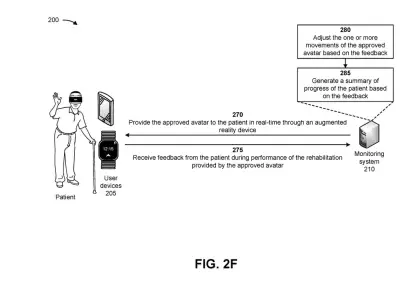
IBM's patent application describes a fix. A system gathers your records, such as readings from your fitness tracker, videos of past therapy sessions and your medical reports, after stripping out identifying details. It builds a 3D avatar of you, then uses machine learning (software that learns patterns from past examples) to predict which movements your recovery calls for. Your therapist reviews the avatar's moves and can change them before you see them.
Then you put on AR glasses (see-through glasses that overlay digital images on the room) and the avatar performs the exercise right in front of you. If you report pain, it adjusts.
… creating a personalized three-dimensional avatar based on the historical anonymized patient data; processing the historical anonymized patient data, with a machine learning model, to predict one or more movements for rehabilitation of the patient; …
Translation: It builds a custom digital twin of you and uses AI to figure out your physical therapy needs.
How IBM builds and corrects the avatar's moves
The system starts by collecting a patient's history: feeds from wearable devices (fitness trackers and smartwatches), video recordings of rehab sessions, and medical reports. It then anonymizes that data, meaning it hides or swaps out anything that identifies the patient, using methods such as masking names, replacing ID numbers with random codes, or encrypting records.
From the cleaned data, a neural network (software loosely modeled on how brains find patterns) builds a personalized 3D avatar. It estimates body shape, joint positions and even how soft tissue like skin and muscle bends. A separate machine learning model predicts which movements the rehab should include, and the avatar is updated to perform them.
Before the patient sees anything, a medical professional can review the animation and change it, for example its range, duration or intensity, using gestures or by demonstrating the move. A generative adversarial network (two AI models that check each other's work) can apply those edits.
The avatar then appears through an AR device in real time. The filing also describes:
- Taking patient feedback, such as reports of pain, and easing the movements.
- Adjusting for surroundings, such as a slope or uneven ground.
- Producing a progress summary for both patient and clinician.
… and may provide the animated avatar to the patient in real-time through an augmented reality device.
Translation: You see your digital double performing the exercises live through a headset.
What this could mean for physical therapy at home
If you are recovering from an injury or surgery, most of your rehab happens when no therapist is in the room. The filing's pitch is that clear, personalized demonstrations and quick corrections could help you do the exercises correctly and avoid re-injury. The IBM filing frames the avatar as a way to cut down on guesswork and subjective judgment in rehab.
The design keeps a human in the loop: a clinician reviews and edits the avatar's movements before they reach you, and both of you get progress summaries afterward. The patent application names no product and offers no clinical results, so it shows an approach IBM wants to cover, not a proven treatment. It would also need AR glasses or a similar device in your home.
That makes this IBM's 18th filing we've tracked since July in our AI agents acting for you watch, which already includes one on spinning up new assistants mid-chat and one on turning vague requests into rules.
Source: US 2026/0368984 A1 at the USPTO (PDF). Full patent text and figures are in the official publication.
Get our take in your Top Stories
Liked this breakdown? Add Patentlyze as a preferred source on Google, and our plain-English take shows up more often in your Top Stories the next time IBM patent news breaks.
Add Patentlyze on Google
One click.
There are more where this came from
We read every patent application Big Tech publishes and send you the ones worth knowing. Plain English, free, every week.
The drawings · 9 sheets
9 drawing sheets from US 2026/0368984 A1 · click any drawing to enlarge


Show the other 1 sheets

More from IBM
All 481 IBM patents →


More in AR / VR
All 713 AR / VR patents →
Meta
Meta Files Patent for Glasses That Turn Your Hike Into a Highlight Reel
Samsung
Samsung Files Patent for Fixing Your Fridge Without Leaving a Virtual World

Meta
Meta's New Patent Teaches Smart Glasses to Spot Danger Before You Do
Qualcomm
No comments yet