
Microsoft
Microsoft · Networking · Filed Jul 16, 2026 · USPTO published Nov 19, 2026 · This week's release
Microsoft Files Patent for AI That Turns Network Repair Manuals Into Step-by-Step Fixes
Microsoft's patent filing describes an AI that reads a network engineer's troubleshooting guide ahead of time and turns it into a checked, step-by-step plan. When something breaks, that plan can run on its own.
- Publication number
- US 2026/0370537 A1(US20260370537A1)
- Applicant
- MICROSOFT TECHNOLOGY LICENSING, LLC
- Filed · Published
- Jul 16, 2026 · Nov 19, 2026
- Inventors
- Sharad AGARWAL, Pedro Henrique Bragioni LAS CASAS, Rodrigo Lopes Cancado FONSECA, Manikanta KOTARU, Alok Gautam KUMBHARE
- Status when we published
- Waiting for an examiner
- Document
- 20 claims
- US classification
- 709/223
- Parent application
- Continuation of 18/772,098 (filed Jul 12, 2024)(18772098)
What Microsoft's AI-run repair checklist does
At 3 a.m., a monitoring system flags that calls on a phone network are suddenly slow. An on-call engineer gets paged, opens a long troubleshooting guide, and starts working through it line by line. Microsoft's patent tries to take much of that routine off the engineer's plate.
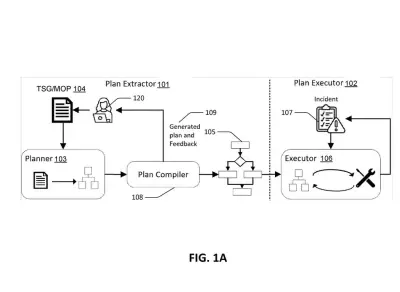
Here's the approach. Instead of asking an AI to read the guide in the middle of a crisis, the AI reads it ahead of time, as soon as the guide is written or edited. It turns the guide into a flowchart of steps, and a separate checker sends the flowchart back for fixes if steps are missing or don't make sense. The finished plan is stored next to the guide.
When trouble shows up, the system pulls out the matching plan and runs it, confirming after each step that it worked before moving on. If a guide is too vague to turn into a good plan, the system sends feedback so a person can improve the guide.
… generating, by the AI agent, a plan schema outlining a structure of an executable plan for executing the structured operator-readable document, the plan schema comprising a plurality of interconnected steps and relationships among the interconnected steps …
Translation: The AI creates a structured outline of interconnected steps to run the repair manual.
How the AI drafts, checks and fixes its plan
The claims cover a method for managing a cloud network, meaning a large pool of servers running virtual machines or containers (self-contained software packages) that carry out network functions. It starts with a structured operator-readable document: a troubleshooting guide (TSG), a method of operation (MOP, a written procedure for making changes), a run book, or a play book.
An AI agent (a language-model program that can plan tasks) receives the document plus a list of tools it can use. It first produces a plan schema, a rough skeleton of the plan drawn as a directed graph (a flowchart where arrows show what comes next). Each box is an action, a condition (a branch point), or an event (waiting for a person or a timer).
A validation component then checks the skeleton for completeness, correctness and executability. For example, every action box needs exactly one next step, and every branch needs a rule for each path. If the check fails, feedback goes back to the AI, which tries again until the plan passes or a retry limit is hit. The final plan is stored with the document.
At run time, the system:
- Detects a problem from network data
- Pulls up the stored plan
- Runs each step and verifies it finished before the next one
- Keeps language-model use inside single steps so the overall path stays predictable
Tools come in two kinds: script tools (ordinary programs that need no language model) and semantic tools (which use a language model, for example to read a log).
… a data store is accessed to identify an associated executable plan for responding to the detected anomaly …
Translation: The system looks up the right repair plan when a network problem occurs.
Why this matters for cloud outages and costs
If you use a phone or cloud service, the people keeping it running spend a lot of time following written repair guides. This patent aims to hand much of that work to software, so a known problem gets the same fix every time without waiting for someone to read the guide. The filing says this should cut both the cost and the time it takes to deal with an incident.
The cost angle is specific. Because the plan is built once, when a guide is written or updated, the company pays for the AI's reading once instead of every time an incident hits. Keeping the language model inside single steps also limits the damage from hallucinations (confident but wrong AI answers). The filing describes tooling for network operators, with no consumer feature attached.
That makes this Microsoft's 34th filing we've tracked since July in our AI agents that act for you watchlist, building on their work with finding the right button to click and suggesting your next move.
Source: US 2026/0370537 A1 at the USPTO (PDF). Full patent text and figures are in the official publication.
Get our take in your Top Stories
Liked this breakdown? Add Patentlyze as a preferred source on Google, and our plain-English take shows up more often in your Top Stories the next time Microsoft patent news breaks.
Add Patentlyze on Google
One click.
There are more where this came from
We read every patent application Big Tech publishes and send you the ones worth knowing. Plain English, free, every week.
The drawings · 11 sheets
11 drawing sheets from US 2026/0370537 A1 · click any drawing to enlarge


Show the other 3 sheets


More from Microsoft
All 681 Microsoft patents →
More in Networking
All 516 Networking patents →
Google
Google Patents an AI System That Watches Your Network for Problems in Real Time
Adobe
Adobe Files Patent to Turn a Typed Request Into a Step-by-Step Marketing Automation
Google
Google Patent Turns a Single Prompt Into Documents With Text, Images, and Charts
Google
No comments yet