
Amazon Files Patent for a Side-by-Side Report Card on AI Model Updates
Amazon's filing describes a tool that explains why an AI model made a decision and lets you fix it, but its claims zero in on one thing: comparing two versions of a model side by side.
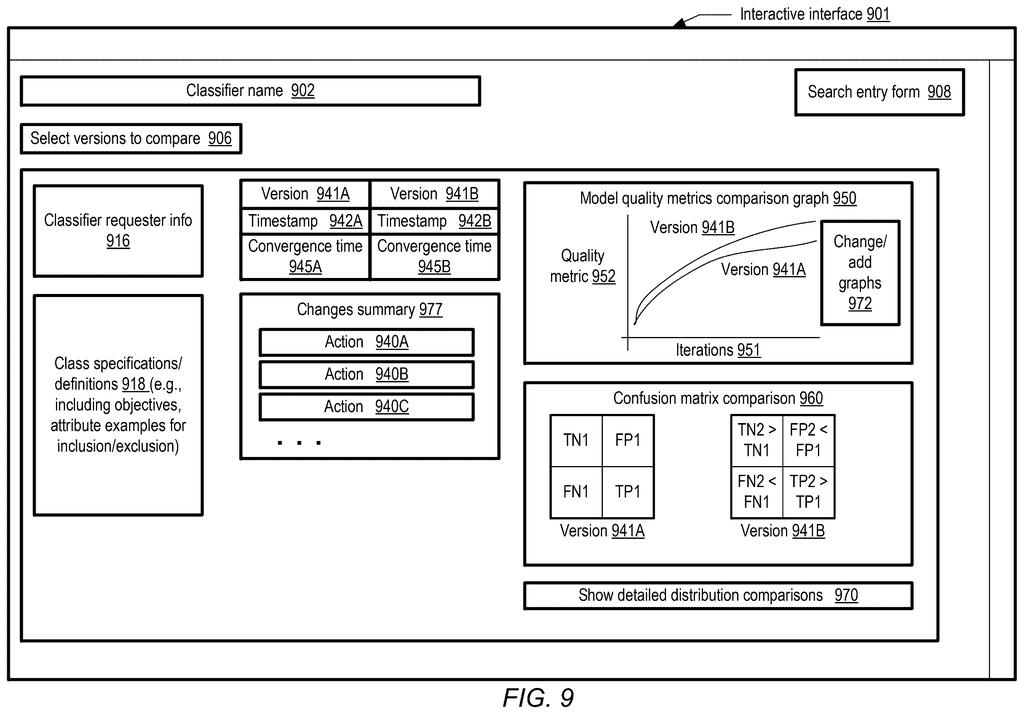
What Amazon's model-comparison screen shows
Every time a team tweaks an AI model and trains it again, someone has to answer one plain question: did that change actually help? Amazon's filing points out that many of these models are hard for non-experts to understand or fix, so the answer is not always easy to find.
This patent application describes a comparison screen offered through a cloud service. You pick two versions of the same model, and the screen shows a graph of how each one scores, plus a list of what was changed to get from the first to the second.
Think of it as a before-and-after report card with a change log attached. The filing also describes a larger toolkit that explains why a model made a decision and suggests fixes, but the claims in this version focus on the comparison.
receive, via one or more programmatic interfaces at a network-accessible service of a cloud computing environment, a request to compare a first version of a machine learning model to a second version of the machine learning model …
Translation: Users can ask the cloud to compare two different versions of an artificial intelligence model.
How a tweak to an AI model gets tracked
The core claim covers a request-and-response step. A user sends a request, through an interface on a cloud computing service, to compare a first version of a machine learning model with a second version. The service answers with a representation of the differences.
That answer has to include two things:
- A graph of one or more metrics (scores that measure how well a model performs) for both versions.
- An indication of the actions that were performed to get from the first version to the second.
The dependent claims add detail. The actions can include a change to a hyper-parameter (a setting that controls how the model learns) or a change to the training input (the examples the model learns from). The service can also list every version of a model by its name or ID, train a third version on request, and show a graph of another metric.
The description shows what a finished screen might hold: when each version finished training and how long it took, a curve of quality over training rounds, and a count of right and wrong calls for each version (a confusion matrix). It also describes a wider session where the service highlights which factors drove a model's predictions and suggests fixes, such as adjusting weights or removing records.
In the session, indications of factors contributing to a prediction decision are provided, as well indications of candidate model enhancement actions.
Translation: The system shows what caused a specific prediction and suggests ways to improve the model.
Why AI teams may want a clear change log
If you build or manage AI models, even without being an expert, a screen like this would let you see whether a change paid off and exactly what was changed to get there. The filing says the wider tool is aimed at business users who want to develop and use models without a data science background, and it argues that clear explanations help people trust a model's results.
For Amazon, the filing fits a cloud service where customers build and manage models. The examiner's first review rejected the claims as filed, which is routine at this stage and usually followed by amendments. The application also continues earlier filings, two of which are now granted patents, so the final wording here may still shift.
Amazon's 11th filing we've tracked in Enterprise AI since May builds on earlier applications like one routing requests across models and one scoring AI responses early.
Claim 21 is short and broad. It asks for three things: a request to compare two versions of a model, a graph of at least one metric for both versions, and a note of the actions that produced the newer one.
It names no type of model, no particular metric and no specific kind of change. Only the dependent claims mention a neural network, a hyper-parameter or edits to training data. As written, it would reach any cloud service that offers this comparison view, which is a wide net for a screen many people would call routine bookkeeping.
The title promises explanations and fixes, but the claims here cover only the comparison screen, so the more ambitious part of the description sits outside what this application would protect. The examiner's first-round rejection leaves open whether the final wording ends up narrower.
Get our take in your Top Stories
Liked this breakdown? Add Patentlyze as a preferred source on Google, and our plain-English take shows up more often in your Top Stories the next time Amazon patent news breaks.
There are more where this came from
We read every patent application Big Tech publishes and send you the ones worth knowing. Plain English, free, every week.
The drawings
11 drawing sheets from US 2026/0330260 A1 · click any drawing to enlarge


Show the other 3 sheets


Want this weekly breakdown for a company we don't cover? Patentlyze Pro →
Be the first to weigh in