
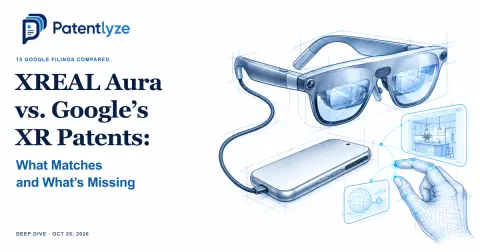
Google’s first Android XR glasses are out, and XREAL built them. Google announced XREAL Aura on October 28 as “the first wired XR glasses powered by Android XR.” Launch pricing starts at $1,099 through the end of the year, and orders opened in the U.S., Canada and Korea.
The glasses weigh under 95 grams and show apps in a 70-degree field of view through transparent lenses. The heavy computing happens in a puck on a cable, built around Qualcomm’s new Snapdragon Reality Elite chip, UploadVR reported.
At Patentlyze, we track new tech trends through big tech’s newest patent filings and explain them in plain English. We checked Aura’s features against the Google patent applications in our database. Fifteen relate to what Aura does, and several come close: an assistant that sees what you see, hand gestures and apps pinned to real surfaces.
XREAL Aura vs. Google’s patents: the short version
- Gemini: the closest match. Five filings describe glasses that see what you see, answer questions about it and highlight things in the room.
- Hands and the puck: one filing splits hand tracking between the glasses and a companion device that draws the result, the same division of work Aura uses.
- Windows in space: five filings cover moving apps between real surfaces, sizing text by distance, keeping it readable on see-through lenses and a menu that stays in view.
- Spatial view: one filing turns a single flat photo into a 3D scene, with sound.
- No Google filing found: the dimming lenses, Wired Mirroring for laptops and the Google Photos spatial gallery.
XREAL Aura’s Gemini features match Google’s closest filings
Google says Aura’s Gemini “can highlight what to focus on, in the room around you or on your screen,” and can talk you through a game “so you don’t have to put down your controller.” Five Google filings describe pieces of that.
A filing published in June describes an AI companion for XR glasses that knows where you are in a movie or game. Point at a dragon on screen, and the glasses can pull up a 3D model of it. The video or game can pause while you look, then pick up where it stopped.
An October filing describes glasses that answer a question you never typed. Point at the ports on the back of a router, and the glasses label what each one does. In one example, they put a red highlight on a coffee cup sitting too close to a hard drive, with a warning to move it.
Another filing adds what the camera on your glasses sees to your question before searching. Ask “what is the breed of the red-colored dog?” or say “it,” and the camera supplies the missing detail. It continues an earlier application that Google has already turned into a granted patent.
Aura’s Gemini can also find places to visit in Google Maps. A July filing replaces a wall of floating map labels with short summaries such as “8 Italian Restaurants” and “5 Cafes,” which you can tap or look at to open.
An October filing guides you by landmarks, such as a fountain or a storefront, instead of distances. When you drift off course, it uses directional sound to point you back.
The landmark and router filings share lead inventor Mar Gonzalez Franco and the same April 2025 starting date, a sign of one team working on glasses that understand the room around you.
XREAL Aura hand tracking and the puck: Google’s split-computing filing
Aura has built-in hand tracking. You aim and pinch to select, according to an early hands-on, and Google says you can pan through Google Photos “from an entire year down to a single day with your hands.” The glasses lean on the puck for the heavy work.
A September filing describes that division of work for hand gestures. The glasses track a small set of points on your hand, and only while a hand is in view, to save power. They send the gesture to a companion device, which draws the result and sends it back to show.
In the filing’s example, the companion device is a phone. Aura’s puck plays the same role over a cable, while XREAL’s own chip in the glasses handles the camera work so raw video doesn’t have to travel to the puck, UploadVR reported.
A June filing goes after a common hand-tracking annoyance: clicks you didn’t mean. It treats your two hands differently and sets a stricter bar for pinches from your non-dominant hand, so a drifting hand doesn’t select something by accident.
Aura also lets you use the puck as a trackpad. A filing published in May describes a touchpad for controlling XR apps that predicts where your finger is heading and powers only the sensors in its path, to save battery. It shares an inventor, Dongeek Shin, with the hand-gesture filing.
XREAL Aura windows in space: how Google’s filings place apps
Aura can open several apps at once, at any size, and its lenses are transparent, so those windows float over the real room. Five Google filings deal with putting apps and text into a real space.
One filing lets you drag a virtual object from one real surface to another, such as from a wall to a desk, placing it on each surface as it moves.
Another measures how far away a wall is and resizes the content placed on it, so it stays sharp at the distance your eyes focus on.
A June filing keeps text from vanishing on see-through lenses. Before showing a window, the glasses check the color and brightness of whatever sits behind it, then add a background or border that keeps the window easy to read.
Google says Aura plays 3D movies and 180- and 360-degree video from YouTube and Google TV. Another June filing describes an immersive mode where the headset tells a streaming app where to place its video panel inside a themed 3D setting. In one version, it tints your surroundings to match the movie’s colors.
Aura’s window follow mode keeps an app centered in front of you as you move. The closest Google filing, published in June, describes a menu locked to your view that you steer with small head turns. It continues an earlier application that Google has already turned into a granted patent.
XREAL Aura spatial view: a Google filing turns a flat photo into 3D
Spatial view “turns almost any video, photo, or game into 3D with a tap,” Google says, and Google Photos is adding a spatial gallery that wraps your library around you.
A June filing starts from one flat photo, builds a 3D scene from it, then adds sound placed where it belongs. A photo of a busy street could get a bus and traffic you hear from the right direction as you look around.
The filing names smart glasses and head-mounted displays as the devices that would show it.
Google’s other 3D video filings we have covered build 3D video from several cameras at once for video calls, so they don’t match spatial view.
XREAL Aura features with no Google patent filing yet
Several of Aura’s headline features don’t match any Google filing in our database: lenses you can dim to fade out the room, which turn clear again “when someone is in view”; Wired Mirroring, which shows your laptop screen as a window over a USB-C cable; and the Google Photos spatial gallery.
The closest to Wired Mirroring is an October filing that shows your real phone inside a VR headset, tracked by radio and motion sensors. It brings a second device into view, though it tracks a phone in VR rather than mirroring a laptop.
Google’s smart glasses display filings, which we follow on a watchlist, are mostly about thin waveguide lenses. Aura uses prism optics instead, so those filings don’t apply here. The puck and optics are XREAL’s hardware, and XREAL isn’t one of the companies Patentlyze tracks.
U.S. patent applications usually publish about 18 months after they are first filed, so Google’s newest Android XR work may not be public yet. New matches will land on our AR glasses race watchlist.
What XREAL Aura says about Google’s XR patents
The timing lines up. Eight of the 15 filings trace back to provisional applications Google filed in December 2024, the month it announced Android XR. Google and XREAL first announced the glasses as Project Aura at Google I/O in May 2025.
The matches are mostly software: how the glasses see, listen and place things. That fits the split behind Aura, with Google supplying Android XR and Gemini, Qualcomm the chip and XREAL the glasses.
All 15 are published applications, so their claims can still change. Two continue earlier applications that Google has already turned into granted patents.
All 15 Google filings compared with XREAL Aura
| Google filing | What it describes | Closest Aura feature |
|---|---|---|
| AI companion for media US 2026/ |
An AI that knows where you are in a movie or game and answers about it, pausing and resuming | Gemini talking you through a game |
| Glasses that read what you point at US 2026/ |
Turns pointing into a question and highlights hazards, like a cup near a hard drive | Gemini pointing out what to focus on |
| Camera-aware search US 2026/ |
Adds what the glasses’ camera sees to your question before searching | Asking Gemini about what’s in front of you |
| Filtered places nearby US 2026/ |
Replaces crowded map labels with short summaries you can open | Gemini finding places in Google Maps |
| Landmark navigation US 2026/ |
Directions by landmarks, with directional sound when you drift off course | Gemini with Google Maps |
| Low-power hand gestures US 2026/ |
Tracks hands only when one is in view and sends gestures to a companion device that draws the result | Hand tracking and the compute puck |
| Pinch filter US 2026/ |
Filters pinches more strictly on your non-dominant hand to stop accidental clicks | Aim and pinch to select |
| XR touchpad US 2026/ |
A touchpad for XR apps that powers only the sensors in your finger’s path | Using the puck as a trackpad |
| Objects that move between surfaces US 2026/ |
Drags a virtual object from one real surface to another | Multi-window workspace |
| Text sized by wall distance US 2026/ |
Resizes content by how far away the surface is so it stays sharp | Multi-window workspace |
| Readable backgrounds US 2026/ |
Adds a background matched to the color and brightness behind a window | Windows on transparent lenses |
| Immersive streaming US 2026/ |
Tells a streaming app where to put its video panel in a themed 3D setting | Immersive YouTube and Google TV video |
| Head-locked menu US 2026/ |
A menu fixed in your view, steered by small head turns | Partial match for window follow mode |
| Photo to 3D scene with sound US 2026/ |
Builds a 3D scene from one flat photo and adds sound placed in it | Spatial view and 3D photos |
| Your phone inside VR US 2026/ |
Tracks a real phone by radio and motion and draws it in a headset | Nearest to Wired Mirroring |
XREAL Aura patent FAQ
Does XREAL Aura use Google’s patents?
Google never says which patents are inside a product, and none of the filings here names Aura. The Google filings closest to Aura describe an assistant that sees your view, hand gestures and apps placed in the room.
What does the XREAL Aura puck do?
The puck holds the battery and Qualcomm’s Snapdragon Reality Elite chip and runs Android XR, connected to the glasses by a cable. Google says Aura’s heavy processing happens there, and you can also use the puck as a trackpad.
Does XREAL Aura have hand tracking?
Yes. You aim and pinch to select. A Google filing published in September 2026 describes saving power by tracking hands only while one is in view and sending gestures to a companion device.
Can XREAL Aura’s lenses dim?
Yes. Google says you can dim the lenses to fade out the room, and they turn clear again when someone is in view. No Google patent filing in our database describes that dimming.
How much does XREAL Aura cost?
Google lists launch pricing starting at $1,099 through the end of 2026. Orders opened October 28 in the U.S., Canada and Korea, with Japan following on November 2.
Are Google’s XR patents granted?
Not the 15 filings in this story. All are published applications, and two continue earlier applications that were granted.
Get lists like this in your inbox
We read every patent application Big Tech publishes and send you the ones worth knowing. Plain English, free, every week.