
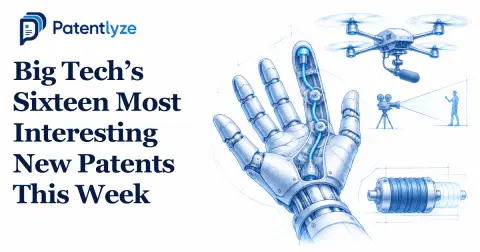
A weekly read of what the world’s biggest technology companies just told the U.S. patent office.
We wrote up 265 filings this week, up from 224. Google led with 58, including six from Waymo and two from Wing, then Microsoft at 30, Sony at 29, Samsung at 28 and Apple at 27.
The full run lives under this week’s Big Tech patents; these sixteen stood out.
1. Sony Patents a Car That Sprays Hamburger Smell When You Pass a Burger Ad
Billboards and car screens reach you through your eyes and ears. Sony has filed for a car that releases a matching smell when you pass a burger billboard or watch a food ad on the car’s screen.
Claim 1 is short: a scent output unit and a control unit that picks a scent based on an advertisement and releases it. Nothing in it mentions a car, a camera or a billboard. Those details come in later claims and the description.
In the description, a camera facing the road spots a sign, and the car checks it against a server that lists registered ads, their locations and their scents. A camera inside reads each rider’s face to estimate age and gender, because each ad carries rules about who gets the scent.
The filing’s table shows ad A giving a 30 second scent to women 18 and older between 8:00 and 16:00, and ad B a 20 second scent to riders aged 5 to 60. The scent can strengthen as the car nears the sign, as if it floated off the burger in the picture.
Taxi operators could collect an ad fee, the filing says, and it names Sony’s AROMASTIC scent unit as existing hardware. Four inventors, including Satoshi Konya and Shuji Fujita. Filed in July 2026 as a continuation in a family dating to a July 2019 Japanese application, with two U.S. patents already granted. Sixteen claims.
2. Samsung Patents a Phone Assistant That Waits on Hold and Gets Firm in Your Voice
A customer service call can leave you on hold for up to an hour. Samsung has filed for a phone assistant that waits on hold for you, then talks to the agent in your own voice and gets firmer as the call drags on.
Claim 1 has a voice AI model listen to the call to work out its purpose and context, step in for you with one vocal nuance, keep listening, then speak again with a different nuance chosen from what happened in between.
The filing names three nuances: neutral, assertive and satisfied. One example stays neutral for the first 10 minutes, hold time included, then turns more assertive. Words such as accidents or emergency, repeated questions and transfers push it firmer, and calls to 911 or a roadside assistance number are handled differently.
If you walk away, the phone can alert your watch or a smart home device, using a one meter zone around the phone in the example. A summary of the whole call follows. If the law requires it, the filing says, the agent may be told an AI is speaking for you.
Five inventors, including Ji Yeon Han and Wenpin Li. Filed in April 2025 with no parent application, twenty claims. The examiner rejected the claims in a first review in September.
3. Google Files Patent for Training AI Chatbots to Work Ads Into Their Answers
A chatbot answer is one reply with no page of links around it, so there is no obvious slot for an ad. Google has filed for a way to train AI chatbots to work sponsored items into their answers.
Claim 1 trains a reward model with human feedback to predict how satisfied a person would be with an answer that contains a sponsored item. A second model is then trained on a mix of that satisfaction score and predicted clicks on the item, and it answers new questions with text plus sponsored content.
Training answers are varied with temperature sampling, which adds a bit of randomness, and some carry no sponsored item at all. Candidates can come from bidding on cost per click or click rate. The reward model can also learn from a written set of principles, an approach called constitutional AI.
The filing names chatbots, search boxes and AI agents as places the model would run, and says training can continue from thumbs up and thumbs down. Its stated problem: tuning only for satisfaction might drop sponsored content, while pasting ads on top of answers produces poorly integrated and potentially disruptive placements.
Two inventors, Florian Nils Hartmann and Duc-Hieu Tran. Filed in May 2025 with no parent application, twenty claims, still waiting for examination.
4. Apple Files Patent for Smart Glasses That Warn Bystanders When the Camera Is On
A camera built into a pair of glasses is easy for everyone else to miss. Apple has filed for smart glasses that show people nearby when the camera is on.
Claim 1 is a head-mounted device with a housing, lenses, a camera or other optical sensor that switches between on and off, and an indicator on the housing that shows when the sensor is on.
The filing lists several indicators: an e-ink or electrochromic layer that changes the frame’s color or pattern, an electroluminescent wire that glows around a lens, light through tiny holes between one and 20 microns wide, and a shutter over the camera moved by a switch on the frame or adjusted automatically.
A shutter is the plainest signal, since a covered lens sees nothing. The glow can also reach the frame’s surface through light pipes or a diffuser. For anyone across the table, the frame answers whether they are being recorded without anyone having to ask.
One inventor, Paul X. Wang. Filed in April 2026, claiming a May 2025 provisional application, twenty claims.
5. Google Files Patent for Smart Glasses That Remember Where You Left Your Keys
Forgetting where you set something down is an everyday annoyance. Google has filed for smart glasses that remember what you saw so you can later ask where you left your keys.
Claim 1 captures data from the wearer’s point of view with a sensor on head-worn glasses, stores a piece of it when other data shows it matters to the user, then answers the user’s questions with a model that draws on what was stored.
One trigger is gaze: an image is flagged when you look at an object longer than a set time, such as five seconds. Sensors can raise their frame rate when something worth keeping appears, and blurry frames and near duplicates are dropped before data leaves the glasses.
Sample questions include the name of a cafe with a blue awning and whether you already own a book you saw at the library. Unprompted help includes a bathroom code shown as you reach the door. Before storage, the glasses can mask faces, passwords and audio from bystanders.
Thirteen inventors, including Juston Payne and Andrea Colaco. Filed in May 2026, claiming a May 2025 provisional application, twenty-two claims.
6. Sony Files Patent for Catching Players With Second Accounts by Their Button Habits
Experienced players sometimes open a fresh account to beat newcomers. Sony has filed for a system that spots the same player behind a second account by their button habits.
Claim 1 collects interaction data for one player account, works out a set of characteristics, compares them with another account’s, and reports a match when they line up.
The data can include how long each button is held, the time between presses and the order of inputs, from menus as well as games. The filing says ten matches or fewer, each running 20 minutes to an hour, may give enough data to judge a player’s skill before the matchmaking rating catches up.
Uses run both ways: flagging second accounts, catching an account shared by family members, and moving a strong newcomer into tougher matches. The filing also covers players who lose on purpose to drop their rating, and keeping data in separate databases for each jurisdiction to follow privacy rules.
Five inventors, including Christopher Fife and Dustin Clingman. Filed in April 2025 with no parent application, twenty claims. The examiner rejected the claims in a first review in September.
7. Google Patents a Camera Sensor That Counts People Without Keeping a Single Photo
A camera that saves video can be hacked or misused. Google has filed for a sealed camera sensor that counts people and deletes every frame without ever saving one.
Claim 1 is a housing with cameras, processors and memory. Frames stay only in a temporary buffer while an object detection model looks at them, are deleted as soon as it produces a result, and are never written to permanent memory. The sensor reports only the result.
The description puts the frame rate at about 2 to 15 per second and says the sensor can have just four electrical connections: two for power, one ground and one signal out. New frames overwrite old ones in a ring buffer, and LEDs on the outside can flash patterns that show what the sensor reports.
Trust is the harder sell, so the filing adds a tamper resistant housing and a public hash of the sensor’s software that anyone can check. It also names license plate reading for traffic systems, a reminder that a camera that forgets can still produce a record.
Four inventors, including Vikram Vasant Tank and William Sumner Rutledge. Filed in January 2026 as a continuation of an application that traces to an April 2020 international filing, and that parent is already granted. Twenty claims.
8. Waymo Files Patent for a Car That Notices When a Pedestrian Starts to Fall
A car that reacts after someone hits the ground has less room to stop. Waymo has filed for a self-driving car that reads body posture to notice a pedestrian or cyclist starting to fall.
Claim 1 covers any autonomous machine that marks reference points on a vulnerable obstacle, tracks the gaps between those points in one direction, flags a risk when the gaps change, and has its control system take an avoidance action.
Points can be the nose, chin, knees or ankles, or a motorcyclist’s helmet. A sudden drop in height between upper and lower points, plus a sharp loss of speed, signals a fall; the speed check rules out someone stopping to tie a shoelace. A second model scores how close the person is to lying down.
Children in strollers and riders of recumbent bikes are skipped because the readings are unreliable. If a fall happens within about 6 to 10 meters, the car can presume it played a part, stop, and ask a remote assistant for instructions. The filing says driver assistance systems could use the same method.
Three inventors, Lenna Kanehara, Kevin Sheu and Clayton Gregory Kunz. Filed in July 2026 as a continuation of a November 2024 application that is already granted. Twenty claims.
9. Samsung Patents an AI Guard Built Into Your Storage Drive to Stop Ransomware
Ransomware defenses usually run in the operating system, which is what attackers try to switch off first. Samsung has filed for an AI guard built into the storage drive itself.
Claim 1 takes a sequence of memory commands, has a transformer model decide for each command whether a ransomware attack is present, and runs commands based on those verdicts.
In one example the model reads a sliding window of 1,000 commands that moves forward 500 at a time. When it finds an attack, the system can trigger an alarm or disable the attack. Claim 1 never mentions an SSD or a window size; those details sit in later claims and the description.
The filing says businesses are moving their data onto fast NVMe SSDs, which makes those drives a more lucrative target. A guard inside the drive could keep working after an attacker has taken over the computer around it.
Three inventors, Amit Berman, Elisha Halperin and Evgeny Blaichman. Filed in May 2025 with no parent application, twenty claims. The patent office has approved it, so it should issue as a patent once Samsung pays the final fee.
10. Qualcomm Patents a Phone Map Showing Where People Stood in a Restaurant
Before walking into a packed restaurant, you could check where people are standing. Qualcomm has filed for a phone map, built from a venue’s Wi-Fi, that shows where people stand now and where they stood earlier.
Claim 1 opens a contact tracing app on the phone, sends configuration options to a contact tracing network, receives contact history in return, and draws a map from it.
The options include how close counts as contact, how long two devices must stay that close, and how near in space and time separate incidents must be to group them. Positions come from Wi-Fi round trip timing between phones and access points, and a validation code can be required first.
The background says location based contact tracing worries some users about privacy, which holds back adoption. Bluetooth or cellular links can serve as a second connection. The map exists only where a venue runs the network, and the filing does not say who would pay for that.
Three inventors, Rishabh Raj, Xiaoxin Zhang and Ravindra Chauhan. Filed in April 2026 as a division of a March 2023 application that is already granted. Fourteen claims.
11. Sony Files Patent for a Drone Microphone That Hides From the Camera
A boom microphone that dips into the shot ruins a take. Sony has filed for a drone that holds the microphone at the closest spot to an actor that the camera cannot see.
Claim 1 is broad: a unit that gathers the microphone’s position or orientation, a unit that calculates the best placement, and a unit that moves the microphone there. Drones, cameras and film sets only appear in later claims.
The description estimates what the camera can see and where the microphone can still pick up the actor’s voice, then picks the nearest point inside the second and outside the first. It can store the microphone’s position relative to the actor and recreate it for later takes.
Drone noise gets its own fix: the system records propeller speed so that hum can be filtered out afterward. If the drone is about to touch a person or object, avoiding contact takes priority over staying out of frame, and a screen tells the crew the microphone has moved.
One inventor, Ryutaro Watanabe. Filed in April 2025 as the U.S. entry of an October 2023 international application, with a Japanese application from October 2022. Twenty claims.
12. Samsung Patents a TV Feature That Names the Song Playing in Your Show
A good song in a show is easy to lose once the scene ends. Samsung has filed for a TV that names the music playing in your program and sends the list to your phone.
Claim 1 is a TV with a receiver, screen, speaker, network connection and controller. While an audio recognition function runs during a program, it captures data from the sound and shows information about it, obtained from a server, alongside the content.
The description saves an audio fingerprint for each song, separates music from dialogue with statistical models such as a Gaussian mixture model, and sends the fingerprints to a music server for titles and artists. The results can land on your phone as an album list you can stream.
The filing notes that soundtracks take a considerable share of the music charts, yet finding one again is a chore. Claim 1 covers any audio recognized during a program, which reaches past the background music used in the examples.
Four inventors, including Ji-hun Park and Myung-jae Kim. Filed in July 2026 as the latest continuation in a family that started with a Korean application in September 2015; three U.S. patents from it are already granted. Twenty claims.
13. Sony Files Patent for Tiny Rubber Muscles That Flex on Electricity
Small actuators get harder to wire as they shrink. Sony has filed for a rolled rubber actuator that stretches and contracts like a muscle when voltage is applied.
Claim 1 is a rolled body made from a stack of paired electrode layers and a stretchy insulating rubber layer, with at least one stepped bottom surface at an end of the roll.
Voltage pulls the electrodes together and squeezes the rubber, changing the roll’s length. The steps come from cutting the sheet’s edge at different levels before rolling, so the electrodes sit exposed on separate steps for a matching cap. The roll can be wound on a paper core held with water soluble glue.
The filing says short circuits and poor connections get worse as these parts shrink, and the steps address both. Uses include buttons, wheels, balls and joysticks whose feel can change, and an endoscope. The same roll can sense being squeezed by measuring capacitance.
Five inventors, including Daisuke Yamamoto and Yusaku Kato. Filed in March 2025 as the U.S. entry of a September 2023 international application, with a Japanese application from October 2022. Twenty claims.
14. Samsung Files Patent for a Floating Screen That Watches Your Hand Through the Glass
A button floating in the air gives no feedback when you miss it. Samsung has filed for a floating screen with a hidden sensor that watches your hand right where the image hangs.
Claim 1 flips an input image, sends its light through a thin plate called a waveguide, and uses a lens in front of the plate to focus it into an image floating on a plane in midair. The lens flips it back, so you see it the right way up.
Other claims add a camera that looks back through the same plate, so it focuses on the floating plane where your hand will be. A hand away from the plane looks blurry, which lets the device judge distance and show an indicator that sharpens as your finger gets close.
Because the image looks a little different to each viewer, the device calibrates with target points to build a transform matrix, and recalibrates when your taps miss the intended button. Possible homes include phones, monitors, laptops, robots, head-up displays and digital signs.
Five inventors, including Jaeseung Chung and Changkun Lee. Filed in June 2026 as a continuation of an April 2026 international application, with priority claims back to April 2025. Fifteen claims.
15. A New Tesla Patent Gives Robot Fingers Cables That Work Like Tendons
A robot hand that drops things or wears out its cables holds back the whole robot. Tesla has filed for a robot finger moved by a single cable that works like a tendon.
Claim 1 is a hand with a palm and fingers. Each finger has two sections on two pivots, and a cable from the actuator runs along both sections, kept away from the pivots. The cable’s end is thicker than the cable itself and catches the fingertip section when pulled.
That thick end can float in a pocket and be potted, set in hardened filler. One actuator drives both joints. Torsion springs at the pivots add stiffness, a magnet and a Hall effect sensor read the joint angle, and a curved surface keeps the cable bending at a set radius.
The filing calls hands among the hardest parts of a robot to design and describes optimization and simulation tools for adapting the grip so objects do not slip or fall. A drawing shows the hand on a humanoid robot.
One inventor, Michael Leddy. Filed in March 2025 as the U.S. entry of an October 2023 international application, with two September 2022 provisional applications. Twenty claims. The examiner rejected the claims in a first review in October.
16. IBM Files Patent for Cars That Report the Loud Vehicle Next to Them
Noise cameras and microphones on poles struggle to single out one car in traffic. IBM has filed for a system that turns cars into moving noise monitors that pick out the loud vehicle next to them.
Claim 1 gathers noise and vibration readings above a threshold from many vehicles’ sensors, reads their RFID tags, pulls vehicle records, and uses a machine learning model to find the source vehicle and its likely causes, then sends an alert naming both.
A Markov chain estimates how likely the suspect is the source; in one example the alert goes out only at 0.8 or higher. The filing’s scene has three cars, one parked and two moving. Causes include an old muffler, the wrong tires for the season, faulty engine parts or worn brake pads.
Alerts can go to the driver, a maintenance service or a transportation authority. The system only works if many cars carry the sensors and tags, and it relies on records about other people’s vehicles, so a wrong match could land on an innocent owner.
Five inventors, including Cristina Bonanni and Martina Verrelli. Filed in May 2025 with no parent application, twenty claims, still waiting for examination.
What ties them together
Two of the top three are about ads. Sony adds smell to billboards and car screens, and Google trains chatbots to fold sponsored items into their answers.
Five read people closely: Waymo reads body posture, Sony reads button habits, Google’s glasses keep what you look at, Qualcomm maps where people stood, and IBM’s cars listen to the car beside them. Two pull the other way, with Apple’s glasses telling bystanders the camera is on and Google’s sensor forgetting every frame.
Samsung’s four cover very different ground: an assistant that speaks in your voice, a TV that names songs, a floating screen that sees your finger, and a drive that guards itself. Three are physical parts, Sony’s rubber muscle, Tesla’s tendon cable and Sony’s microphone drone.
Six of the sixteen continue earlier applications, and five of those families already hold granted patents: Sony’s scent ads, Google’s camera sensor, Waymo’s fall detection, Qualcomm’s map and Samsung’s TV, which has three. Samsung’s ransomware guard has been approved, and three drew first-round rejections: Samsung’s hold assistant, Sony’s account matcher and Tesla’s hand.
Patentlyze reads every new patent application that Apple, Google, Microsoft, Meta, Nvidia, Samsung, OpenAI, Qualcomm, Sony, Intel, AMD, IBM, Adobe, Salesforce, Tesla, Amazon, and Disney file at the USPTO, and writes a plain-English breakdown of the ones that say something about where products are heading. New filings drop every Thursday. The full archive lives in our patent library.
Get lists like this in your inbox
We read every patent application Big Tech publishes and send you the ones worth knowing. Plain English, free, every week.