
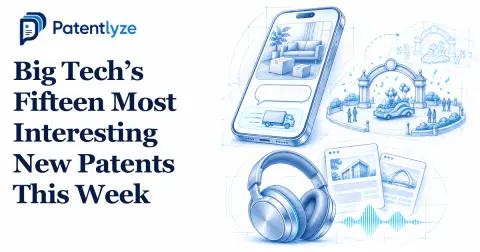
A weekly read of what the world’s biggest technology companies just told the U.S. patent office.
We wrote up 213 filings this week, down from 265. Google led with 40, one of them from DeepMind, then Qualcomm at 35, Microsoft at 28, Apple at 25 and Samsung at 24.
The full run lives under this week’s Big Tech patents; these fifteen stood out.
1. Google Files Patent for an Ad Chatbot That Reads Your Photos to Pitch Products
Booking a moving truck usually starts with a form asking how many couches you own. Google has filed for an ad with a chat button that asks for photos of your home and recommends something to buy based on what it sees.
Claim 1 covers an ad with a button that opens a chat. You upload images, an image classification model lists the objects in them, and a language model reads the photos plus text you typed earlier, such as a search. The two results merge into a description, and the system generates an offer.
The main example starts with a search for a move to Atlanta. The chat asks for apartment photos, describes the furniture it sees and waits for you to confirm, then suggests a truck size with price and availability. Prices, links and images come from the advertiser’s own website, and a policy checker screens the results.
Speed is the stated problem. One large model could take 20 seconds or more, so the filing pairs a fast object spotter with a smaller language model and aims for replies under 5 seconds. The open question is whether people will send an advertiser photos of their home.
Ten inventors, including Shahab Kamali and Alpa Jain. It entered the U.S. in December 2025 from an international application filed in November 2024. Twenty claims, still waiting for examination.
2. A New Google Patent Turns Your Browsing History Into a Podcast for Your Commute
Open tabs pile up faster than anyone can read them. Google has filed for an AI that turns a photo, article or spoken request into a podcast sized to your free time.
Claim 1 feeds three things into machine-learned models: the content, such as an image or text; your input, such as a tap, circle or spoken prompt; and the context, such as your location or search history. The models produce synthetic speech about what you picked.
The description builds shows around objects it recognizes, like a building circled in a skyline photo, and searches other sources for extra material. Formats range from a single narrator to a host and expert, a panel or a documentary. If navigation says the drive takes 45 minutes, the show runs about 45 minutes.
It can adjust for the listener, with simpler words and no profanity for a ten-year-old, and the filing says training on a person’s own voice needs their consent. Every signal that makes the show fit better, from calendar to browsing history, is personal data the listener hands over first.
Four inventors, including Clement Dickinson Wright and Sarah Fay Smith. Filed in May 2025 with no parent application, twenty claims. The examiner rejected the claims in a first review in September.
3. Disney Files Patent for Game Worlds That Change With Live Events
A virtual park usually looks the same every time you open it. Disney has filed for a game world that changes as things happen in the real one, so a parade starting in a physical park fills a virtual plaza with floats and confetti.
Claim 1 is brief: take real-time feeds and user input, have a trained machine learning model write a description of what the virtual world should look like, build the world from that description and display it.
The description splits the work among AI agents. One gathers feeds such as park sensors, schedules, sports scores and weather. Another ranks them, and in its example a fireworks show beats a ride queue topping 45 minutes. A fine-tuned language model writes the scene, and a game engine or video model builds it.
Disney owns both the parks and the characters, which suits the idea. The filing keeps people in the loop: a human operator can steer or block changes, and moderation agents can filter out negative events before they reach the scene.
Three inventors: Alif Khalfan, Malcolm Murdock and Tatiana Marie Vaz. Filed in May 2025 with no parent application, twenty claims. The examiner rejected the claims in a first review in October.
4. Nvidia Patents AI That Generates Fake Medical Scan Images From Text Descriptions
Medical AI needs huge numbers of labeled scans, and rare conditions barely show up in existing collections. Nvidia has filed for an AI that turns a typed sentence into a full 3D CT, MRI or PET scan of a patient who does not exist.
Claim 1 runs free-form text through a diffusion model to get a compact code, expands that code into simulated 3D image data with the decoder of a 3D compression network, and adds the result to one or more datasets.
Radiology reports follow a stiff format, so a model trained on them only understands prompts written that way. A language model rewrites real reports in many styles, including one-line descriptions, and training samples different mixes of those fields. The filing describes scans produced at 512 by 512 by 192 voxels.
One example pre-trains the compression network on over 55,000 3D medical volumes. The filing offers no test results, and nothing in it shows how a generated scan would be checked for sound anatomy, so the value for training other medical AI is a promise for now.
Seven inventors, including Pengfei Guo and Daguang Xu. Filed in May 2025 with no parent application, twenty claims. The examiner rejected the claims in a first review in June.
5. Google Patents Satellites That Link by Laser to Act as One AI Computer
AI chips need power and floor space, and the filing says demand is outrunning what data centers on Earth can hold. Google has filed for flat, solar-powered satellites that link to each other by laser so their AI chips work as one computer.
Claim 1 is a satellite module with optical link devices spread around its outer surface and a processor that works out where the other modules are. For a chosen subset of neighbors, it adjusts a link device to open a channel, and those channels connect the machine learning accelerators on each satellite.
Satellites can learn each other’s positions by swapping GPS coordinates over radio. Aim can come from a steerable lens, a gimbal, a tiny MEMS device or thrusters that turn the whole module. In one example, each satellite picks eight of 30 nearby neighbors and fine-tunes each beam for the strongest signal.
Better aim lets the satellites get by with lower-power transmitters, the filing says. Groupings can also change, with large formations for training a model and smaller ones for answering questions. The document gives no costs, launch plans or link speeds.
Four inventors, including Travis Roland Beals and Blaise Aguera-Arcas. Filed in May 2025 with no parent application, thirty-one claims, still waiting for examination. Two companion Google filings published the same day: one steers the satellites with Earth’s magnetic field, and one, already granted, covers the satellite module itself.
6. Samsung Files Patent for a Wearable That Remembers Where You Left Your Wallet
Setting a wallet down and forgetting where is an everyday annoyance. Samsung has filed for a wearable that turns what it sees and hears into written notes, so you can later ask where you left your wallet.
Claim 1 takes unstructured sensor data from the wearer’s surroundings, turns it into structured text with a vision language model and a large language model, and stores the text in a spatial-temporal knowledge graph, a web of linked notes.
The vision model captions video clips, a speech model transcribes audio, and a language model merges the two into one written episode. Episodes link to people and objects, such as a green cup, with each appearance timed. A question about misplaced glasses could return an answer like the living room couch at 3:45 PM yesterday.
Storing short text keeps the memory small enough for a battery-powered device, and the camera can switch on only when a motion sensor notices something. The examples point to medication tracking, meeting recall and older users. The filing does not address consent for the people a wearable records along the way.
Five inventors, including Zhongyang Zhang and Priyabrata Parida. Filed in May 2026, claiming a May 2025 provisional application, twenty claims, still waiting for examination.
7. Google Patents Video Calls That Translate Everyone Into Their Own Language
A video call with colleagues in several countries usually stalls while someone interprets. Google has filed for a meeting platform that plays each person the call in the language they chose, all at the same time.
Claim 1 identifies the language of a speaker’s audio, checks each listener’s language preferences, and for every listener whose profile meets a translation condition, adds generated audio in that person’s language to the stream they receive during the meeting.
Profiles keep the languages you speak apart from the languages you understand. A translation is made only when the speaker’s language matches none of yours, and one model can produce several languages at once, such as Russian and French. Some versions go straight from speech to speech with no transcript in between.
Only people who opted in get translated, and users under an age limit or in places that ban live speech translation can be left out. Routing updates mid-call, and the description mentions meetings with over a hundred connected devices. The quality of the translated voices will decide whether anyone uses it.
Five inventors, including Maria Josefin Karlsson and Huib Victor Kleinhout. Filed in May 2025 with no parent application, twenty claims, still waiting for examination. A companion Google filing in the same batch keeps the speaker’s tone of voice in the translation.
8. Apple Files Patent for a Phone Camera Hidden Behind the Screen
The front camera is one of the last holes left in a phone’s screen. Apple has filed for a phone camera hidden behind the display, looking out through gaps between thinned-out pixels.
Claim 1 is short: a display with an array of OLED pixels, a camera that captures images of the user through those pixels, and a printed layer with an opening lined up with the camera so light can reach it.
Other claims space the pixels farther apart over the lens and let the camera shoot while some pixels are switched off, for example when the camera app opens. The description puts each pixel at about 85% transparent and imagines a flash, fingerprint reader or light sensor hidden the same way, revealed by a black spot.
The filing admits that fewer pixels over the camera means lower resolution in that patch. The payoff it names is room for a larger display or a smaller device, and a front with nothing visible until a part is in use.
Nine inventors, including Christopher J. Stringer, Richard P. Howarth and John Patrick Ternus. Filed in July 2026 as a continuation in a family that dates to a November 2011 application, with at least three U.S. patents already granted. Twenty claims, still waiting for examination.
9. A New Samsung Patent Turns Smart Rings Into a Stylus for Phone Drawing
Draw on a phone with a bare finger and every line comes out the same width and shade. Samsung has filed for two smart rings that stand in for a stylus, one reading finger bend as pressure and the other reading tilt.
Claim 1 has the phone receive a pressure value from one wearable and a tilt value from another. Pressure sets the line’s thickness or transparency, tilt sets its gradation, and your touch on the screen decides where the stroke lands.
In the examples, the pressure ring sits on a finger of your free hand and senses how far you bend it, while a ring on the drawing finger tracks its angle. At 0 degrees a stroke has one tone; at 60 degrees it has four, with a thicker line.
Other claims subtract the phone’s own tilt, weigh the size of the touched patch and add sliders from 0.5 to 2 times. A brush preview appears when a ring’s Bluetooth signal shows it is close. The screen needs no pen-sensing layer, though the full effect takes two rings.
Three inventors: Jeonghyun Lee, Youngjae Meen and Nina Lee. Filed in July 2026 as a continuation of an international application from November 2024, twenty claims, still waiting for examination.
10. Apple Patents a Headset Setup That Floats Your Video Above Your Laptop Screen
Editing video on a laptop means the preview and the toolbars fight over one screen. Apple has filed for a headset that floats your 3D video above a linked laptop while the editing tools stay on the laptop’s display.
Claim 1 runs on a wearable showing a 3D view that includes a linked device with a screen. When content on that screen meets certain criteria, the wearable shows some features away from the screen while the other device keeps showing a different set. The claim never defines the criteria.
The examples use two: you selected the content, and it is spatial video or photos with depth. Looking back at the laptop pulls the floating content onto its screen. Picking a 3D photo from a gallery makes it hover above the laptop, where an air pinch rotates it.
The headset supplies depth and size, while the laptop’s sharper screen handles fine controls like a timeline. The filing also describes dimming the laptop so the floating video is easier to see. Claim 1 reaches for the split itself, so a phone or tablet could count as the second screen.
Four inventors, including Luis R. Deliz Centeno and Devin W. Chalmers. Filed in May 2026, claiming a May 2025 provisional application, twenty-four claims, still waiting for examination.
11. A New Google Patent Puts a Sound-Trapping Dome Over the Meeting Table
In an open office, one person’s video call becomes everyone’s background noise. Google has filed for a rolling meeting station with a dome that aims call audio down at the table and soaks up the rest.
Claim 1 is a stand with a base and an upright arm, a tabletop on the base, speakers on the arm and an acoustic dome over the table. Inside the dome, a parabolic reflector surrounds the speakers and bounces their sound down toward the tabletop.
The example dome is 120 to 140 centimeters wide and 50 to 60 centimeters tall, its lower edge 65 to 75 centimeters above the table. A felt or foam liner 5 to 20 millimeters thick lines the inside, and the description sketches sound zones that fade from clear at the table to low beyond it.
Wheels, a tabletop that pivots upright and a stand under two meters tall let it roll between rooms and fit through doors. The people talking under the dome still speak into an open room, and the filing gives no measurements of how quiet the outer zone gets.
Two inventors, Shokofeh Darbari and Christine Jean Wu. Filed in May 2026, claiming a May 2025 provisional application, twenty claims, still waiting for examination.
12. Microsoft Files Patent for Telling a Gunshot From Its Echo in a City
In a city of glass and concrete, one gunshot reaches a microphone as several sounds. Microsoft has filed for a way to tell the original bang from its echoes and work out where the shot was fired.
Claim 1 takes audio from a microphone array, the microphones’ positions and a profile of how the array responds to sound, then simulates the sound’s path through a 3D computer model of the surroundings, bounces included, and outputs an estimated origin.
Surfaces in the model carry acoustic values for materials such as cement, steel and glass, and a machine learning model can guess them from camera, satellite or drone images. Simulations can be run ahead of time and stored in a lookup table, so a low-power device can answer quickly. One example array has eight microphones.
It can run beside a conventional locator that compares arrival times, and when the two disagree, the system flags the older answer as an echo. The main example shows a waypoint on a responder’s augmented-reality headset. The filing claims better accuracy but gives no figures, and the city model has to stay current.
One inventor, Sean Matthew Zimmerman. Filed in July 2026 as a continuation of an application from September 2024, twenty claims, still waiting for examination.
13. IBM Wins a Patent for Robots That Get Rebuilt to Fit the Job
Send the wrong robot to a mining site and it can get stuck on rocks or snap a joint. IBM has won a patent for a system that picks a robot team, predicts where it will fail and has the robots rebuilt before the job starts.
Claim 1 gathers data about the job site, works out the job’s demands, reads each robot’s specs and selects a team. It then predicts the team’s weak points, decides on modifications, issues a command that controls them, and configures and runs the modified robots.
Sensors such as cameras, LiDAR and air-quality monitors describe the terrain. An AI model builds a digital twin of the robots and tests combinations in a simulated site. A fabrication unit, such as a 3D printer, welder or laser cutter, then adds or removes material; one example lengthens a digging arm by 5 centimeters.
If no team can do the job, the system can fabricate a custom robot, and a third AI model plans and updates the route. Any real use depends on robots built to clamp together and a machine shop that takes orders from software, which the filing describes only in broad terms.
Three inventors: Sarbajit Kumar Rakshit, Sudheesh S. Kairali and Binoy Thomas. Filed in May 2025 with no parent application and twenty claims in the published version. It has already been granted, so the issued claims may read differently.
14. Samsung Files Patent for TV Lights That Glow on Your Wall When a Message Arrives
A text arriving mid-movie either goes unseen or drops a box over the picture. Samsung has filed for TV lights that glow on the wall behind the set when a message arrives, leaving the picture untouched.
Claim 1 is a display with pixels on the front and light-emitting elements along the edge of the back. When a notification arrives, the processor picks lights based on a screen location tied to that notification and colors them using the notification’s color information.
Normally those back lights copy the picture’s colors onto the wall. For an alert, the lights nearest the spot where the app’s window usually appears glow in the app’s color, steady or flickering for 5 seconds in one example. A remote command or your gaze brings the message onto the screen.
Family members can each get their own color. The same lights can show download progress as a strip along the bottom edge or point toward a nearby appliance, such as an air purifier. The idea is new software rules for rear lighting the filing says TVs already use.
Five inventors, including Donghun Kang and Sunmin Son. Filed in June 2026 as a continuation of an international application from November 2024, twenty claims, still waiting for examination.
15. Salesforce Files Patent for an AI That Writes Hidden Text to Lift Search Rankings
Search engines read the hidden parts of a page closely, and many pages leave them thin or empty. Salesforce has filed for an AI agent that studies top-ranking pages, then writes keywords into your page’s hidden titles and image descriptions.
Claim 1 splits a page into its business text and the spots that feed its search score, such as meta tags. Guided by what top-ranking pages on the same topic do well, an AI agent drafts keywords from the business text, keeps the relevant ones, aligns them to the topic and inserts them.
Keywords are trimmed to each spot’s length limit. The filing adds an optional step where a person approves the keywords, a page score compared against a threshold, real-time updates and a batch mode for many pages at once. Requests can come in everyday words.
The filing names page readers for Salesforce’s Commerce, Sales and Marketing clouds, which puts it close to a feature inside existing products. For shoppers, the side effect is more pages tuned by software to resemble whatever already ranks at the top.
Three inventors: Nikhil Kapre, Tarundeep Batra and Jayakrishnan Radhakrishna Pillai. Filed in May 2025 with no parent application, twenty claims, still waiting for examination.
What ties them together
Two of the top three ask for a lot of personal context. Google’s ad chatbot wants photos of your home, and Google’s podcast reads your calendar, location and browsing history to fit the show to your drive. Samsung’s wearable goes further and keeps written notes of your whole day.
Three deal with sound: Google’s translated meetings, Google’s sound-trapping dome and Microsoft’s gunshot locator. Two put a second surface to work, with Apple’s headset floating video above a laptop and Samsung’s TV lighting the wall behind it.
Google placed five of the fifteen. Its laser-linked satellites arrived beside a granted patent on the satellite module and a filing on steering by magnetic field, and its translated meetings arrived beside a filing on keeping the speaker’s tone.
IBM’s robot system is the only granted patent here. Three drew first-round rejections: Google’s podcast, Disney’s live worlds and Nvidia’s scans. Four are continuations and one entered the U.S. from an international application. Apple’s hidden camera reaches back furthest, to a November 2011 application with at least three granted patents.
Patentlyze reads every new patent application that Apple, Google, Microsoft, Meta, Nvidia, Samsung, OpenAI, Qualcomm, Sony, Intel, AMD, IBM, Adobe, Salesforce, Tesla, Amazon, and Disney file at the USPTO, and writes a plain-English breakdown of the ones that say something about where products are heading. New filings drop every Thursday. The full archive lives in our patent library.
Get lists like this in your inbox
We read every patent application Big Tech publishes and send you the ones worth knowing. Plain English, free, every week.