
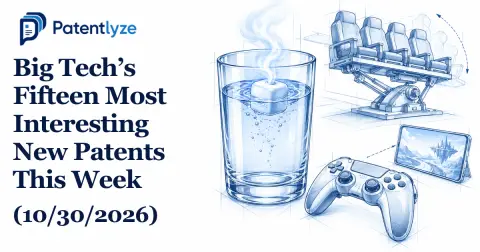
A weekly read of what the world’s biggest technology companies just told the U.S. patent office.
We wrote up 224 filings this week, down from 238. Google led with 35, including four from Waymo and three from DeepMind, then Samsung at 32, Apple at 29, Microsoft at 27 and Qualcomm at 24.
The full run lives under this week’s Big Tech patents; these fifteen stood out.
1. Microsoft Files Patent to Rewrite What Speakers Say in Live Video, Lips Included
Live video goes out as it happens, filler words and all. Microsoft has filed for a system that swaps a speaker’s words a few seconds after they say them and redraws their lips to match.
Claim 1 is a system that scans live video and audio of people speaking, uses an AI agent to pick words to change based on a set of parameters and a user’s profile, and has generative AI replace them in both sound and picture. It also smooths the video and audio around each swap.
The filing defines near-real-time as within a few seconds, such as 1 to 10, close to the delay of a live broadcast. Swappable words include filler words, slang, mumbled or mispronounced words and offensive words. A second main claim translates speech in a language you don’t speak and redraws the lips to match.
Claims name AR eyewear, a phone, a tablet or a video camera, and content such as live lectures, concerts and sporting events. The profile can include age, ethnicity, cultural background and religion. Claim 1 never requires telling viewers a word was changed; one later claim keeps the original recording as ground truth.
Two inventors, David Callaghan and Dinesh Kumar. Filed in April 2025 with no parent application, twenty claims. The examiner rejected the claims in a first review. A sibling filing for recorded video, filed the same day, has already been approved and ranked 16th this week.
2. Disney Files Patent for a Floating Gadget That Makes Fog in Your Drink
Dry ice makes a drink smoke for a few minutes, then the show is over. Disney has filed for a floating gadget that keeps fog rolling off a drink long after dry ice would have run out.
Claim 1 is short: a housing with a fluid inlet and a vapor outlet, and a vibration generator inside that turns liquid from an outside source into vapor. A second main claim covers the method, in which a wicking material carries the liquid to the vibrating part.
Dependent claims name a piezoelectric ultrasonic transducer, a weight opposite the outlet so it faces up, a baffle that shapes the fog, and LEDs a controller can drive. One claim sizes the housing as a cube under two inches on each side; another limits it to containers of 12 ounces or less.
The wicking layer can act as a membrane that lets only water through, since the filing says vaporized alcohol raises health and flammability concerns. Beyond drinks, it suggests a smoking volcano cake, a jack-o-lantern pumpkin and, scaled up, ponds and lagoons. Theme parks, cruise ships and restaurants are the settings it names.
Four inventors, including Daniel Mark Joseph and Jessica Anne Klouda. Filed in April 2025 with no parent application, twenty-one claims. The examiner rejected the claims in a first review, and Disney has filed a response.
3. Apple Files Patent for Entering a Passcode by Looking at Your Fingertips
Glasses without a screen have no keypad for a passcode. Apple has filed for a headset that turns your fingertips into keys you press by looking at them.
Claim 1 runs on a head-mounted device: find the 3D position of several body parts, each tied to a different value, track where your eyes point, work out which body part you are looking at, and enter that part’s value as input.
The filing builds a hand skeleton about 30 times a second and draws a small target zone around each fingertip. Holding a palm flat toward your face can start the mode. A feedback sound can grow louder while you keep looking, until a threshold time when the value counts.
One claim covers a numeric code to authenticate you, and the filing’s example sequence is 2315. Other uses include yes-or-no answers with two fingertips and choosing your saved first name for a form field. Touching a fingertip with the other hand works in place of looking.
Four inventors, including Amit Pratap Rane and Shannon L. Gardiner. Filed in April 2026, claiming priority to a provisional from April 2025, twenty claims. The filing aims at smart glasses with limited or no display, though it also applies to headsets with screens.
4. Nvidia Files Patent to Read Your Texts Aloud in the Sender’s Own Voice
Phones read texts aloud in one stock voice. Nvidia has filed for software that reads each message in a voice that resembles the person who sent it.
The application has a single claim: processors that, on an API call, use neural networks to generate several vectors of different sizes describing a person’s voice, then generate synthetic speech of an electronic message whose sound matches those vectors.
The profile comes from samples of the sender’s speech, from 1 to 10 minutes or longer. It can travel with the message or separately, and the receiving phone can store it with the sender in a contact list. The filing names x-vectors, d-vectors and i-vectors as profile formats.
Examples include a phone reading a text aloud in a moving car, and English voice samples used to speak a message in German. Such vectors can also be used for speaker verification, which is why the filing describes encrypting the profile with keys that expire. How well that protection holds is the open question.
One inventor, Boris Ginsburg. Filed in July 2026 as a continuation of a March 2022 application that has since been granted as U.S. Patent 12,718,792.
5. Disney Files Patent for a Flying Theater Ride That Starts Flat and Tips Upright
Getting riders on and off is a big part of any ride’s line. Disney has also filed for a ride cabin that loads on a flat floor, then swings upright to face a screen.
Claim 1 is a cabin that moves between a loading position and several show positions, a hub that rotates on an axis to swing it from loading to a show position, and a linkage that moves it from one show position to another.
In the main version the linkage is a four-bar linkage pushed by linear actuators. Offset joints form lever arms that turn a short push into a bigger heave or tilt, giving riders a sensation of flying, falling or being launched. A display shows visuals timed to the motion, and seats pivot to stay upright.
A brake holds the hub during boarding, and a counterweight balances riders and platform so smaller motors can do the work. The filing says the cabin can return to loading on its own after a broken actuator or a loss of power. A level floor also helps guests who use wheelchairs, canes or crutches.
Two inventors, James Durand and Stephen Brooks Rowe. Filed in April 2025 with no parent application, twenty claims. The examiner rejected the claims in a first review, and no response is on file yet.
6. Samsung Files Patent to Turn Your Photo Into Custom App Icons
Phone themes swap your icons for a set somebody else designed. Samsung has filed for a phone that redraws app icons using your own photo.
Claim 1 is a device that takes an image, gathers feature information about an app, extracts features from the image, and generates a new interface object for that app from both. Icons and widgets are the examples.
App features include its category or hashtags, the colors in its current icon and any object drawn on it. If that drawing is a person in a pose, such as a runner, your face can be blended into the pose. A health app could show you playing tennis if that is your favorite sport.
Season, weather and location can shape the result, and one example adds winter and Christmas themes. The filing also sets privacy levels: icons on a foldable’s outer screen, which other people can see, look less like you than those inside, and the app drawer can be more personal than the home screen.
Six inventors, including Eunhye Jee and Jeongseob Kim. Filed in May 2026 as a continuation of a Korean international application from October 2024, twenty claims.
7. Meta Files Patent for Glasses That Record Your Walks as 3D Memories
Video from smart glasses comes out flat. Meta has filed for glasses with several cameras and depth sensors that record a scene in 3D for later playback in a headset.
Claim 1 takes images captured at the same moment by cameras at different spots on an extended reality device, adds depth data from its depth sensors, and stitches the combined images into 3D spatial video that an XR system can play back.
The filing suggests capturing all views within about 10 milliseconds, so motion does not smear when the views are combined. Depth can come from time-of-flight or structured light sensors, or LiDAR. Mapping the room while recording, known as SLAM, helps work out where each camera sat.
Dependent claims add cameras on another wearable, such as a hat, and adjust the video to the distance between your eyes and the cameras. Some processing can move from the headset to a server. What several cameras and depth sensors do to battery life and weight is the open question.
Five inventors, including Zuoqian Wang and Shizhe Shen. Filed in March 2026, claiming priority to a provisional from April 2025, twenty claims.
8. OpenAI Files Patent to Let Chatbot Replies Start Before Safety Checks Finish
Checking every word of an AI’s reply before you see it adds delay. OpenAI has filed for a way to start showing a reply while safety checks run a few words behind.
Claim 1 sends a stream of numbered tokens from a generative model to a safety engine, checks them with a safety plugin, and lets tokens reach the front end only while the gap between the token shown and the token checked stays under a buffer.
In the filing’s example the buffer is three tokens: token 3 can appear while the checker is on token 1, but token 4 waits. If a token fails, a stop token halts the output. Each plugin has its own buffer, and a buffer of zero means every token is checked before it is shown.
Example plugins check whether audio drifts from an allowed voice, detect music, or look up copyright-protected content in a database. An administrator can switch plugins off. The filing names ChatGPT, DALL-E and Sora as example models. The cost of the speed is that a few words can go out before a check fails.
Nine inventors, including Madelaine Boyd and Justyn Harriman. Filed in April 2025 with no parent application, twenty claims.
9. Tesla Files Patent for Underbody Fans That Vacuum a Car Onto the Road
Wings press a race car onto the track, but only once it is moving fast. Tesla has filed for fans and drop-down skirts that pull a car down onto the road.
Claim 1 is an aerodynamic system: fans in an airflow path to a region under the car, deployable elements that meet the ground to bound that region, and a control system that reads sensor data, picks a deployment and runs fans and skirts together to create downforce.
In a first mode every skirt drops to seal the floor and central fans pull air out, for low-speed, smooth conditions such as 0-60 sprints or autocross. In a second mode mainly the side skirts stay down while all fans run, for harder driving on uneven surfaces.
Inputs include GPS location, speed, wheel position, pitch and roll, and stored map data can flag an upcoming turn, hill or pothole. Mesh at the fans keeps rocks out. Skirts and fans under a car have to survive real roads, and that durability is the open question.
Three inventors, James Michael Arthur Crook, Christopher Ward and David Lemire. Filed in July 2025 as a continuation of an April 2025 application, already granted as U.S. Patent 12,377,920, twenty claims.
10. Sony Files Patent for One Game Invite Link That Works on PlayStation, Xbox and PC
Pulling a friend on another console into your match takes friend requests and menus. Sony has filed for one link that lets a friend join your game session from PlayStation, Xbox or PC.
Claim 1 starts when a friend opens a share link made during your session. The link is one universal address for every system. A web page asks which system they will join from, then sends them to a system-specific trigger link that launches the game and passes along the session details.
The landing page can list at least three system types, and the trigger link can be signed, single-use and set to expire. A credentials token lets the game server add the new player. The description adds a QR code on your TV that a phone can scan.
The friend need not be registered on Sony’s network; the description gives Xbox network and Steam users as examples. Game developers have to set their titles to accept joins from anyone with the link. Invited players can also see game stats such as total shares and joins.
Seven inventors, including Dustin S. Clingman and Benedikt Neuenfeldt. Filed in July 2026 as a continuation of a June 2023 application, granted as U.S. Patent 12,722,089, twenty claims. It is one of two Sony gaming filings in this list.
11. Adobe Files Patent for Dials and Sliders That a Camera Can Read Without Electronics
A dimmer dial or a slider usually needs wiring to control anything. Adobe has filed for controls with no electronics that a camera reads by watching two printed patterns slide past each other.
Claim 1 receives two images of a composite pattern, formed by a pattern on a physical control overlapping a second pattern by different amounts, compares them to find how far the first pattern moved, and performs an action based on that displacement.
The overlap forms a Moiré pattern, the ripple you see when two screens are stacked, which magnifies small movements and can be read from a distance. The software straightens the view, blurs it, fits a sine wave to the brightness and compares peak positions between frames.
Claims name buttons, switches, sliders, joysticks and dials, and the parts can be 3D printed. Examples include training props shaped like surgical instruments or vehicle controls and artists guiding robotic drawing arms. A camera has to be watching, so the idea suits AR headsets and phones.
Five inventors, including Chang Xiao and Eunyee Koh. Filed in April 2025 with no parent application, twenty claims.
12. Qualcomm Files Patent for Video That Hides Faces Unless You Have the Key
Blurring faces in a video protects the people in it, but the original is gone for good. Qualcomm has filed for video that hides faces from everyone except whoever holds the key.
Claim 1 encrypts regions of interest in a frame, masks those regions, encodes the masked frame with heavier compression inside the regions and lighter compression outside, and outputs one bitstream holding both the encoded frame and the encrypted content.
Regions are picked by an object type set in advance, such as a face, a license plate, a document or a whiteboard. Format-preserving encryption keeps the locked pixels the same size, and a segmentation map stored as a no-display frame records where they go back. Players without the key show only the masked video.
The filing points to body cameras, dashcams, in-cabin monitoring and personal recordings. It notes that privacy expectations vary by country and that people worry personal content may be used to train AI models. Compressing the masked areas hard leaves more detail for the rest of the picture.
Eight inventors, including Khalid Tahboub and Junmin Wu. Filed in April 2026, claiming priority to a provisional from April 2025, thirty claims.
13. Waymo Files Patent for Truck Stops Where Self-Driving Vehicles Exchange Cargo Loads
Self-driving trucks handle highways better than city streets. Waymo, part of Google, has filed for a relay of truck stops where robots move trailers from one driverless truck to the next.
Claim 1 is a relay: a first autonomous truck hauls a trailer to a hub and detaches, a second autonomous truck moves to the trailer, attaches, drives it to a second hub, and detaches there.
Other claims add a hitching robot that moves the trailer between trucks and a lifting robot that slides under its front end to bear the weight. Before leaving, a truck can be weighed wheel by wheel, its trailer scanned with X-ray, infrared or ultrasound against the load manifest, and its brakes tested.
A refueling robot can serve trucks at the hub. When a truck shuts down, it photographs its surroundings and compares new photos on restart to catch whether it was moved. Hubs sit at or near a highway, since the filing says city driving needs detailed mapping that adds cost.
Five inventors, including Charles Jatt and Andre Strobel. Filed in June 2026 as a continuation in a family with two granted patents, U.S. 12,116,009 and 12,703,390, going back to a 2021 provisional. Twenty claims.
14. A New Sony Patent Picks Teammates by Skill, Mic, Location and Free Time
Finding teammates usually means forums or random matchmaking. Sony has also filed for a console that builds a game lobby from a request spoken in plain words.
Claim 1 receives a request with one or more criteria, generates a rule for each, applies the rules to a database to find candidate players, selects some of them and connects them with the requester.
In the filing’s example, a player asks out loud for Call of Duty players at silver skill rating within 10 blocks of home who are free after school next Monday. A language model writes the rules, and chain-of-thought prompting checks each match and corrects a faulty rule.
Criteria can include skill, location, play schedule, a shared college or language, and setup details such as a microphone or connection speed. Narrowing the search first can cut the work from hours to seconds on a database of one billion accounts. Players opt in, and requests that break fair-play or minor-protection rules can be refused.
Five inventors, including Michael J. Fuery and Andrew Farrell. Filed in April 2025 with no parent application, twenty claims. The filing names PS5 and PlayStation Portal among its example devices.
15. Google DeepMind Files Patent for AI That Flags Disease-Causing Changes in Proteins
A genetic test can turn up many small protein changes, and most of them are harmless. Google DeepMind has filed for an AI that scores how likely each change is to cause disease.
Claim 1 builds an input from a multiple sequence alignment, which lines the protein up with related proteins from other species, runs a neural network to get a score distribution over amino acids, and scores the mutation by the gap between the original amino acid and its substitute.
In the filing’s example, the original amino acid L scores 0.55, a swap to N scores 0.44 and a swap to R scores 0.01, so R is judged more likely to be harmful. The filing calls the system AlphaMissense and compares it with other predictors on 82,868 held-out ClinVar variants.
The clinical path starts with a blood or saliva sample or a cheek swab, then checks each mutation against a database covering the human proteome and flags scores above a threshold such as 0.5, 0.8, 0.9 or 0.99. Claims also cover pest control, and the filing suggests picking milder strains for vaccines.
Three inventors, Ziga Avsec, Guido Novati and Jun Cheng. Filed in April 2025 as the U.S. entry of an international application from October 2023, with provisionals from 2022 and 2023. Twenty claims remain after seven were canceled.
What ties them together
Three change what a person appears to say or show. Microsoft rewrites live speech and redraws the lips, Nvidia reads texts in the sender’s voice, and Qualcomm hides faces that only a key brings back.
Three replace buttons with something already at hand: Apple’s fingertips as a keypad, Adobe’s printed patterns read by a camera, and Sony’s teammate search run from one spoken sentence.
Sony’s two filings both get players into a game, one with a link for any system and one with a search that builds the lobby. Disney’s two are physical effects, fog in a drink and a ride that tips upright. Tesla and Waymo cover the road, from launch grip to freight relays.
OpenAI’s filing trades a few unchecked words for speed, and Meta’s records your surroundings in 3D. DeepMind’s has the highest stakes, a score that could help find the cause of a genetic disease.
Five of the fifteen continue earlier applications, and four of those parents are already granted: Nvidia’s, Tesla’s, Sony’s link filing and Waymo’s family. Three have drawn first-round rejections, Microsoft’s live rewrite and both Disney filings, and Disney has already answered on the fog gadget.
Patentlyze reads every new patent application that Apple, Google, Microsoft, Meta, Nvidia, Samsung, OpenAI, Qualcomm, Sony, Intel, AMD, IBM, Adobe, Salesforce, Tesla, Amazon, and Disney file at the USPTO, and writes a plain-English breakdown of the ones that say something about where products are heading. New filings drop every Thursday. The full archive lives in our patent library.
Get lists like this in your inbox
We read every patent application Big Tech publishes and send you the ones worth knowing. Plain English, free, every week.