
Google Patents a System That Moves an On-Screen Pointer by Turning Your Head
Google is working on a way to let you navigate menus on a headset just by turning your head — no hand gestures, no controllers, no voice commands required.
How Google wants you to point at things without your hands
Imagine wearing a pair of AR glasses and trying to tap a button on a floating menu — but your hands are full, or you're in a situation where waving your arms around isn't practical. Google's patent describes a cursor that moves across that floating menu purely in response to how much you turn your head.
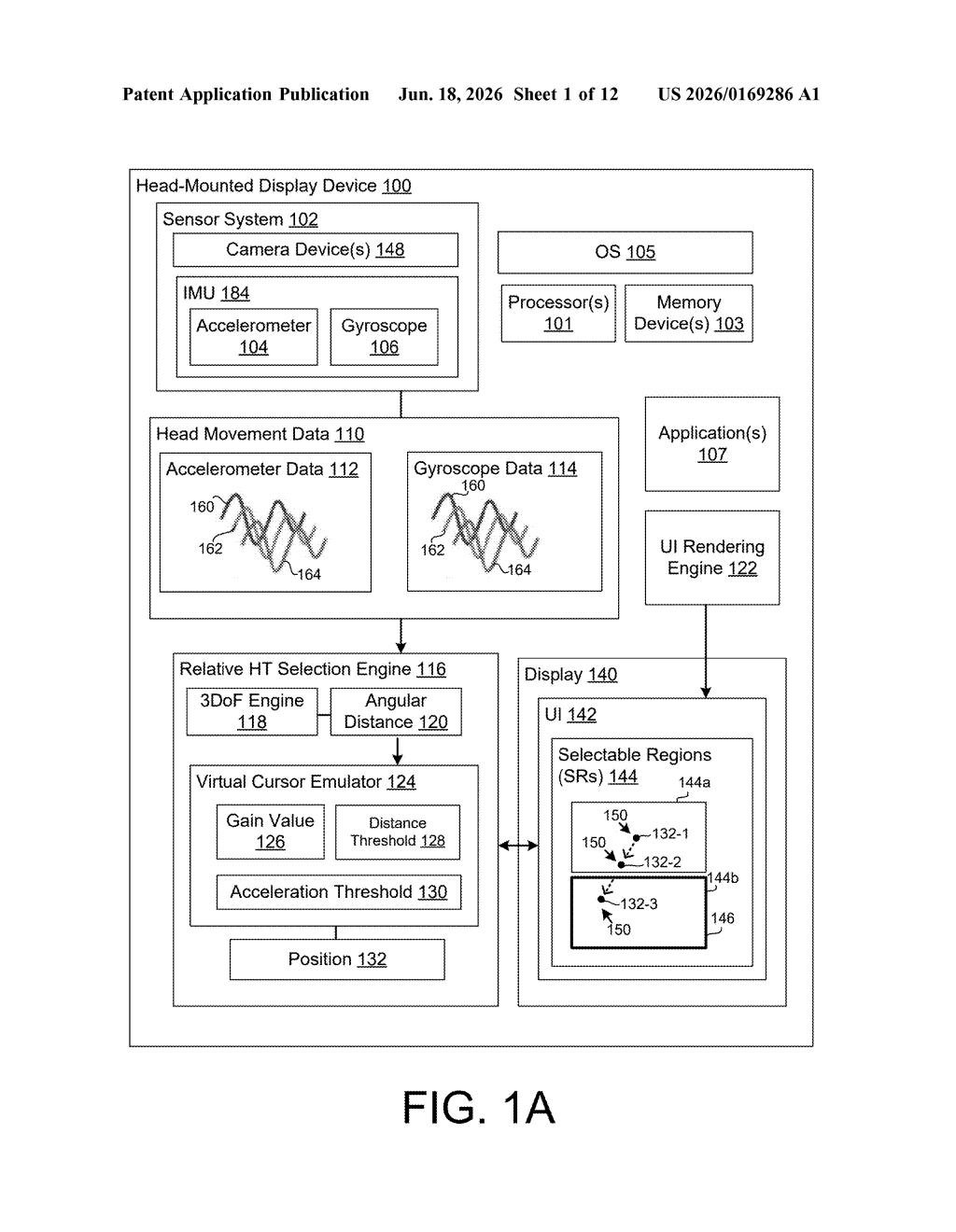
The key insight is that the cursor doesn't track your head's absolute direction in the real world. Instead, it measures how far your head has moved from where it was a moment ago and uses that relative rotation to nudge the cursor across the screen. The interface itself stays fixed on your display, like a heads-up display in a fighter jet.
There's also a snap feature: when the cursor drifts from one zone of the interface into another — say, from a text field into a button area — the system automatically moves it to a preset position inside that new zone. Think of it like how a TV remote highlights the next button cleanly rather than stopping halfway between two options.
How the gain value and snap zones drive the cursor
The patent describes a head-mounted display that renders a fixed user interface — meaning the menu or panel doesn't float around in 3D space as your head moves; it stays locked to your field of view like a dashboard overlay.
To move a cursor (called a position indicator) around that interface, the device calculates the angular distance between your head's last recorded orientation and its current one. In plain terms: it measures the angle your head has rotated, not where your head is pointing in the room. A gain value is then applied to that angle — essentially a sensitivity multiplier — to translate the small head rotation into a proportionally larger or smaller cursor movement on screen.
The patent also introduces region-based snapping. The interface is divided into distinct regions (think: different UI zones like a button, a text field, a slider). When the cursor crosses from one region into another, the system snaps the cursor to a designated position within that new region rather than leaving it wherever the raw head movement landed. This prevents the cursor from hovering ambiguously on a border between two controls.
The sensor data driving all of this would come from the headset's built-in motion sensors — likely an IMU (inertial measurement unit), the gyroscope and accelerometer combo found in virtually all modern headsets and phones.
What this means for hands-free navigation on AR glasses
Hands-free navigation is one of the hardest UX problems in AR and mixed-reality devices. Voice commands require you to speak out loud, hand-gesture tracking can be imprecise or tiring, and eye-tracking needs expensive hardware plus constant calibration. A head-rotation cursor sidesteps all of those — your neck muscles are precise, low-fatigue, and already available on any device with a motion sensor.
The snap-to-region mechanic is the detail worth watching here. It's a direct acknowledgment that raw cursor control via head movement is too jittery for fine menu navigation. By snapping the pointer to a defined position when it enters a new zone, Google is essentially borrowing a trick from game console UI design — where you never have to land a cursor exactly on a small target; the system meets you halfway.
This is practical, unglamorous UX work — exactly the kind of patent that doesn't get headlines but ends up being the reason a product actually feels usable. The snap-to-region mechanic in particular suggests Google's AR team has thought seriously about the frustration of trying to hit small targets with your entire head. Worth tracking if you follow the Google AR glasses project.
There are more where this came from
We read every patent application Big Tech publishes and send you the ones worth knowing. Plain English, free, every week.
Want this weekly breakdown for a company we don't cover? Patentlyze Pro →