
Ultrasound Tech Detects Your Position to Optimize Audio Output
Your laptop speakers don't know where you are — they just blast audio into the room and hope for the best. AMD wants to fix that by turning those same speakers into a kind of sonar system.
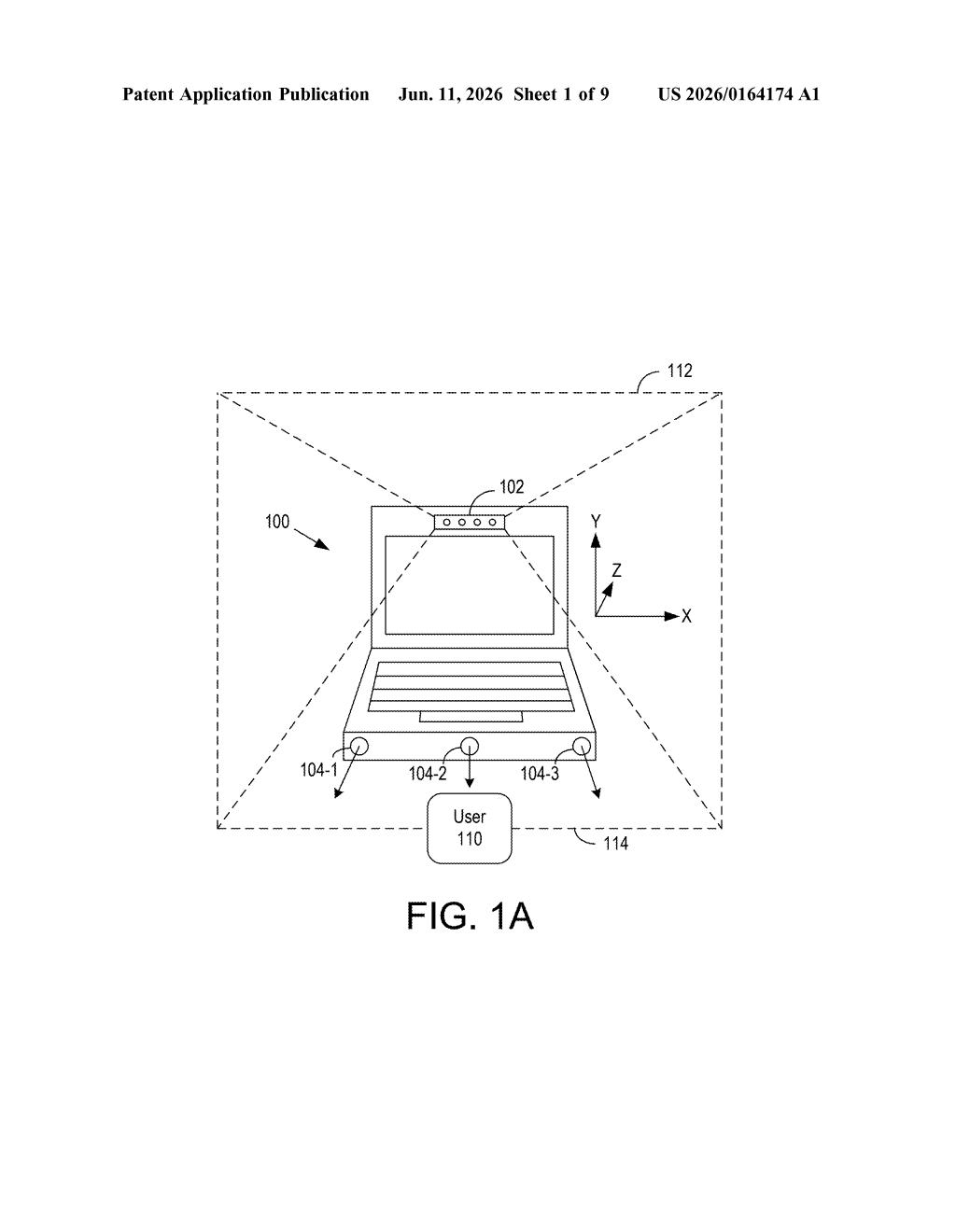
How AMD's ultrasound speaker trick actually works
Imagine your laptop's speakers are not just playing music — they're also quietly sending out ultrasound pulses, the same kind bats use to navigate. Those pulses bounce off you and return to the laptop's microphones. The device now knows roughly where you're sitting.
That location data then feeds directly into how your audio sounds. If you've drifted to the left of your screen, the system can subtly shift the sound to follow you, keeping dialogue and music feeling centered and natural instead of coming from a fixed point in space.
This is essentially spatial audio — the technology that makes sound feel like it's coming from around you rather than from two tiny speaker grills — but personalized to your actual position in real time, not a one-size-fits-all preset.
Inside AMD's reflect-and-adjust audio pipeline
The patent describes an electronic device — a laptop, monitor, or similar — that continuously emits ultrasound signals (sound above human hearing, so you'd never notice them) from its built-in speakers alongside normal audio.
The device's microphones pick up the reflected ultrasound — the echoes that bounce back from a person in front of the screen. A hardware processor analyzes those reflections to determine whether a user is present and, implicitly, where they are positioned relative to the device.
Once the system detects your position, it adjusts the audio output through one or more of its speakers. The patent covers:
- Presence detection (is anyone there at all?)
- Position estimation based on reflected signal timing and intensity
- Dynamic audio adjustment tailored to that detected position
This connects to AMD's role as a chip designer: the hardware processor doing the signal crunching is the kind of compute task AMD's APUs (combined CPU/GPU chips) commonly handle in laptops. The patent suggests this processing happens on-device, with no cloud dependency.
What this means for laptop and PC audio quality
Most laptop and desktop speakers apply spatial audio as a fixed effect — they optimize for a listener sitting dead-center, and the illusion falls apart the moment you move. A system that actively tracks your position and reshapes audio accordingly would make spatial sound feel genuinely convincing rather than like a software gimmick.
For AMD, this matters strategically. The company supplies processors to a wide range of PC makers, and audio quality has historically been one of the weaker points of laptop hardware. A chip-level feature that noticeably improves the listening experience — without requiring extra sensors or cameras — could become a selling point for AMD-powered devices, much the way noise cancellation became a checkbox feature on premium laptops.
This is a genuinely clever use of hardware that already exists in every laptop: speakers and microphones doing double duty as a passive sonar array. The core idea is elegant enough that it's surprising nobody has shipped it widely yet. Whether AMD turns this into a real, user-noticeable feature or it stays buried in a patent database is the real question.
There are more where this came from
We read every patent application Big Tech publishes and send you the ones worth knowing. Plain English, free, every week.
Want this weekly breakdown for a company we don't cover? Patentlyze Pro →