
Meta Patents a VR Display That Syncs Each Eye's Lighting Separately to Cut Motion Blur
VR headsets typically have two separate screens — one for each eye. Meta's new patent describes a clever workaround: one shared screen with lighting that can flash each eye's half at slightly different moments, tuned in real time to what the display is actually doing.
What Meta's single-panel eye-sync display actually does
Imagine watching a fast-moving scene in a VR headset and noticing a smeared, ghostly trail behind every moving object. That's motion blur, and it's one of the biggest reasons VR can feel disorienting or even nauseating.
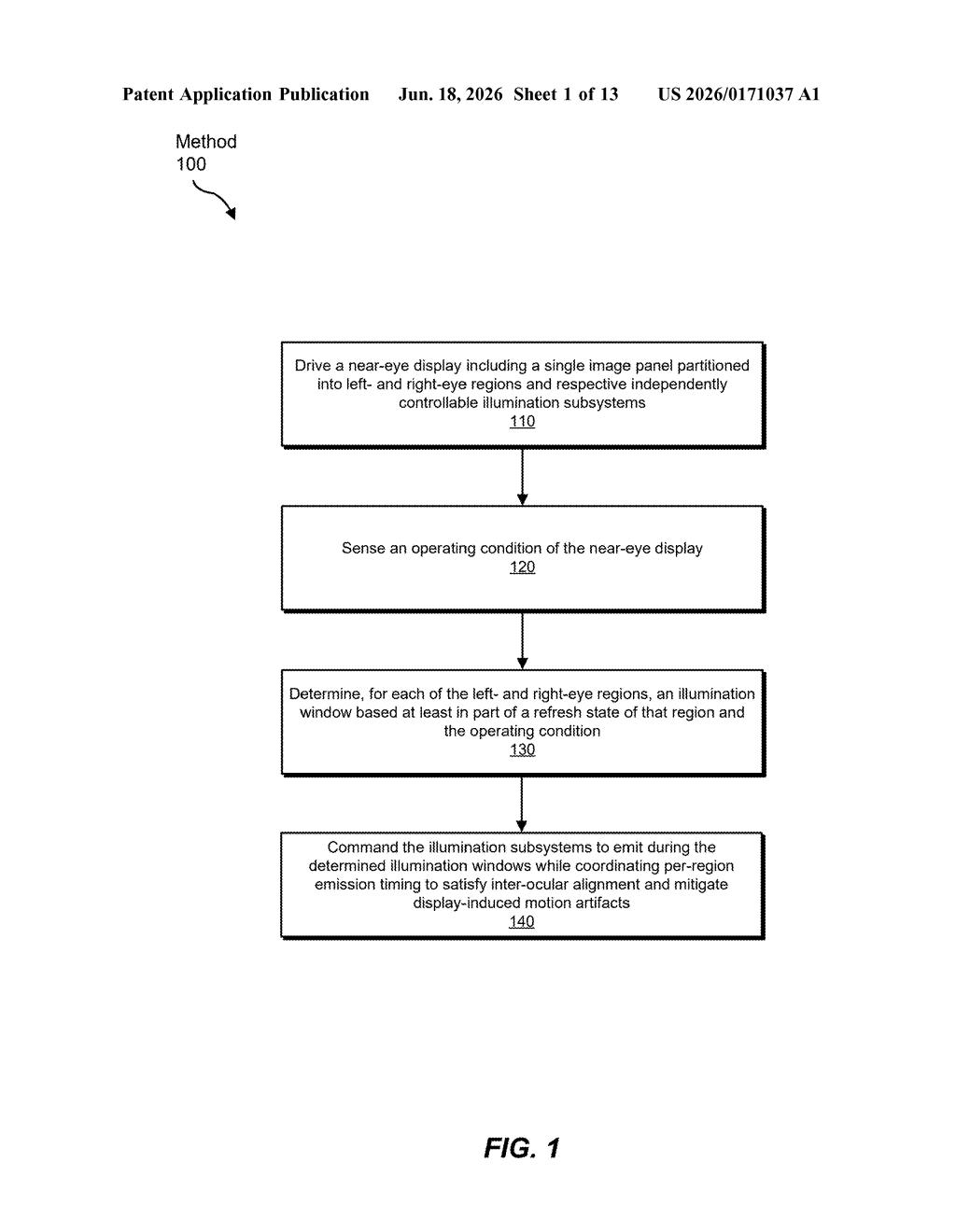
Meta's patent tackles this with a single screen split into a left-eye zone and a right-eye zone, each with its own independent backlight. Instead of both sides flashing at exactly the same time, the system reads what each half of the screen is currently doing — whether it's in the middle of refreshing a new image or just finished — and schedules the flash to happen at the best possible moment for each eye separately.
The trick is that even though the two halves light up at slightly different times, the system keeps them close enough together that your brain still sees one smooth, unified image. This is called inter-ocular alignment. The result is sharper motion, less blur, and potentially a more comfortable VR experience — all without needing two full separate screens.
How the illumination scheduler coordinates both eyes
The patent describes a single image panel physically divided into left-eye and right-eye regions. Each region has its own illumination subsystem — think of it as an independently controlled backlight — that can be switched on and off at different times even though both regions share the same underlying display hardware.
A key part of the system is a real-time sensor loop. The headset continuously reads what it calls an operating condition: things like how fast the display is refreshing, the current temperature of the panel, or what kind of content is being shown. Based on that snapshot, it calculates an illumination window — a precise moment in time when flashing each region's backlight will produce the clearest image with the least motion artifact (blurring or judder caused by the display itself).
The scheduling engine then has to solve a coordination problem:
- Each eye's window must be timed to the refresh state of that specific region (so the image is fully drawn before it's lit).
- The two windows must be close enough together in time that your visual system perceives them as simultaneous — this is the inter-ocular alignment constraint.
- The combination must suppress display-induced motion artifacts, the smearing that happens when a backlight is on while pixels are mid-transition.
By threading all three requirements together, the system can adapt its flash timing on the fly as conditions change, rather than using one fixed timing for every situation.
What this means for VR comfort and headset design
For VR headset makers, the push toward thinner, lighter hardware is relentless. Using one panel instead of two is an obvious way to cut weight, cost, and complexity — but only if you can make that single panel deliver the image quality both eyes need. This patent is Meta's answer to the core optical challenge that's blocked single-panel near-eye displays from being practical: keeping the two eye views in sync when they're sharing the same piece of hardware.
For you as a user, the payoff would be a headset that feels lighter and produces less visual discomfort during fast motion — the two things that most often drive people to take their headsets off. Whether this approach makes it into a shipping Quest or Ray-Ban product isn't clear, but it signals that Meta's display engineers are actively working the single-panel angle as a path to slimmer form factors.
This is genuinely interesting display engineering, not a routine filing. The hard part of single-panel VR has always been the synchronization problem — the patent's claim that adaptive, condition-sensitive scheduling can satisfy both per-eye quality and inter-ocular alignment simultaneously is a real technical bet. Whether it works well enough in practice to beat dual-panel designs is another question, but the approach is worth watching.
There are more where this came from
We read every patent application Big Tech publishes and send you the ones worth knowing. Plain English, free, every week.
Want this weekly breakdown for a company we don't cover? Patentlyze Pro →