
AMD Patents a System That Picks the Right AI Chip Based on Battery Mode
Not every AI task needs the fastest chip in the room. AMD's new patent describes a system that figures out which ones do, and which ones can run on a lower-power chip instead.
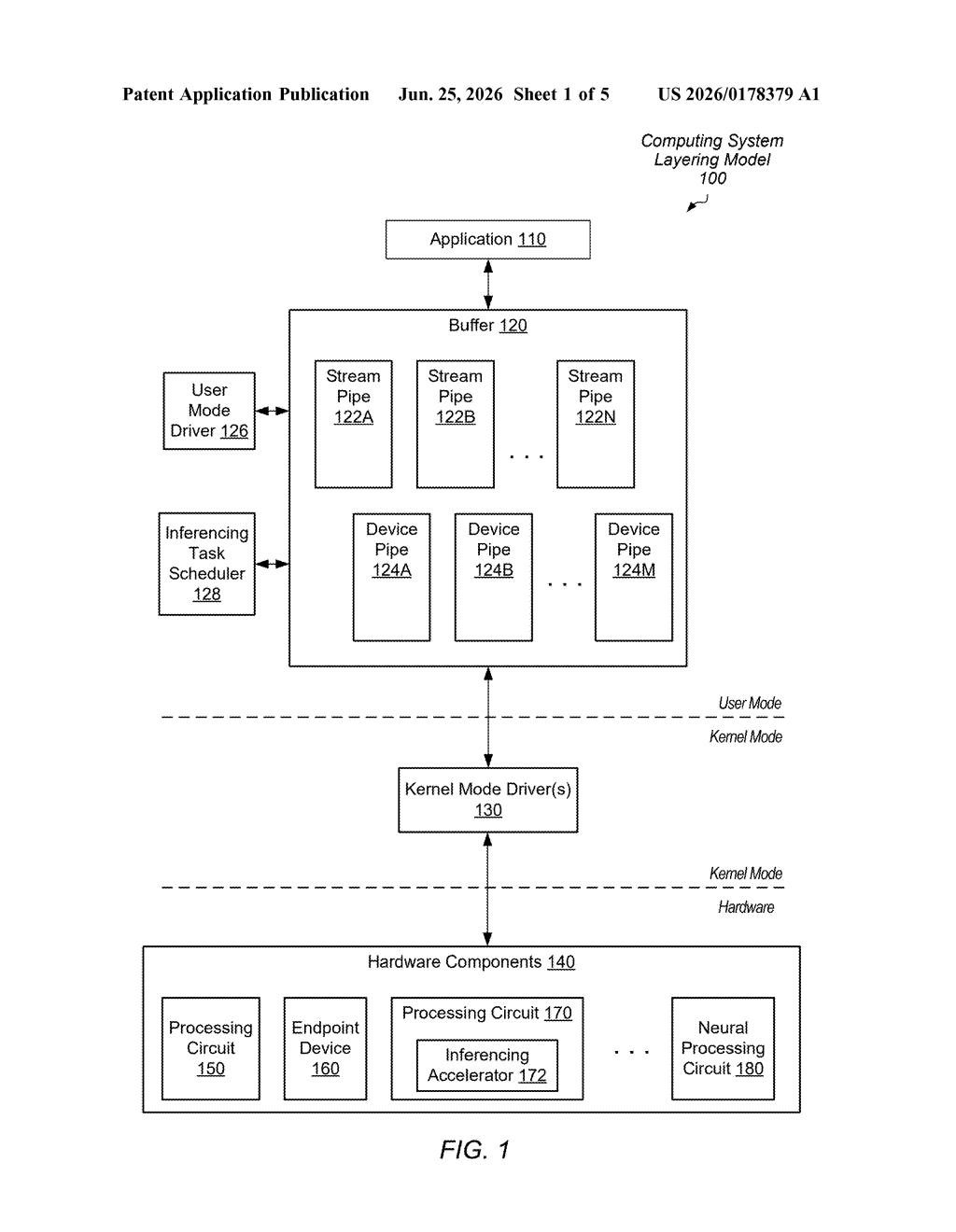
How AMD's patent splits AI work by power mode
Imagine your laptop is in battery-saver mode and you ask an AI assistant to do two things at once: transcribe your voice and generate a detailed image. Those two jobs are very different in terms of how much computing muscle they need. AMD's patent covers a system that knows this and routes each job accordingly.
When your device is trying to save power, the system compiles a stripped-down version of eligible AI tasks and sends them to a smaller, less power-hungry chip. But if a task is too demanding to run in a reduced form, it still gets sent to the full-power AI chip, even in battery-saver mode.
The practical effect: your device stays cooler and lasts longer on a charge, without silently failing at the tasks that genuinely need full power.
How the host circuit compiles and routes each AI task
AMD's patent describes a computing setup with at least two distinct AI processing units: a neural processing circuit (a full-featured, high-performance AI chip) and an inferencing accelerator (a smaller, less capable chip that draws less power). A host processing circuit acts as the traffic controller between them.
When the system enters a low-power operating mode, the host circuit checks each incoming AI task to see whether it can be compiled into a lighter version. If a task is flexible enough, the host prepares that low-power version and assigns it to the inferencing accelerator.
The critical rule: if a task has no low-power alternative (meaning it requires high performance no matter what), the host circuit sends it to the full neural processing circuit anyway, overriding the power-saving preference. This prevents the system from silently producing degraded results just to save energy.
The word "inference" here means running a trained AI model to get an answer (as opposed to training the model in the first place). This patent is entirely about the inference side, which is what happens on your device every time you use an AI feature.
What this means for AI on laptops and low-power devices
On laptops, phones, and edge devices where battery life is a real constraint, running every AI task at full throttle is wasteful. This patent gives AMD a formal architectural approach to splitting that workload, which is directly relevant to its Ryzen AI chip lineup and any device that mixes heavy AI features with battery-conscious use cases.
For you as a user, this could mean your device intelligently decides which AI features get a lighter treatment in power-saver mode and which ones always run at full quality, without requiring you to manage any of that manually. The approach also hints at how AMD is thinking about dedicated AI hardware as a first-class scheduling target, not just an optional accelerator.
This is a solid, practical patent that addresses a real engineering tradeoff. It is not flashy, but the explicit rule that high-demand tasks override the power-saving preference is the kind of detail that separates a useful system from one that just silently degrades. AMD is clearly formalizing the infrastructure for multi-chip AI scheduling as dedicated AI silicon becomes standard in its PC processors.
There are more where this came from
We read every patent application Big Tech publishes and send you the ones worth knowing. Plain English, free, every week.
Want this weekly breakdown for a company we don't cover? Patentlyze Pro →