
Google Patents a Method to Prevent Speech AI From Retaining Private Training Data
When Google trains its speech recognition AI on real recordings, the model might memorize fragments of people's voices without anyone intending it to. This patent describes a system for catching that problem before the model ships to millions of devices.
What Google's speech-memorization check actually does
Imagine a student who, instead of learning the general rules of grammar, just memorized entire sentences word-for-word from a textbook. That student could accidentally recite private notes they weren't supposed to retain. AI speech models can have a similar problem: trained on real voice recordings, they sometimes "remember" specific phrases from specific people's audio in a way that goes beyond just learning to recognize speech.
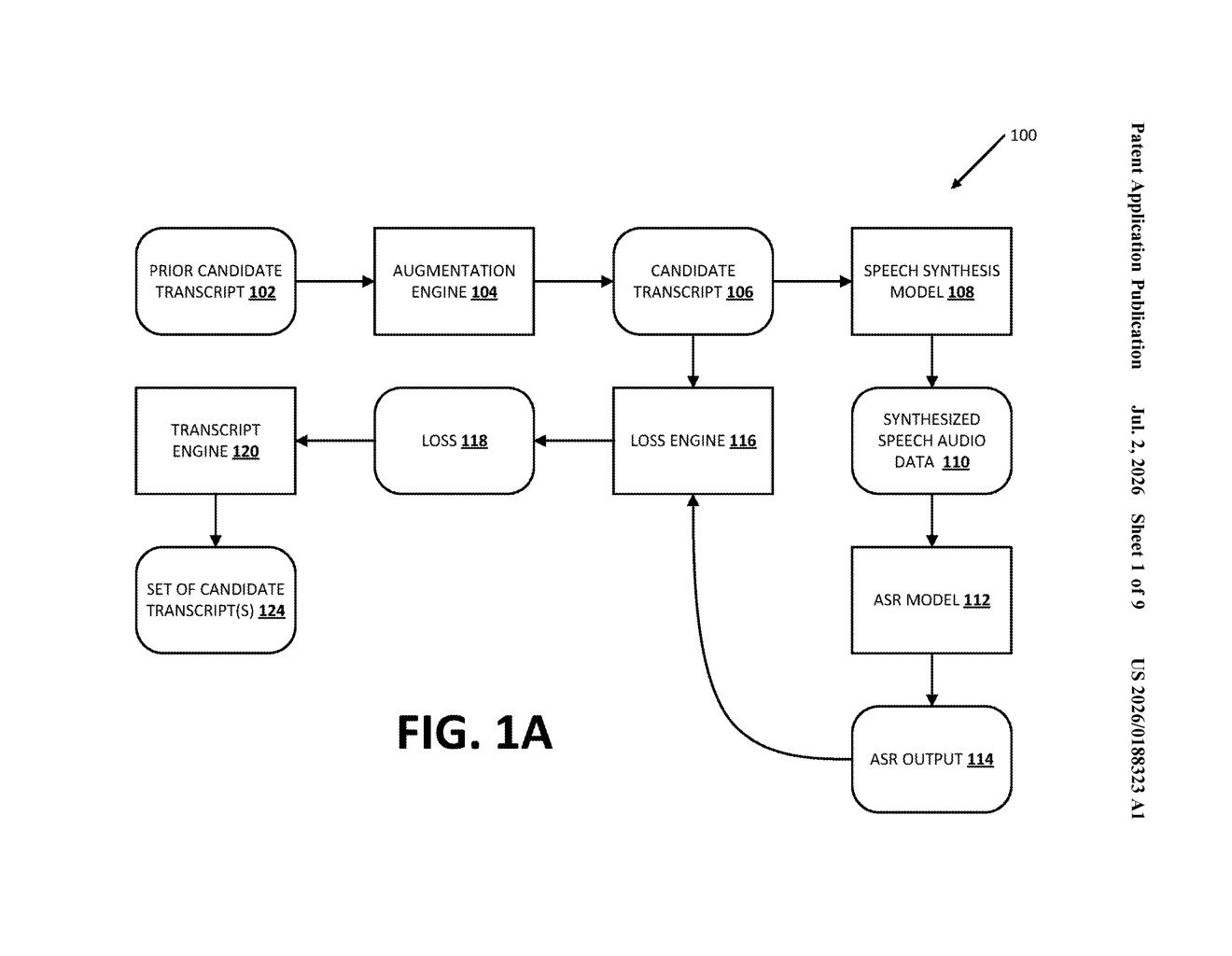
Google's patent describes an automated test for catching this. The system takes a phrase, converts it to synthetic (computer-generated) speech, feeds that synthetic audio back into the speech recognition model, and checks how confidently the model transcribes it. If the model is unusually confident about a phrase, that's a red flag suggesting it memorized real training data rather than learning general patterns.
The key detail is in the last step: if the overall memorization score crosses a threshold, the system can block the model from being deployed to users' devices at all. It's an automatic privacy gate, not just a diagnostic report.
How the loss score catches memorized phrases
The patent describes a pipeline that measures what researchers call unintentional memorization in automatic speech recognition (ASR) models, which are the AI systems that convert spoken audio into text.
The process works in a loop:
- The system generates candidate transcripts, short text strings assembled token by token from the model's vocabulary.
- A speech synthesis model (a text-to-speech engine) converts each transcript into synthetic audio, deliberately avoiding any real human recordings.
- The ASR model under evaluation processes that synthetic audio and produces a transcription output.
- The system computes a loss score (a numerical measure of how closely the model's output matches the original candidate transcript). A very low loss means the model reproduced the phrase with high confidence.
The intuition is straightforward: if the model transcribes synthetic audio of a phrase with unusually high accuracy, it likely saw that exact phrase many times in training data tied to a specific speaker, meaning it memorized rather than generalized.
Those individual scores roll up into an overall memorization measure. Critically, the claim specifies that the system then uses that measure to decide whether to push the model to client devices at all, making this a deployment gate, not merely a research metric.
What this means for voice privacy on Google devices
Speech recognition models are trained on vast amounts of real audio, much of it sensitive. A model that has memorized specific phrases from specific speakers could, in theory, expose information about those speakers through its behavior, a well-documented AI privacy risk known as a membership inference attack. Regulators in the EU and elsewhere are already scrutinizing whether AI training data creates these kinds of residual privacy exposures.
For you as a user, this patent suggests Google is building automated privacy checks directly into its model release pipeline, so that a model that fails the memorization threshold simply never reaches your Pixel phone or Nest speaker. That's a meaningful structural commitment, moving privacy from a policy document into an engineering constraint.
This is genuinely interesting infrastructure work, not a splashy consumer feature. The move to make memorization testing an automatic deployment gate rather than an optional audit is the substantive part: it embeds a privacy check at the point where it's hardest to skip. Given Google's ongoing regulatory exposure over training data practices, this kind of paper trail also has obvious legal and compliance value.
Get our take in your Top Stories
Liked this breakdown? Add Patentlyze as a preferred source on Google, and our plain-English take shows up more often in your Top Stories the next time Google patent news breaks.
There are more where this came from
We read every patent application Big Tech publishes and send you the ones worth knowing. Plain English, free, every week.
Want this weekly breakdown for a company we don't cover? Patentlyze Pro →