
Nvidia Patents an AI System That Fills In Missing Video Frames on the Fly
Your eyes can tell when video motion looks choppy, even if you can't explain why. Nvidia's latest patent describes an AI pipeline that invents the frames your display never received, using two neural networks working in sequence.
What Nvidia's real-time frame generation actually does
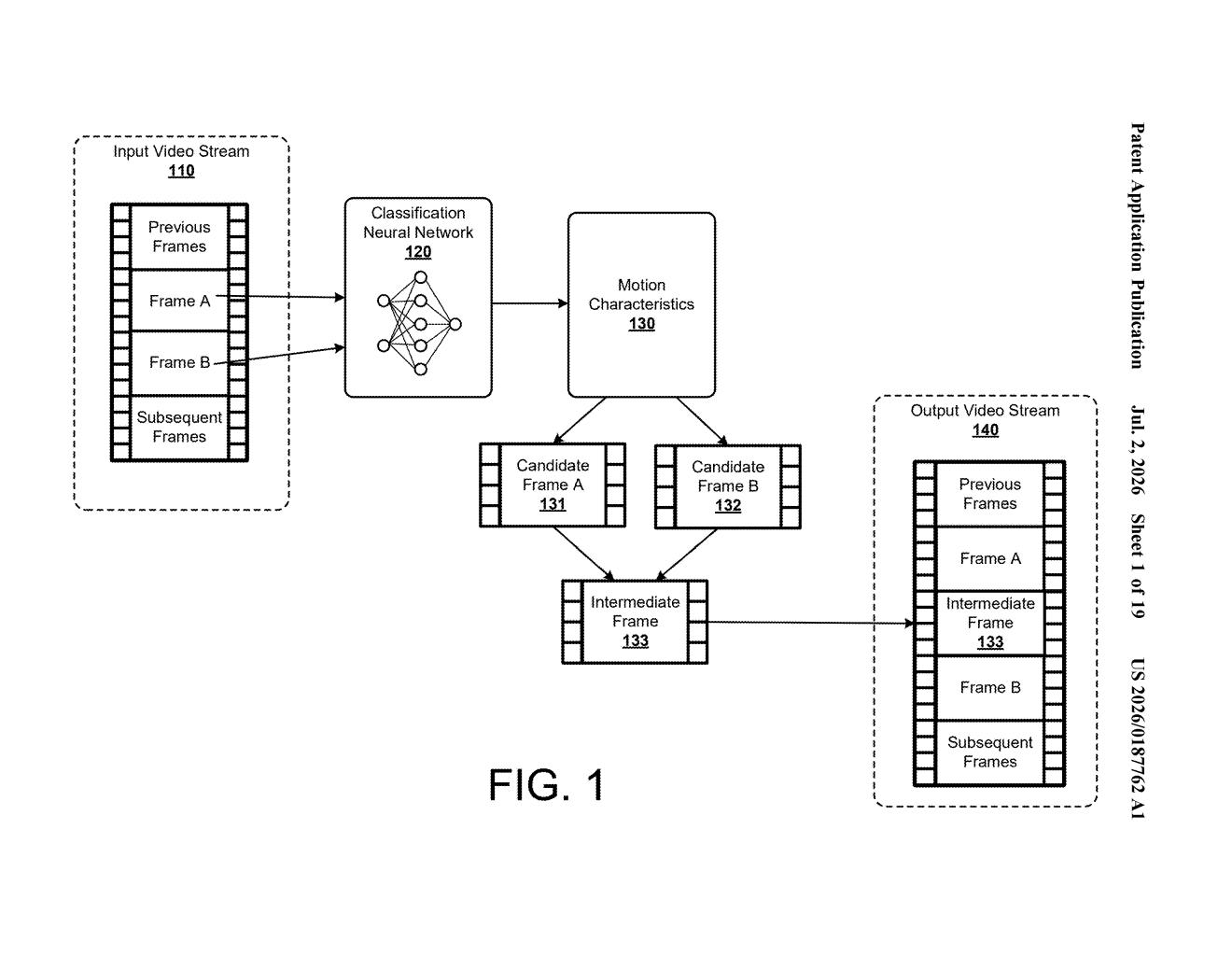
Imagine watching a fast-moving sports play on your TV, and instead of smooth motion you see a slight blur or stutter between movements. That usually happens because the original video didn't capture enough frames per second to make every moment look fluid. Nvidia's patent describes an AI system that watches two real frames and generates a plausible in-between frame to fill the gap.
The system first studies each pixel in both frames to figure out which ones are actually moving and which are standing still. It then builds two draft versions of the missing frame by shifting pixels forward and backward in time. A second AI network compares those two drafts, figures out where they disagree, and blends them into one final frame that looks natural.
The whole process is designed to run fast enough for live video, not just pre-recorded content. That's the harder problem, and it's why Nvidia is leaning on neural networks instead of older math-only approaches.
How two neural networks split the frame-blending job
The patent describes a two-stage neural network pipeline for real-time video frame interpolation (generating artificial frames between real ones to raise the apparent frame rate).
Stage one: motion classification. A first neural network analyzes a pair of consecutive frames and produces confidence scores for each pixel's motion data. Essentially, it asks: "Is the motion vector (the direction and speed estimate for this pixel) trustworthy, or is this pixel effectively standing still?" Pixels where motion is ambiguous get flagged as static so they aren't warped incorrectly.
Stage two: candidate frame generation. Using those motion characteristics, the system generates two candidate frames:
- A forward candidate: pixels from frame one are shifted in the direction of motion to approximate where they'll be.
- A backward candidate: pixels from frame two are shifted in reverse to approximate where they came from.
Stage three: refinement and blending. A second neural network takes both candidates, predicts intermediate optical flows (fine-grained motion paths between the two drafts), and generates per-pixel blending weights. Those weights determine how much of each candidate contributes to the final output frame, correcting alignment errors neither candidate got right on its own.
The entire chain is built for real-time throughput, meaning it has to complete before the next frame is due on screen.
What this means for gaming and streaming video quality
Frame interpolation isn't new, but doing it reliably at real-time speeds with a two-network architecture is a harder engineering target than post-processing recorded video. If Nvidia can ship this in drivers or dedicated hardware, it would mean smoother motion in games and streaming without requiring content creators to shoot at higher frame rates. That's a meaningful practical benefit, especially for lower-end displays that can't always get native high frame rates from the GPU.
Nvidia already ships a consumer feature called DLSS Frame Generation, which uses AI to insert frames in games. This patent could represent the next iteration of that technology, extending it toward live video streams beyond gaming contexts, such as sports broadcasts, video calls, or cloud-streamed media.
This is incremental but real work on a problem Nvidia is already commercially invested in. The two-network split (one for motion classification, one for blending refinement) is a sensible architectural choice that addresses a known weakness in single-pass interpolation: it fails badly on pixels where motion data is unreliable. Whether this specific approach ships in DLSS or a future product line, it's a genuine signal that Nvidia is refining its frame-generation pipeline beyond the first-generation implementation.
Get our take in your Top Stories
Liked this breakdown? Add Patentlyze as a preferred source on Google, and our plain-English take shows up more often in your Top Stories the next time Nvidia patent news breaks.
There are more where this came from
We read every patent application Big Tech publishes and send you the ones worth knowing. Plain English, free, every week.
Want this weekly breakdown for a company we don't cover? Patentlyze Pro →