
Google Patent Reveals Cell Towers Teaming Up to Share Radar Network Duties
Cell towers already blanket cities to carry calls and data. Google is now filing patents to make those same towers work together as a coordinated radar system, turning everyday wireless infrastructure into a sensing grid.
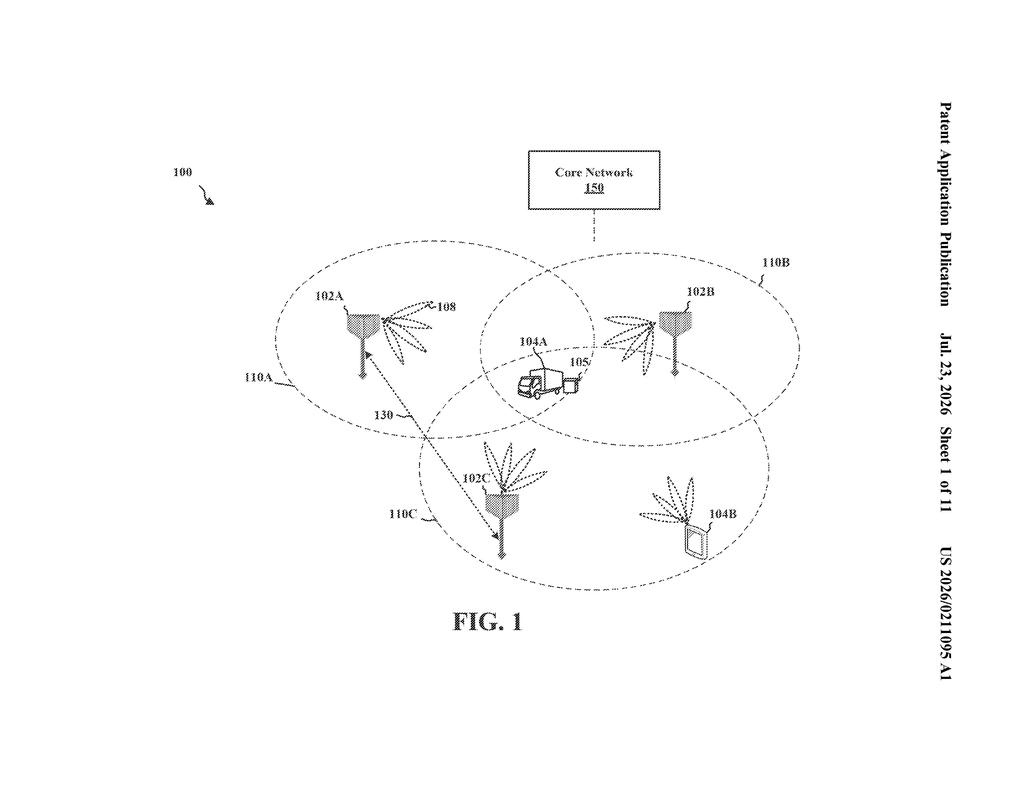
What Google's multi-tower radar coordination actually does
Imagine a neighborhood where several traffic cameras can each only see a narrow slice of the street. Now imagine those cameras could talk to each other and stitch their views together into one wide picture. That's roughly what this patent is proposing, but for radar signals and cell towers.
Right now, each cell tower operates independently. Google's idea is to let towers check in with each other before jointly processing radar signals. One tower asks its neighbors, "What radar sensing capabilities do you have?" The neighbors answer, and the leading tower then picks which ones to team up with, forming what the patent calls a radar coordination set.
The result is that instead of one tower trying to detect or track something on its own, a group of coordinated towers can share the job, covering more ground and getting more accurate readings, all using wireless infrastructure that's already installed.
How base stations negotiate radar roles over the Xn interface
The patent describes a multi-static radar setup (a radar system where the transmitter and receiver are in different locations, rather than the same box) built on top of existing 5G cell tower infrastructure. Instead of purpose-built radar hardware, the system repurposes base stations that are already in place.
The coordination process works in three steps:
- A leading base station sends a request over the Xn interface (the standard wireless link that neighboring 5G towers already use to talk to each other) asking nearby towers what radar capabilities they support.
- Each neighboring tower responds with its capability information, essentially a list of what radar-related tasks it can perform.
- The leading tower uses those responses to form a radar coordination set (RCS), a chosen group of towers that will work together on joint radar signal processing.
By using the Xn interface, the system doesn't require a new communication channel. It builds radar teaming on top of plumbing that 5G networks already have, which lowers the barrier to deployment considerably.
What this means for 5G sensing beyond your phone call
The telecommunications industry has been exploring integrated sensing and communication (ISAC), the idea that 5G networks can simultaneously carry data and sense the physical world around them. Applications range from traffic monitoring and crowd density measurement to detecting drones or supporting autonomous vehicles. Getting multiple towers to coordinate their radar processing is a foundational step toward making any of that work at real scale.
For you as an end user, this kind of technology wouldn't change how your phone connects to a network. But it could shape what cities and enterprises can do with 5G infrastructure they've already paid to install, turning passive antennas into an active sensing layer without adding new hardware to every block.
This is foundational plumbing work for 5G sensing, not a flashy consumer feature. But the decision to build radar coordination on top of the existing Xn interface, rather than a new protocol, is genuinely practical engineering. If ISAC ever becomes a mainstream part of 5G deployments, patents like this one will be load-bearing.
There are more where this came from
We read every patent application Big Tech publishes and send you the ones worth knowing. Plain English, free, every week.
The drawings
11 drawing sheets from US 2026/0211095 A1 · click any drawing to enlarge


Want this weekly breakdown for a company we don't cover? Patentlyze Pro →
Be the first to weigh in