
Adobe Patents an AI That Rewrites Your Vague Chatbot Questions Before Sending Them
You type a half-baked question into an AI assistant and get a useless answer. Adobe's new patent puts a filter between you and the chatbot that fixes the question before the chatbot ever sees it.
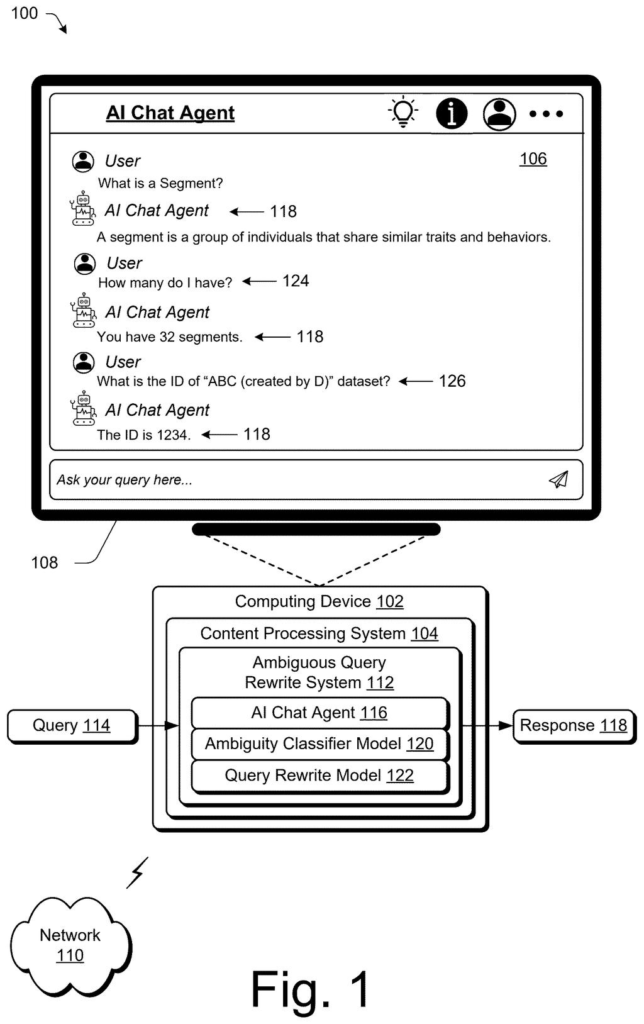
What Adobe's query-clarifying AI chat system actually does
Imagine asking an AI assistant at your bank, "What about my account?" That question could mean a dozen things, and a chatbot that takes it literally will either guess wrong or ask you to start over.
Adobe's patent describes a two-step system built in front of an AI chat agent. First, a lightweight detector reads your question and decides whether it's clear enough. If it is, your question goes straight to the chatbot unchanged. If it's too vague, a second AI rewrites the question to be more specific before passing it along.
The key idea is that these are two separate AI models doing two separate jobs. The detector is fast and runs locally on your device. The rewriter only gets called when it's actually needed, which saves time and computing resources. You'd likely never notice this is happening, but your chatbot answers would get noticeably better.
How the ambiguity classifier and rewrite model split the work
The patent describes a pipeline with two distinct machine learning components that sit between a user and an AI chat agent.
Step one: the ambiguity classifier. This is a smaller, faster model that runs directly on the user's device (called "on the processing device" in the patent). It reads the incoming query and outputs a simple judgment: ambiguous or not. If not, the query skips ahead to the chatbot without any further processing.
Step two: the query rewrite model. If the classifier flags the query as ambiguous, the system calls an API endpoint (a remote server that hosts a separate, more capable AI model) and asks it to produce a clearer version of the query. That rewritten version is what the chatbot actually receives.
The patent stresses that the classifier and the rewrite model are different models, not the same one doing double duty. The split is deliberate:
- The classifier stays lightweight and local, so it doesn't add much delay.
- The rewriter can be a larger, more capable model hosted remotely, invoked only when needed.
- The chatbot downstream doesn't need any changes, since it just receives a cleaner prompt.
This kind of conditional routing (run the expensive step only when necessary) is a common efficiency pattern in production AI systems.
What this means for AI assistants inside Adobe's apps
For anyone who uses AI assistants inside tools like Adobe Acrobat or the company's Creative Cloud apps, this patent hints at a concrete fix for one of the most common frustrations with chatbots: garbage in, garbage out. If the system behind the scenes can catch a poorly worded question and clean it up automatically, the chatbot looks more capable even if the underlying model hasn't changed at all.
From a product strategy angle, this also makes AI assistants more accessible to users who aren't fluent in "prompt engineering" (the practice of carefully wording questions to get better AI responses). If you work in marketing, design, or document editing and just want a quick answer, you shouldn't need to learn a new skill to talk to a chatbot.
This is a practical, unsexy engineering patent that solves a real problem in a sensible way. Adobe isn't trying to build a smarter chatbot here; it's building a smarter front door. The two-model split with a fast local classifier and a remote rewriter shows genuine attention to production cost and latency, which suggests this was designed to actually ship, not just to hold a filing date.
There are more where this came from
We read every patent application Big Tech publishes and send you the ones worth knowing. Plain English, free, every week.
The drawings
9 drawing sheets from US 2026/0220130 A1 · click any drawing to enlarge


Want this weekly breakdown for a company we don't cover? Patentlyze Pro →
Be the first to weigh in