
Adobe Patents AI Fill That Compares Colors Twice to Reduce Patchy Results
When an AI fills in a missing chunk of a photo, getting the colors right is surprisingly hard. Adobe has filed a patent for a training trick that checks AI-generated fill against the original image twice, in two different color systems, to catch errors that a single check would miss.
How Adobe teaches its AI to fill gaps in photos more accurately
Every time an AI photo editor fills in a missing or deleted part of an image, it has to guess what belongs there, including shapes, textures, and especially colors. If the AI's training doesn't penalize subtle color errors hard enough, the filled area can look slightly off even when the shapes are fine.
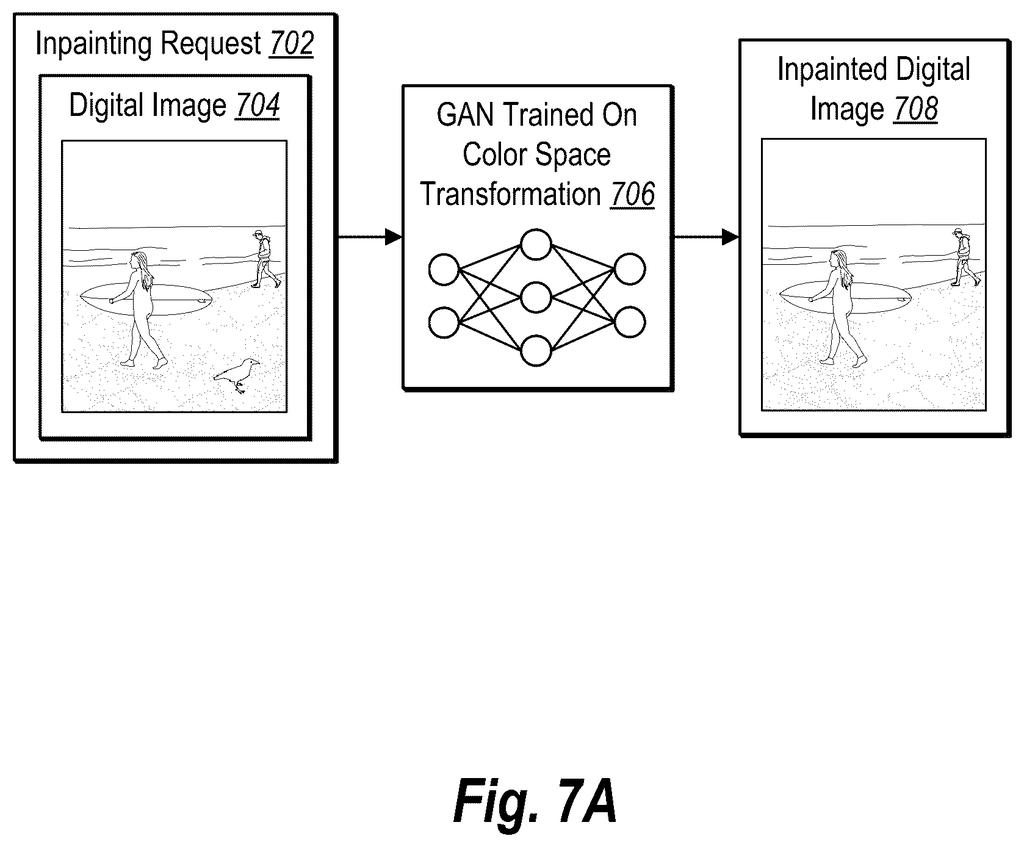
Adobe's patent describes a way to make that training stricter. Instead of grading the AI's work once, the system grades it twice: once in the standard way photos are normally measured, and once after converting both the AI's version and the correct version into a different color space (a different mathematical way of describing color). That second check catches tonal and hue errors that the first pass can miss.
The result is an AI model that, after training, is more sensitive to color accuracy when it fills in parts of a photo. For you as a user, that could mean fewer times when a photo edit looks almost right but has a weird tint or an oddly flat tone in the filled region.
… generating a first measure of loss based on comparing the modified digital image with a ground truth version of the digital image with the region complete; generating a transformed modified digital image and a transformed ground truth image of the digital image by performing a color space transformation …
Translation: The system checks how well the AI filled a gap by comparing the result to the original image in two different color modes.
How the two-loss color comparison guides the generative model
The patent describes a training pipeline for a generative model (an AI system that can create or complete image content) specifically focused on inpainting, which means filling in a missing or masked region of a photo so it blends with the rest.
During training, the model generates a filled version of a photo. The system then measures how wrong that fill is using two separate calculations:
- First loss: a standard pixel-by-pixel comparison between the AI's filled image and the correct (ground truth) image, measured in the usual RGB color system.
- Second loss: both images are converted into a different color space (such as Lab or HSV, which separate brightness from color information in a way RGB doesn't), and the comparison is repeated there. This second color space makes certain hue and luminance errors more visible mathematically.
Both loss values are then combined and used to update the model's parameters (the millions of internal numbers that control how the AI behaves). By penalizing color errors from two angles at once, the training signal is more sensitive to the kinds of color mistakes that a single measurement would underweight.
The approach is purely a training-time change: the deployed model runs normally; only the process used to teach it is different.
From the first measure of loss and the second measure of loss, the disclosed systems modify parameters of a generative model.
Translation: The software uses these two separate color comparisons to automatically adjust and improve how the AI generates images.
What this means for AI photo editing tools like Firefly
For anyone who uses AI-powered photo editing, color accuracy in filled or removed regions is one of the most common reasons an edit looks fake. A sky that's been extended, an object that's been erased, or a background that's been swapped can all fall apart at the color level even when the geometry looks plausible. Adobe's approach targets exactly that failure mode by making the training process more sensitive to color errors without requiring new hardware or a fundamentally different model architecture.
This is a software-only improvement to a training recipe, which means the path from patent to shipped feature is relatively short if the results hold up in testing. Adobe already ships generative fill in Firefly and Photoshop, so the infrastructure to deploy a better-trained inpainting model is already in place. Adobe's color-accuracy work sits alongside a broader wave of new Big Tech patents in generative image training, where companies are competing on training methodology as much as on model size.
The ship-path here is about as clear as it gets for an AI training patent: no new hardware, no new model architecture, just a changed loss function that plugs into an existing pipeline Adobe already runs for Firefly and Photoshop. The practical barrier is validation, proving the dual-loss approach consistently improves real editing tasks rather than just benchmark scores. If internal testing confirms the quality gains, this could move into production quickly, making it one of the more deployment-ready filings Adobe has made in the generative image space.
There are more where this came from
We read every patent application Big Tech publishes and send you the ones worth knowing. Plain English, free, every week.
The drawings
14 drawing sheets from US 2026/0237025 A1 · click any drawing to enlarge


Want this weekly breakdown for a company we don't cover? Patentlyze Pro →
Be the first to weigh in