
Google Patents an AI System That Adjusts Chip Power Based on What You're Doing
Every chip inside your phone is constantly doing more work than it needs to, because it can't tell the difference between a quick email check and a graphics-heavy game. Google's new patent describes an AI layer that watches what the chip is actually doing and dials power up or down accordingly.
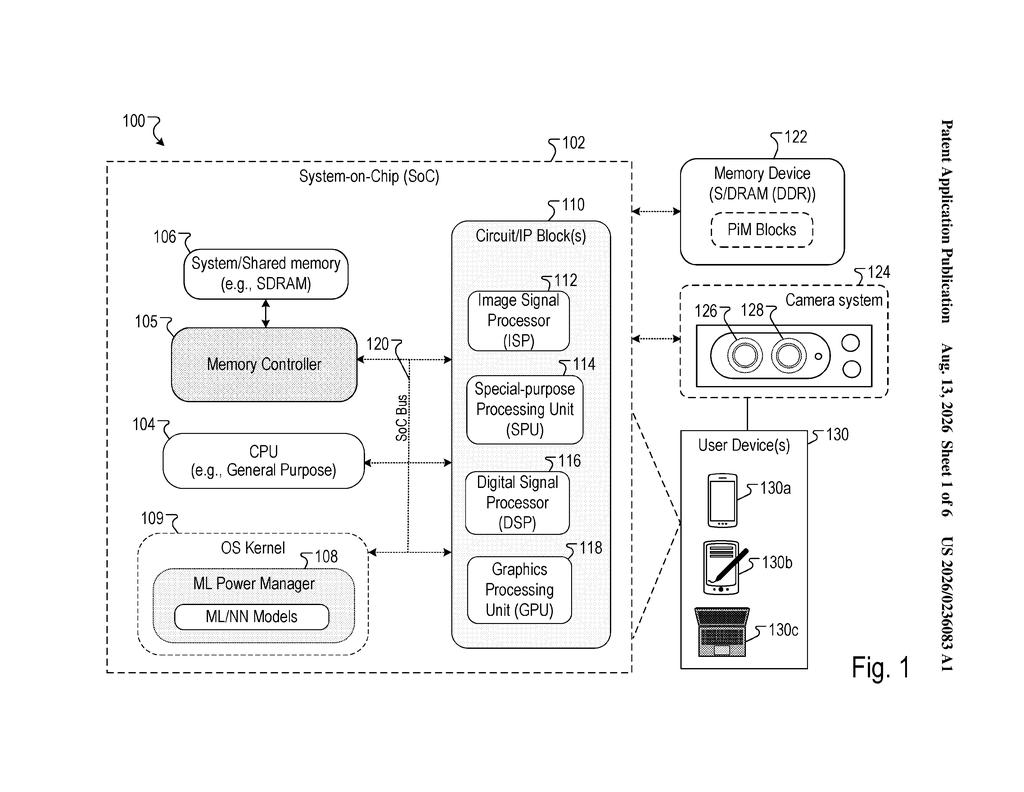
How Google's AI power manager reads your chip's workload
Every time you tap your phone awake, a handful of chips start running at a fixed gear even if all you need is to glance at a notification. They don't inherently know whether you're about to play a demanding 3D game or just scroll through a grocery list, so they tend to over-prepare and burn more battery than necessary.
Google's patent describes a power manager that uses a small AI model to watch built-in chip counters, the tiny scorekeepers that track how hard each part of the processor is working, and then classify what kind of task is actually running. Once it labels the task, it looks up a matching "power hint" in a table and adjusts the processor's speed and energy settings to fit.
The result, in theory, is a chip that wastes less power on light tasks and still has headroom for heavy ones. You'd feel this as longer battery life without any slowdown during the moments that actually need speed.
… determining, by an ML classifier model of the power manager, a workload type in response to processing the plurality of inputs based on a clustering algorithm applied to the plurality of inputs by the ML classifier model …
Translation: The system uses machine learning to categorize exactly what kind of task your device is currently performing.
How the ML classifier maps workloads to power settings
The system centers on a power manager that sits alongside the processor inside a system-on-chip (SoC), the single integrated circuit that houses the CPU, GPU, and memory controller in modern phones and tablets.
Here's the sequence:
- Hardware performance counters (built-in meters that track cache misses, memory bandwidth, instruction throughput, and similar metrics) feed a stream of numbers to the power manager.
- An ML classifier model applies a clustering algorithm (a technique that groups similar data points together, like sorting emails by topic) to identify which of several predefined workload types the chip is currently handling, such as video decode, browsing, or gaming.
- The identified workload type is used to look up a power hint in a mapping table, a pre-built chart that links each workload category to a recommended power-and-performance profile.
- Those profile settings, covering things like clock frequency and power caps, are then applied to a specific processor block within the SoC.
The patent emphasizes "fine-grained" control, meaning the system can adjust individual processor blocks independently rather than scaling the whole chip up or down as a unit. One or more neural network models are listed as part of the power manager's design, suggesting the classifier can be more expressive than a simple lookup table alone.
A power hint is identified based on the workload type and using a data structure that maps workload types to power hints. For the determined workload type, power and performance policy settings are determined for a processor block of the system-on-chip based on the identified power hint.
Translation: Once the task is identified, the system looks up a power setting to adjust how much energy the processor uses.
What this means for Android battery life and Tensor chips
Battery life is one of the most complained-about aspects of modern phones, and much of the waste happens not during intensive tasks but during the hundreds of in-between moments when chips run hotter than they need to. A workload-aware power manager that reacts in real time, rather than relying on static profiles set by engineers before shipping, could meaningfully close that gap without sacrificing the speed users notice.
For Google, this is directly relevant to its in-house Tensor chips inside Pixel phones, where tight integration between hardware and software is the main selling point. The approach also fits neatly into Android's broader power management framework. Power-efficiency patents like this one are among the newest Big Tech patents in the chip-software integration space, where Google, Apple, and Qualcomm are all competing to squeeze more from the same silicon.
The design bets heavily on the classifier being fast and accurate enough to keep up with workload transitions that can happen in milliseconds. If the model lags or mislabels a burst of activity, the chip could find itself under-clocked exactly when the user taps into something demanding, which is the worst possible outcome for the experience this patent is trying to improve. The tradeoff of adding an ML inference step to the critical path of power management is real, and the patent doesn't describe how the system recovers from misclassification. That said, the underlying architecture, offloading judgment to a trained model rather than hard-coded thresholds, is a logical evolution for chips where workloads have grown too varied for static rules to handle well.
There are more where this came from
We read every patent application Big Tech publishes and send you the ones worth knowing. Plain English, free, every week.
The drawings
6 drawing sheets from US 2026/0236083 A1 · click any drawing to enlarge


Want this weekly breakdown for a company we don't cover? Patentlyze Pro →
Be the first to weigh in