
Qualcomm Patents a Way to Find Nearby Devices Using a Phone's Own Microphones
Your phone's microphones might do a lot more than record your voice. Qualcomm has filed a patent describing a way to use the tiny timing differences in how sound hits each microphone to figure out exactly where another nearby device is sitting in 3D space.
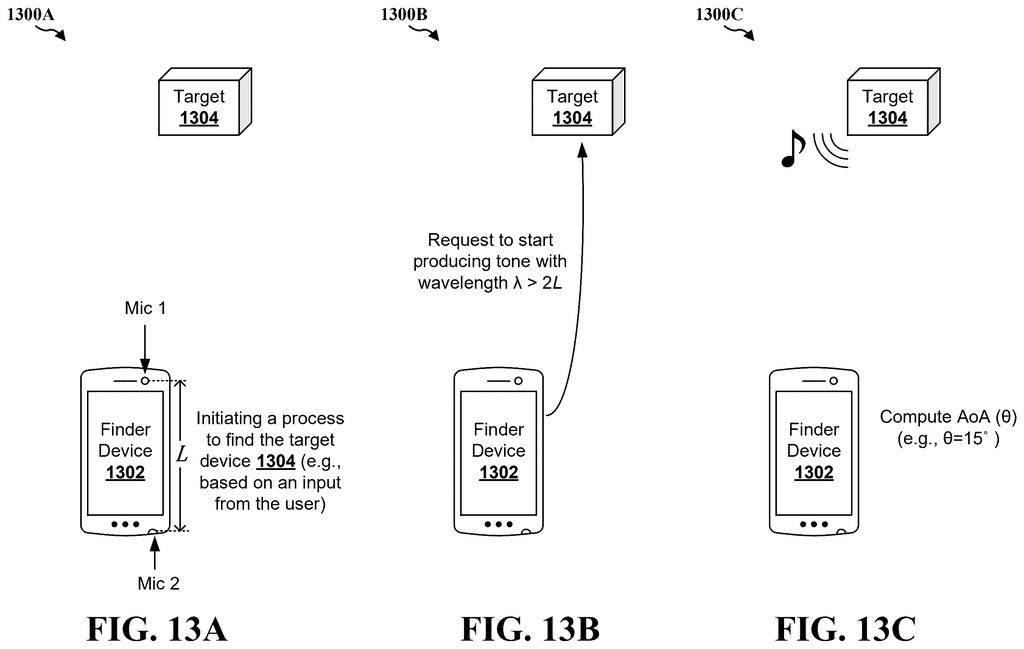
How Qualcomm's microphone-based location trick works
Ever tried to find a friend in a crowded venue by just listening for their voice? That's roughly the idea here, except your phone is doing the listening and doing the math.
Qualcomm's patent describes a system where one phone uses its built-in microphones to detect sound coming from a second phone. Because the microphones are spaced apart, sound from a nearby source arrives at each one at a very slightly different moment. By measuring those tiny timing gaps, and by moving the first phone around a little to take readings from different angles, the device can calculate where in 3D space the second device is sitting, no GPS, no Wi-Fi triangulation required.
The key insight is that you don't need a single perfect measurement. The phone collects data from multiple positions as it moves, then combines all of it to get a reliable location estimate. It's a bit like how you instinctively tilt your head when you're trying to pinpoint where a sound is coming from.
measure, from a plurality of poses of the first UE, at least one of a set of phase delays or a set of time delays of sound from a second UE using at least two microphones of the first UE; and estimate a relative location of the second UE …
Translation: The phone tracks how sound hits its microphones while you move it to calculate exactly where another device is located.
How phase delays and device motion build a 3D position fix
The system relies on a property of sound called phase delay (the fraction of a sound wave's cycle that arrives later at one microphone than another) and time delay (the raw difference in arrival time). Because microphones are physically separated on a device, a sound source off to one side will reach one microphone a hair earlier than the other. That gap encodes directional information.
The patent adds a second layer: the first device records these measurements across multiple poses (orientations and positions as the user moves or tilts the phone). Each pose provides a fresh geometric angle on the target. The system then combines all of those readings to triangulate the second device's location in three dimensions.
- Input: Sound emitted by a second phone, captured by at least two microphones on the first phone
- Sensor fusion: Phase or time delay measurements are combined with the first phone's orientation data (from its gyroscope or accelerometer) at each pose
- Output: An estimated 3D position of the second device relative to the first
The claim is device-agnostic: it covers any two UEs (user equipment, meaning any wireless device) and does not require GPS, ultrawideband (UWB) hardware, or a dedicated ranging radio.
… rely on measuring the time or phase difference between the sound captured by each microphone of the first user equipment (UE), and then using that information (in conjunction with the position/orientation of the first UE relative to a reference frame) to determine the direction in three dimensional (3D) space from which the sound is coming.
Translation: By comparing how sound reaches different microphones while you move your phone, the device can pinpoint where a sound starts.
What this means for phone-to-phone tracking without GPS
Most short-range tracking today leans on dedicated hardware, whether that's the UWB chips in Apple AirTags and newer iPhones, Bluetooth beacons, or Wi-Fi round-trip timing. Those approaches work well, but they require both devices to support the same radio technology. A microphone-based approach is different because every phone already has microphones, meaning the capability could theoretically run on existing hardware through a software update.
The practical ceiling here is noise sensitivity: sound-based ranging works best in quiet environments, and real-world audio clutter could degrade accuracy significantly. That tradeoff between hardware universality and environmental fragility is the honest question hanging over this filing. Still, for use cases like finding a friend's phone in a quiet room or enabling precise device-to-device handoffs, the approach has real appeal, and it fits neatly into the stream of new Big Tech patents aimed at short-range spatial sensing without specialized radio chips.
Qualcomm's 307th filing we've tracked since May builds on chip efficiency work seen in our Qualcomm coverage, including the shared memory processor patent and the low-power AI video filter.
Sound quality falls apart in noisy places. Yet noisy places, think packed stadiums or outdoor festivals, are exactly where this technology would matter most.
Qualcomm is betting that taking many quick measurements and averaging them out will fix the problem. That is a sensible guess, but no one has proven it works at real-world scale. Skipping the expensive location-tracking radio chip saves money on cheaper phones, so the idea is worth trying, even if it hits a hard ceiling in the worst conditions.
Get our take in your Top Stories
Liked this breakdown? Add Patentlyze as a preferred source on Google, and our plain-English take shows up more often in your Top Stories the next time Qualcomm patent news breaks.
There are more where this came from
We read every patent application Big Tech publishes and send you the ones worth knowing. Plain English, free, every week.
The drawings
22 drawing sheets from US 2026/0243863 A1 · click any drawing to enlarge


Want this weekly breakdown for a company we don't cover? Patentlyze Pro →
Be the first to weigh in