
Nvidia Patents Faster Software for Building the Hidden Geometry Behind 3D Characters
Every 3D object on screen is secretly a web of triangles, and figuring out how those triangles connect to each other is surprisingly slow work. Nvidia has filed a patent that offloads that bookkeeping to the GPU itself, running the whole analysis in parallel rather than one step at a time.
How Nvidia speeds up the geometry behind 3D graphics
Imagine you're playing a video game and a detailed character walks into view. Under the hood, that character is made of thousands of tiny triangles stitched together. Before the graphics card can do anything fancy with those triangles, it needs a map of how they all connect, which edges are shared, which corners meet, and which corners look the same but are actually treated differently by the engine.
Building that map is normally a slow, sequential process, the kind of job that forces everything else to wait in line. Nvidia's patent describes a way to build all of that connection data at once, spreading the work across the thousands of small processors inside a GPU so it finishes in a fraction of the time.
The practical effect for you is that games, animation software, and 3D design tools could spend less time preparing a scene and more time actually drawing it. That's especially relevant as scenes get more detailed and real-time graphics push into territory that once belonged only to Hollywood rendering farms.
… generating, for at least one vertex represented in the second index buffer, a list of geometric primitives that are adjacent to the at least one vertex; generating an edge buffer, wherein at least one edge represented in the edge buffer corresponds to a unique edge of the mesh …
Translation: The software maps out which shapes touch each point and catalogs every single edge in the mesh.
How two index buffers split position from surface detail
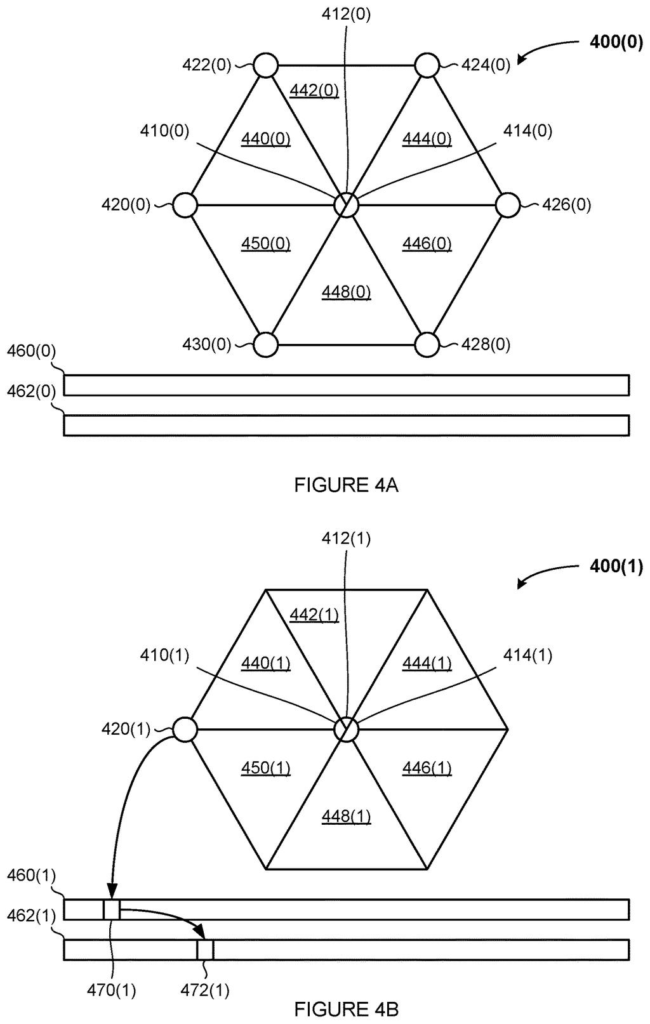
The patent describes a system for generating what engineers call topological data for a 3D mesh. Topology here just means the relationship map: which triangles share an edge, which vertices (corner points) are truly identical, and which ones only look the same but carry different surface information like a different color or texture direction.
The key insight is that a vertex can exist in two meaningful senses:
- By position only: two corners that sit at exactly the same point in 3D space, regardless of how the surface looks at that point.
- By position plus attributes: the same point, but treated as distinct because it has a different color, normal vector (the direction the surface faces), or texture coordinate.
The method creates two separate index buffers (lookup tables) to track both kinds simultaneously. One buffer maps every unique combination of position and surface attributes. The other maps unique positions alone. Using both together, the system can build an edge buffer listing every unique edge in the mesh, and per-vertex lists of every triangle touching that vertex.
All of this is designed to run on a GPU (graphics processing unit), which can handle thousands of small calculations at exactly the same time rather than working through them one by one. That parallelism is what makes the approach meaningfully faster than doing the same analysis on a CPU.
… identify vertices in the mesh that have the same position and have identical attributes, such as color, normal vector, and texture coordinates. The disclosed techniques further identify vertices in the mesh that have the same position but differ in one or more attributes.
Translation: The system sorts mesh points by whether they share the exact same visual traits or just occupy the same physical spot.
What this means for real-time 3D rendering pipelines
For anyone building real-time 3D software, mesh topology analysis is one of those tasks that eats into your frame budget every time a new object loads or deforms. Faster topology generation means engines can handle more complex geometry, swap assets in during gameplay without a visible hitch, and run physics or deformation effects that depend on knowing which triangles are neighbors.
Nvidia's GPU hardware business depends in part on making GPUs useful for an ever-wider set of graphics workloads, and this filing fits that pattern. The GPU does more of the prep work, keeping the CPU free and making the overall pipeline leaner. GPU-focused graphics patents like this one sit alongside a wide range of interesting tech patents that trace how chip companies are gradually pulling more of the 3D pipeline onto programmable silicon.
Nvidia's 25th filing we've tracked in our GPU rendering race watchlist since July builds on earlier work like a two-processor freeze fix and text search on graphics chips.
Every time a video game draws a new frame on your screen, it first has to sort through a massive pile of 3D shape data, and as games get more complex that sorting job slows everything down. The core problem is that two different kinds of information about a 3D shape get tangled together, forcing the computer to work through them one step at a time instead of doing many things at once.
Nvidia's solution splits that tangled data into two clean, separate buckets. That one change lets the hardware do far more work in parallel, and the size of the improvement matches the size of the problem it solves.
There are more where this came from
We read every patent application Big Tech publishes and send you the ones worth knowing. Plain English, free, every week.
The drawings
15 drawing sheets from US 2026/0245309 A1 · click any drawing to enlarge


Want this weekly breakdown for a company we don't cover? Patentlyze Pro →
Be the first to weigh in