
Qualcomm Patents a Sound-Wave System for Locating Tracked Objects
Your phone already uses radio signals to search for lost items, but Qualcomm thinks sound waves could do the job with greater precision, and this patent lays out exactly how that would work.
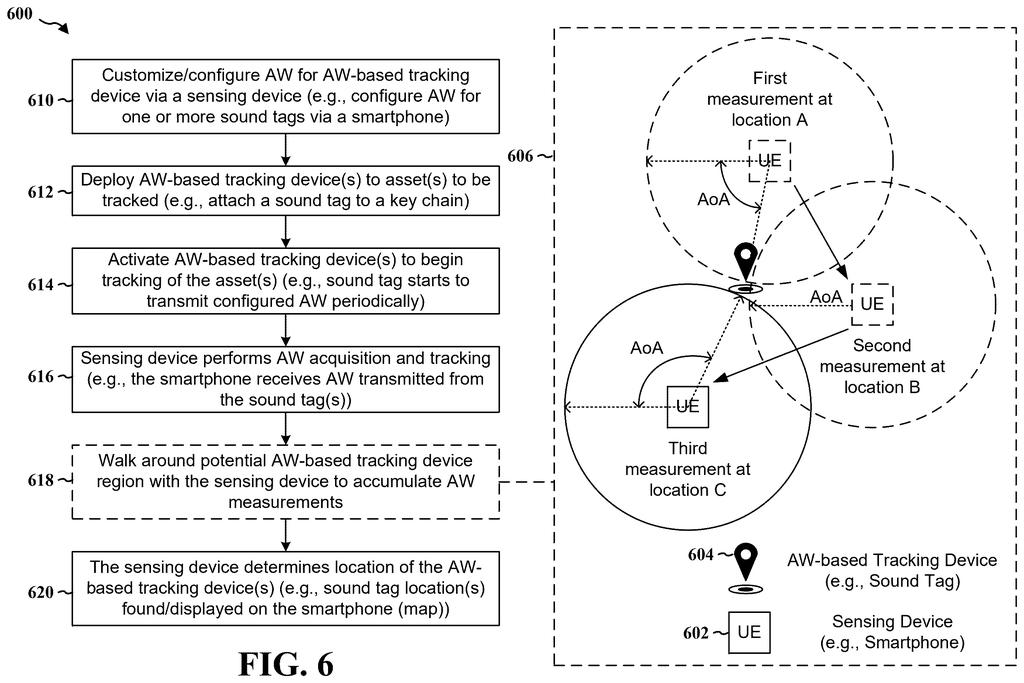
How Qualcomm's acoustic tracking tags find lost items
Imagine you clip a small tracking tag to your keys, toss them in a drawer, and later ask your phone where they are. Instead of the tag sending out a radio pulse like today's Bluetooth trackers do, it emits a burst of acoustic waves (think of them as carefully shaped sound signals, inaudible to you, but detectable by hardware).
Your phone wakes the tag up, listens for those acoustic waves, takes a series of measurements from what it hears, and uses the results to calculate where the tag is sitting. The whole handshake, wake, emit, measure, locate, is described in Qualcomm's patent as a tightly sequenced process that completes before any other sensing tasks run.
The idea is that acoustic waves behave differently from radio frequencies in close-range, cluttered environments like a messy bag or a room full of furniture. Qualcomm is betting those physical properties can translate into a more accurate position fix than radio alone.
receive an indication of an activation of at least one tracking device, wherein the at least one tracking device is associated with a plurality of acoustic waves (AWs); perform a set of measurements associated with the plurality of AWs …
Translation: The device detects when a tracker is turned on and uses sound waves emitted by that tracker to gather data.
How the phone measures acoustic waves to pin a location
The patent describes a wireless device (a phone or similar gadget) that orchestrates a short back-and-forth with a small tracking tag. Here is the sequence the patent outlines:
- Activation: The wireless device sends a signal that wakes the tracking tag. The tag confirms it is live by sending back an activation indication.
- Wave emission: The tag then broadcasts a plurality of acoustic waves (AWs), multiple distinct sound-based signals, not a single ping. Sending several waves rather than one gives the receiving device more data points to work with.
- Measurement set: The wireless device receives all those waves before running its calculations. The patent specifies the measurements must be gathered first, which prevents partial data from skewing the result.
- Location computation: The device processes the measurements (things like signal travel time or phase differences between waves) to derive the tag's position.
The patent does not lock this to a single sensing method. The phrase "set of measurements" is deliberately broad, covering time-of-flight (how long the wave takes to arrive), angle-of-arrival (which direction it came from), and potentially other acoustic analysis techniques. That flexibility is the core of what Qualcomm is protecting here.
Aspects presented herein provide improved sensing and tracking devices that may be used for locating and tracking objects and/or for performing environmental sensing based on AW.
Translation: This technology uses sound waves to help people find lost items and monitor the area around them.
What this means for item trackers and chip competition
Today's consumer item trackers, think Apple AirTags or Tile, rely on Bluetooth radio and, in some cases, ultra-wideband (UWB) radio for precision finding. Acoustic-wave sensing adds a different physical layer. Sound travels at a known, predictable speed, and its behavior around dense objects differs from radio, which means it could reduce the "it says it's right here but I can't find it" frustration that plagues current trackers in cluttered spaces.
For Qualcomm specifically, this fits a broader push to embed more sensing capability into the chips it sells to phone makers. The company already supplies Wi-Fi, Bluetooth, and UWB silicon; acoustic tracking would be another feature to bundle in. Readers who follow wireless-chip patent activity will find this patent alongside other sensing and positioning filings covered in plain-English patent summaries that track how chipmakers are expanding beyond pure connectivity.
Qualcomm's 315th filing among the patents we've tracked since May includes an AI cell-tower location system and spotting objects near moving vehicles as earlier entries in our Qualcomm coverage.
Sound moves slowly and gets soaked up by soft things like fabric, foam, or a coat stuffed in a bag. Qualcomm's patent explains the measurement steps carefully but never addresses that problem, which is the exact place where sound-based tracking has always fallen apart indoors.
The design probably works fine when nothing is in the way. Whether it still works buried inside a pocket or bag, where people actually lose things, is the question this filing does not answer.
Get our take in your Top Stories
Liked this breakdown? Add Patentlyze as a preferred source on Google, and our plain-English take shows up more often in your Top Stories the next time Qualcomm patent news breaks.
There are more where this came from
We read every patent application Big Tech publishes and send you the ones worth knowing. Plain English, free, every week.
The drawings
15 drawing sheets from US 2026/0247325 A1 · click any drawing to enlarge


Want this weekly breakdown for a company we don't cover? Patentlyze Pro →
Be the first to weigh in