
Qualcomm
Qualcomm · Networking · Filed Aug 31, 2025 · USPTO published Aug 20, 2026 · Aug 20 release
Qualcomm Patents an AI Location System That Picks Its Own Model Based on Visible Cell Towers
Your phone's location accuracy often falls apart the moment you're inside a building or surrounded by skyscrapers. Qualcomm's new patent tries to fix that by giving each phone a custom AI model matched exactly to the towers and beacons it can see.
- Publication number
- US 2026/0247341 A1(US20260247341A1)
- Applicant
- QUALCOMM Incorporated
- Filed · Published
- Aug 31, 2025 · Aug 20, 2026
- Inventors
- Varun Amar REDDY, Jay Kumar SUNDARARAJAN, Alexandros MANOLAKOS
- Status when we published
- Waiting for an examiner
- Document
- 40 claims
- US classification
- 455/456.1
- Parent application
- National Stage Entry of PCT/US2024/014137 (filed Feb 2, 2024)(PCTUS2024014137)
How Qualcomm's anchor-matched AI location system works
Imagine you're trying to navigate a large shopping mall, but your phone has no GPS signal and can only pick up three or four nearby wireless beacons. Standard location systems treat every scenario roughly the same, which is why they sometimes place you in the wrong store or on the wrong floor.
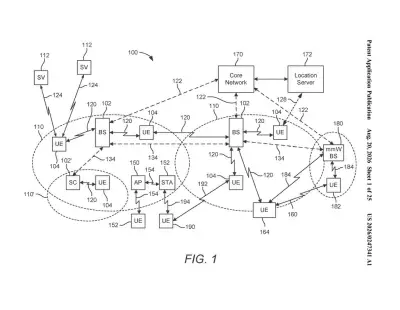
Qualcomm's patent describes a different approach: your device first sends a list of all the wireless anchor points (think cell towers, Wi-Fi access points, or 5G base stations) it can currently detect. The network looks at that specific combination and sends back an AI model trained for exactly that mix of anchors. Your phone then uses that tailored model to work out where you are.
The idea is that a model tuned for the particular set of signals you can see should be far more accurate than a one-size-fits-all approach. Whether it delivers on that promise in a real building full of interference is the open question.
… obtaining assistance information from the network entity, the assistance information indicating a machine learning model corresponding to the set of anchor devices; and engaging in a positioning procedure that is based on the machine learning model …
Translation: The phone asks the network which AI model to use based on the specific cell towers it can currently see.
How the network selects and delivers the right ML model
The patent describes a three-step loop between a user device (your phone or tablet) and a network entity (a server or base station that manages positioning).
- Step 1, Report what you can see: The device transmits "observable anchor information" listing every anchor device it can detect. Anchor devices are fixed wireless reference points: 5G base stations, Wi-Fi routers, Bluetooth beacons, or similar infrastructure.
- Step 2, Receive a custom model: The network entity looks up or constructs a machine learning model that corresponds specifically to that combination of anchors. It sends that model back as "assistance information." The patent's core insight is that different anchor combinations need different models, because the geometry and signal characteristics of three specific towers are not the same as any other three towers.
- Step 3, Run the positioning procedure: The device uses the received ML model, together with measurements from at least some of those anchor devices (signal timing, strength, or angle data), to compute an estimated location.
The ML model essentially replaces or supplements traditional geometric formulas (like triangulation) with a learned function that can account for reflections, obstructions, and other real-world messiness that simple math struggles with. The network side would need to maintain a large library of pre-trained models, one per plausible anchor combination, which is where the engineering complexity lives.
… a user device may transmit observable anchor information to a network entity, the observable anchor information indicating a set of anchor devices observable by the user device.
Translation: Your device sends a list of all the nearby cell towers it detects to the network provider.
What this means for indoor and urban phone positioning
For everyday users, better indoor and urban positioning means more reliable turn-by-turn navigation in malls, airports, and dense city blocks where GPS struggles. It also matters for emergency services, asset tracking in warehouses, and any app that needs to know which room you're in rather than just which building.
For Qualcomm specifically, positioning technology is tightly linked to its modem chips, which power a large share of the world's Android phones. A differentiated approach to location accuracy could become a selling point in chipset negotiations with phone makers. Coverage of wireless and chip-level positioning patents is part of the latest Big Tech patents Patentlyze tracks across the 5G and AI-on-device space.
Qualcomm's 314th filing we've tracked since May in our Qualcomm coverage joins earlier work on spotting objects near vehicles and fixing out-of-sync earbud video.
Source: US 2026/0247341 A1 at the USPTO (PDF). Full patent text and figures are in the official publication.
Get our take in your Top Stories
Liked this breakdown? Add Patentlyze as a preferred source on Google, and our plain-English take shows up more often in your Top Stories the next time Qualcomm patent news breaks.
Add Patentlyze on Google
One click.
There are more where this came from
We read the new patents from Big Tech, carmakers and more and send you the ones worth knowing. Plain English, free, every week.
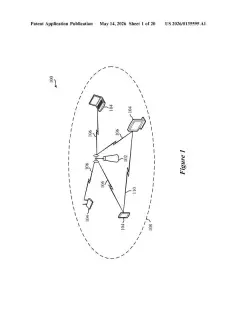
The drawings · 25 sheets
25 drawing sheets from US 2026/0247341 A1 · click any drawing to enlarge


Show the other 17 sheets


More from Qualcomm
All 637 Qualcomm patents →
More in Networking
All 516 Networking patents →
Samsung
Samsung Patents a Network Device That Picks Its Own Least-Busy Path
Samsung
Samsung Patents a System That Figures Out Where You Live by Watching Your Phone Linger
Google
Google's New Patent Stops Your Phone From Waiting on Its Own SIM Card
IBM