
Google Patents an AI System That Turns Videos Into Searchable Text
Videos are notoriously hard for search engines to read because the content lives in audio and images, not text. Google's new patent describes a system that automatically breaks a video apart, figures out what kind of content each piece contains, then converts those pieces into text or images that a search engine can actually use.
How Google's video-to-text AI pipeline actually works
You're watching a cooking tutorial on YouTube and you want to jump straight to the part about how long to bake the dish. But the answer is buried somewhere in 20 minutes of spoken audio and on-screen graphics, and the search bar has no idea where to look.
Google's patent describes a system that tackles this by splitting a video into smaller chunks, running each chunk through an AI that figures out what type of content it is (spoken dialogue, an on-screen chart, a demonstration, and so on), then handing each chunk to a specialized AI trained to convert that specific type into readable text or a usable image. The result is a set of building blocks that a search system can actually index and retrieve.
When you type a question, the system finds which of those building blocks best matches what you asked, and assembles an answer from them. In short, it's a way to make video content behave more like a web page that search can crawl.
… determining, by the computing system, based on inputting the content data into one or more machine-learned classification models, one or more classes associated with the plurality of content segments …
Translation: AI categorizes different sections of a video.
Inside Google's segment classifier and reformat models
The patent describes a multi-stage pipeline with three main jobs.
Step 1: Segment and classify. The system takes a piece of audio-video content and cuts it into a series of smaller content segments. It then feeds those segments into one or more machine-learned classification models (AI models trained to label content by type). Each segment gets assigned to a class, which is essentially a category like "spoken narration," "on-screen text graphic," or "visual demonstration."
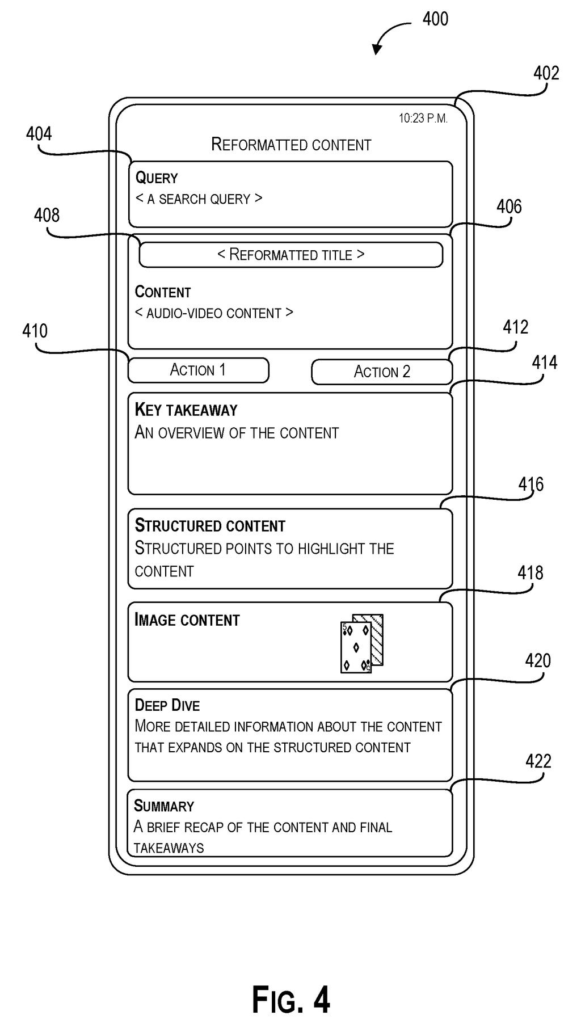
Step 2: Class-specific reformatting. Here's where the design gets precise. Rather than running every segment through a single, generic AI, each segment is handed to a class-based model built specifically for that category. A segment labeled as narration goes to a speech-to-text model; one labeled as a chart might go to an image-description model. The output is a set of reformatted content segments made of text or images that capture the key features of the original video chunk.
Step 3: Query matching and answer assembly. When a user submits a query (a search question), the system identifies which reformatted segments are most relevant and uses them to generate a final answer or result.
The architecture is essentially a routing system: classify first, then apply the right specialist tool, rather than forcing one model to handle everything.
… reformatted content data comprising reformatted content segments associated with text content or image content that is based on the features of the content segments can be generated.
Translation: The system turns video parts into searchable text or images.
What this means for video search and AI answers
Video is the internet's largest category of content and also its least searchable. Most search systems rely on video titles, descriptions, and captions that creators write by hand, which are often incomplete or missing entirely. A system that automatically converts video content into machine-readable form could dramatically expand what search and AI assistants can answer, especially for how-to content, news footage, and educational material where the real information is inside the video, not attached to it.
For you as a viewer, the payoff would be a search experience where asking a specific question about a video gets you a precise, sourced answer rather than a link to a 30-minute upload you have to scrub through yourself. Google's video AI push sits squarely alongside the latest Big Tech patents in AI-powered search and content understanding, a cluster of filings that collectively describe a future where search engines read media the way they currently read web pages.
Google's 608th filing we've tracked since May joins our Google coverage alongside a search ranking patent and Waymo's blind spot work.
The real payoff is simple: you no longer have to scrub through a long video just to find one quote or one chart. The system pulls that moment out for you as readable text or a still image.
It manages this more reliably because it sorts the job before starting. Speech gets handled by a tool built for speech. Images get handled by a tool built for images. That division means the result reflects what was actually in the video, not a vague guess at it.
Get our take in your Top Stories
Liked this breakdown? Add Patentlyze as a preferred source on Google, and our plain-English take shows up more often in your Top Stories the next time Google patent news breaks.
There are more where this came from
We read every patent application Big Tech publishes and send you the ones worth knowing. Plain English, free, every week.
The drawings
25 drawing sheets from US 2026/0246985 A1 · click any drawing to enlarge


Want this weekly breakdown for a company we don't cover? Patentlyze Pro →
Be the first to weigh in