
Samsung Patents a Chip Circuit That Randomly Scrambles Data Before Encrypting It
Samsung is patenting a way to scramble data inside a chip before encryption even begins, using a carefully sized network of switching circuits that guarantees every possible output is equally likely.
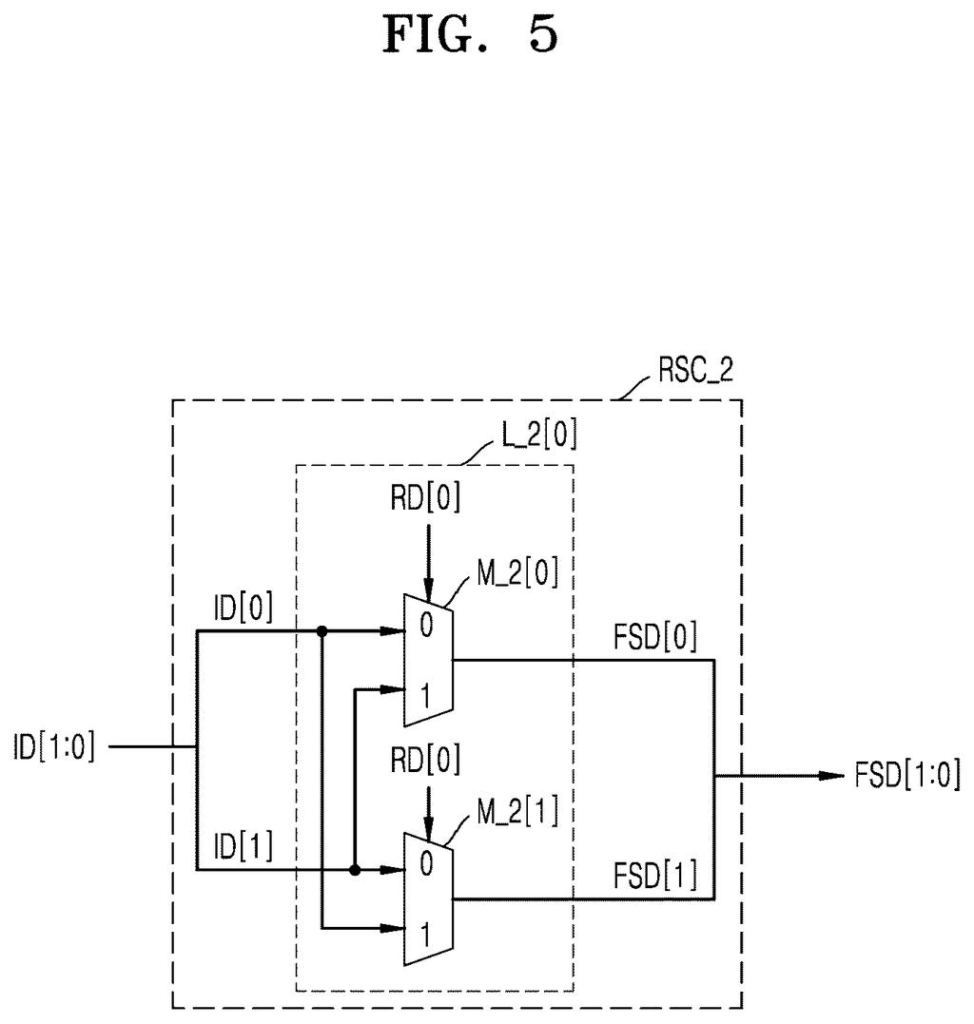
What Samsung's random data-shuffling chip actually does
Ever tried to hide something by putting it in a random spot? The problem is that "random" choices made by computers often aren't truly unpredictable, and attackers who study a chip's power usage or timing can sometimes reverse-engineer what the chip is doing. That's a real vulnerability in encryption hardware.
Samsung's patent describes a circuit that shuffles your data before the encryption step, the way a dealer shuffles a deck of cards before a hand is dealt. The key promise is a uniform distribution: every possible shuffled arrangement is equally likely, so an outside observer can't use statistics to guess what the original data looked like.
The shuffling is done by a network of tiny switches called multiplexers, organized in layers. The circuit is sized using a specific formula so it uses the minimum number of switches needed to hit that guarantee, keeping the chip small and power-efficient.
… a random shuffling circuit configured to receive N input bits and perform a random shuffling operation on the N input bits, based on a plurality of layers each comprising the random data and an even number of multiplexers, to output final shuffling data having a uniform distribution …
Translation: The device uses layers of electronic switches to mix up input data until it is spread out in a completely random pattern.
How the multiplexer layers produce a uniform shuffle
The patent describes an encryption device built around two main pieces: a controller that generates random bits, and a random shuffling circuit that uses those bits to reorder incoming data before it gets encrypted.
The shuffling circuit is organized into layers, and each layer contains an even number of multiplexers (think of a multiplexer as a tiny switch that picks between two inputs based on a control signal). Each random bit from the controller drives exactly two of those switches, so no bit is wasted and no switch is left uncontrolled.
The total number of multiplexers is exactly 2 × K, where K is the number of random bits the controller produces. The number of layers is calculated using a formula that picks the smallest integer that fully covers K, divided by the largest integer that fits within half the input size N. In plain terms, the formula finds the most compact arrangement of layers that still achieves a complete, unbiased shuffle.
The input size N is constrained to the family N = 3 × 2b (so values like 6, 12, 24, 48...). The output is described as having a uniform distribution, meaning that after shuffling, an attacker cannot statistically distinguish one arrangement from another, which is the property that makes the extra step worthwhile for encryption.
… a number of layers is a smallest integer from among integers greater than or equal to K divided by a largest integer from among integers less than or equal to N/2.
Translation: The patent uses a specific mathematical formula to determine how many processing layers are needed to scramble the data.
What this means for hardware-level encryption security
Side-channel attacks (methods where an attacker studies a chip's power draw, heat, or timing rather than the encrypted output itself) are a known, practical threat to hardware security. A shuffling step that truly randomizes which data goes where before encryption makes those statistical attacks much harder, because the attacker can no longer line up measurements with known data patterns.
The claim is tightly scoped to a specific mathematical structure: fixed input sizes, a precise multiplexer count, and a layer formula. That narrowness means this is a focused engineering solution rather than a broad claim over all hardware shuffling. Samsung's work on encryption circuits sits alongside a wider stream of interesting tech patents in the chip-security space that companies are filing as hardware-level attacks become a bigger concern.
Samsung's 16th filing we've tracked since June in our keeping AI private on devices work follows earlier applications like hiding personal info in 3D and scrubbing data before the blockchain.
Claim 1 covers a very specific design: a fixed formula for input sizes, exactly twice as many selector circuits as a key variable, and a precise rule for how many layers the circuit must have. A rival company could almost certainly sidestep this patent by picking different numbers or a different arrangement, while still reaching the same result.
What the patent does protect is this one particular compact, formula-driven design. That is a real engineering achievement, not a minor tweak. If approved, it would matter most to makers of security chips who need to save space and reduce power use, because fewer selector circuits means a smaller, cheaper chip.
There are more where this came from
We read every patent application Big Tech publishes and send you the ones worth knowing. Plain English, free, every week.
The drawings
21 drawing sheets from US 2026/0246605 A1 · click any drawing to enlarge


Want this weekly breakdown for a company we don't cover? Patentlyze Pro →
Be the first to weigh in