
Adobe Patents a Way to Send Human Reviewers Only the Data That Will Trip Them Up
Training an AI model with human reviewers is expensive and slow. Adobe's new patent describes a system that figures out which examples are the hardest to judge, then makes sure those are the ones human experts actually spend their time on.
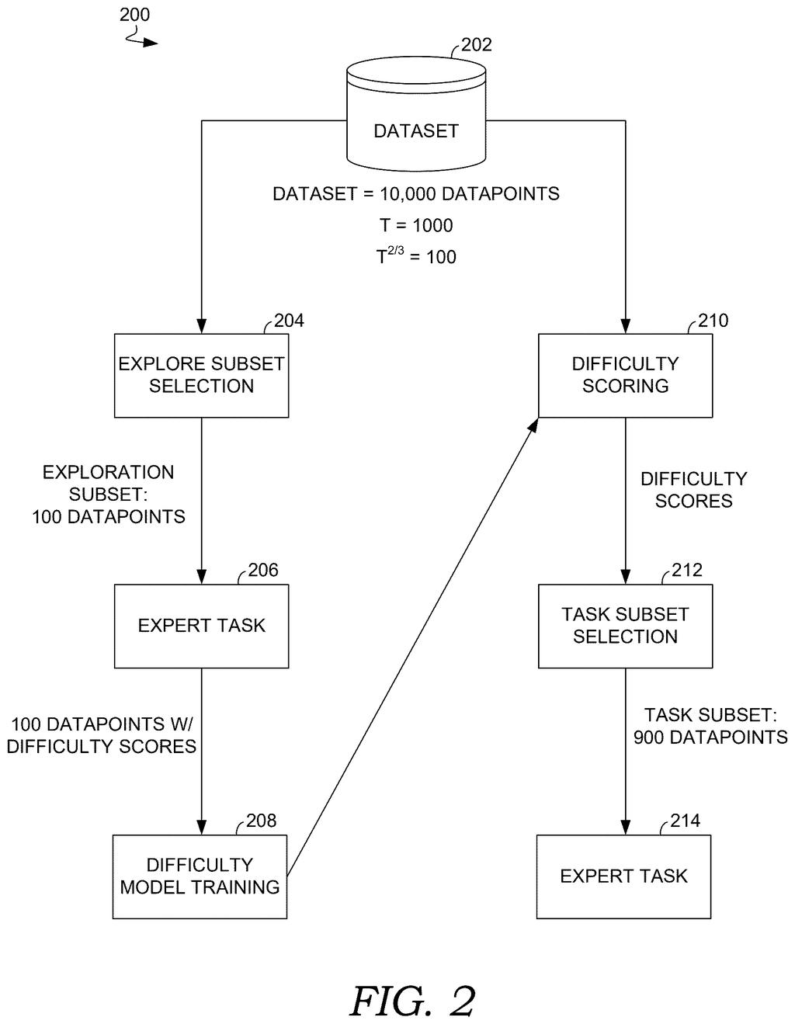
How Adobe's difficulty-prediction system works for human reviewers
You're an expert hired to review hundreds of AI-generated images, flagging the ones that are wrong, confusing, or off-brand. The company doesn't have time or budget to show you every example in a dataset of thousands. Which ones should you actually see?
Adobe's patent is an answer to that question. The system starts by sending you a small sample of examples. As you work through them, it records how hard each one was to judge. It then uses those difficulty ratings to train a secondary model that can predict how hard every other example in the dataset would be. From there, it selects a second batch for you that skews toward the tricky cases, not the easy ones.
The practical effect: human reviewers spend less time on obvious examples and more time on the edge cases that actually need a careful eye. That makes the resulting AI training data more useful without dramatically increasing the cost of collecting it.
… accessing task difficulty scores for the first subset of datapoints, each task difficulty score for the first subset of datapoints being indicative of a difficulty for the expert in performing the expert task for each datapoint in the first subset of datapoints …
Translation: The system measures how hard it is for a human to label or evaluate specific pieces of data.
How the difficulty model scores and resamples unlabeled data
The patent describes a pipeline with two phases, both centered on an "expert" (a human reviewer performing a task like labeling, rating, or correcting an AI model's output).
- Phase one: A random first batch of data is sent to the expert. For each item, a task difficulty score is recorded. This score captures how hard the expert found that particular example to work with, whether because it was ambiguous, borderline, or required careful judgment.
- Phase two: Those difficulty scores become training data for a secondary difficulty prediction model (a lightweight classifier that learns to recognize which features of an example correlate with being hard to judge). That model then scores every other unlabeled example in the dataset without sending them to the expert first.
- Sampling step: A second batch is drawn from the unseen examples, weighted toward high-difficulty predictions. That batch goes to the expert for review.
The target use cases named in the patent are model adaptation (fine-tuning an existing AI on new data) and model evaluation (testing whether a model meets quality standards). Both tasks rely heavily on human-labeled examples, and both suffer when the labeled set is dominated by easy, unambiguous cases that teach the model little.
The claim is intentionally hardware-agnostic: the system runs on "one or more computing devices" communicating over a network, with the expert working from a separate user device.
A second subset of datapoints is sampled from the other datapoints based on the task difficulty scores for the other datapoints. The second subset of datapoints are provided to the expert for performance of the expert task.
Translation: The software automatically filters the remaining data to send only the most challenging examples to the human reviewer.
What this means for the cost of training AI on human feedback
The cost of human labeling is one of the real ceilings on how often companies can update or audit their AI models. When reviewers spend most of their time confirming easy cases that any simple rule could handle, the budget runs out before the genuinely ambiguous ones get looked at. A system that front-loads the hard examples changes that economics without requiring more reviewers or more time.
For Adobe, whose creative tools increasingly rely on AI models that need to stay calibrated to professional standards (what counts as a "good" edit in Photoshop is not a fixed target), having a cheaper path to high-quality human feedback is directly relevant to the product roadmap. This is the kind of infrastructure patent that rarely makes product announcements but shapes how often a company can afford to retrain and refine what it ships. Big Tech patent news covering AI labeling and model-feedback systems has been tracking this space as the hidden cost of generative AI starts getting more attention from engineering teams.
This is the fifth Adobe filing we've tracked since July in our AI safety guardrails watchlist, following one on sourcing AI answers and one on preventing broken database code.
Claim 1 is broad. It covers any system that (1) sends a data sample to a human expert, (2) uses the resulting difficulty scores to train a predictor, and (3) uses that predictor to select the next sample. There is no restriction on the domain, the type of model being trained, the nature of the expert task, or the specific algorithm used for the difficulty prediction model. That scope is wide enough to apply to image labeling, text annotation, audio review, or any other human-feedback pipeline.
In practice, that breadth is what makes this filing interesting from a patent-strategy standpoint. The underlying idea, that you should prioritize hard examples for human review rather than sampling randomly, is intuitive enough that variations of it have appeared in academic work on active learning for years. Whether the specific claim language here is novel enough to survive examination is a real question, and the USPTO will push on it.
If it does get granted as written, it would cover a lot of territory. Any company building a human-feedback loop for AI training that adds a difficulty-prediction step in the middle would be doing something Claim 1 describes. That includes players in content moderation, AI evaluation services, and creative tooling. Adobe is not the only company with this problem, which is exactly why the filing is worth tracking.
Get our take in your Top Stories
Liked this breakdown? Add Patentlyze as a preferred source on Google, and our plain-English take shows up more often in your Top Stories the next time Adobe patent news breaks.
There are more where this came from
We read every patent application Big Tech publishes and send you the ones worth knowing. Plain English, free, every week.
The drawings
5 drawing sheets from US 2026/0252949 A1 · click any drawing to enlarge


Want this weekly breakdown for a company we don't cover? Patentlyze Pro →
Be the first to weigh in