
Apple Patents a Crown That Measures How Hard You Press It
Apple's Digital Crown is already a multi-function dial, but a new patent wants to add one more dimension: knowing exactly how hard you're pressing it, not just that you pressed it at all.
What Apple's force-sensing crown actually does
Every time you twist or push the little dial on the side of an Apple Watch, the device registers a simple yes-or-no: pushed, or not pushed. That's been good enough, but it leaves a lot of potential on the table.
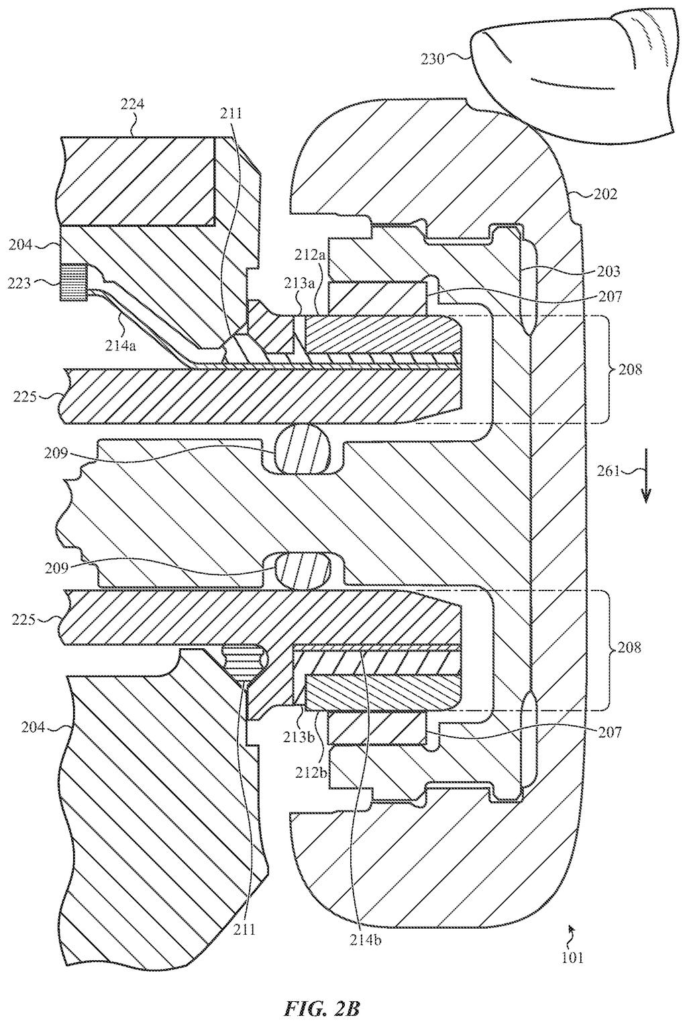
Apple's new patent describes a crown that can also feel pressure. Push softly and the watch could do one thing; push hard and it could do another. The trick is a tiny ring-shaped collar where two electrical surfaces sit close together. When you push the crown, those surfaces move toward each other, changing a measurable electrical property called capacitance (basically, how much charge the gap between them can hold). The device reads that change and translates it into a force measurement.
The result is an input that behaves more like a physical button with real give, opening up a third axis of control on a gadget where screen space is already tight.
… movement of the input structure changes a capacitance between the moveable conductor and the conductive element.
Translation: The device detects how hard you press the crown by measuring tiny electrical changes inside the mechanism.
How the collar's capacitor tracks your push
The patent centers on a collar, a small ring-shaped housing attached to the device's body, from which the crown stem extends. Inside the collar sit two key pieces:
- A moveable conductor: a conductive surface that shifts when you push or move the crown in any direction.
- A conductive element: a fixed surface that stays in place.
- A separation: a precisely controlled gap between those two surfaces.
When you apply force to the crown, the stem moves, which nudges the moveable conductor closer to (or farther from) the fixed conductive element. That changes the capacitance between them, a measurement of how much electrical energy the gap can store. Think of it like a sponge: squeeze it and its capacity changes predictably.
A processing unit reads the sensor signal continuously and converts the capacitance shift into an actual force value. The stem is designed to be rotatable, translatable (pushed straight in), and transversely moveable (pushed sideways), meaning the sensor can theoretically detect force across multiple directions, not just a straight press.
This is a hardware-level sensing approach, distinct from software guesswork, because the mechanical deformation of the collar itself drives the measurement.
… a stem coupled to the enclosure such that the stem is rotatable, translatable, and transversely moveable with respect to the enclosure …
Translation: The crown is designed to move in three different ways, including spinning, pushing in, and tilting side to side.
What pressure-sensitive crowns mean for wearables
For a device where every millimeter of the casing is contested real estate, a force-aware crown could replace what might otherwise need two separate buttons. A light press could scroll; a firm press could confirm. That kind of pressure-graduated input is already familiar from laptop trackpads that simulate a click through force rather than a physical spring, and it changes how much a tiny screen-side dial can actually do.
The wearables input space is one of the more active areas of interesting tech patents right now, because cramming more control into smaller form factors is a problem every major device maker is working around. Apple's approach here bets on capacitive force sensing built into the crown's mounting collar rather than strain gauges deeper in the mechanism, which keeps the design compact and potentially more durable.
This is the 23rd Apple filing we've tracked since May in our eye and hand controls watchlist, building on one about whether a tap counts and one about hand height and typing intent.
The shortest path from this patent to a shipping product is actually quite short, and that is what makes it stand out. The core hardware, a collar with two conductive surfaces and a measurable gap between them, fits inside an existing crown housing without requiring Apple to redesign the watch case around it.
The harder engineering question is calibration. Force sensing sounds simple, but making it consistent across thousands of production units, at different temperatures, on wrists that push and pull the crown in unpredictable ways, is where these designs typically get slowed down.
If Apple does ship this, the most immediate beneficiary is Apple Watch, where the crown is already the primary way people navigate. More distinct levels of pressure means fewer compromises on a screen too small to comfortably stack menu on top of menu.
Get our take in your Top Stories
Liked this breakdown? Add Patentlyze as a preferred source on Google, and our plain-English take shows up more often in your Top Stories the next time Apple patent news breaks.
There are more where this came from
We read every patent application Big Tech publishes and send you the ones worth knowing. Plain English, free, every week.
The drawings
12 drawing sheets from US 2026/0252033 A1 · click any drawing to enlarge


Show the other 4 sheets


Want this weekly breakdown for a company we don't cover? Patentlyze Pro →
Be the first to weigh in