
Qualcomm Patents a Way to Keep Two Spots Sharp in VR Headsets at Once
Your eyes don't look at one spot for long, and VR headsets that track your gaze know it. Qualcomm has filed a patent for a system that keeps two separate zones of a VR image sharp at the same time, which matters more than it sounds.
How Qualcomm's two-focus rendering actually works
Ever noticed how hard it is to focus on two things at once while wearing a VR headset? Your eyes jump between a game character on the left and a health bar on the right, and the display has to work hard to keep both sharp.
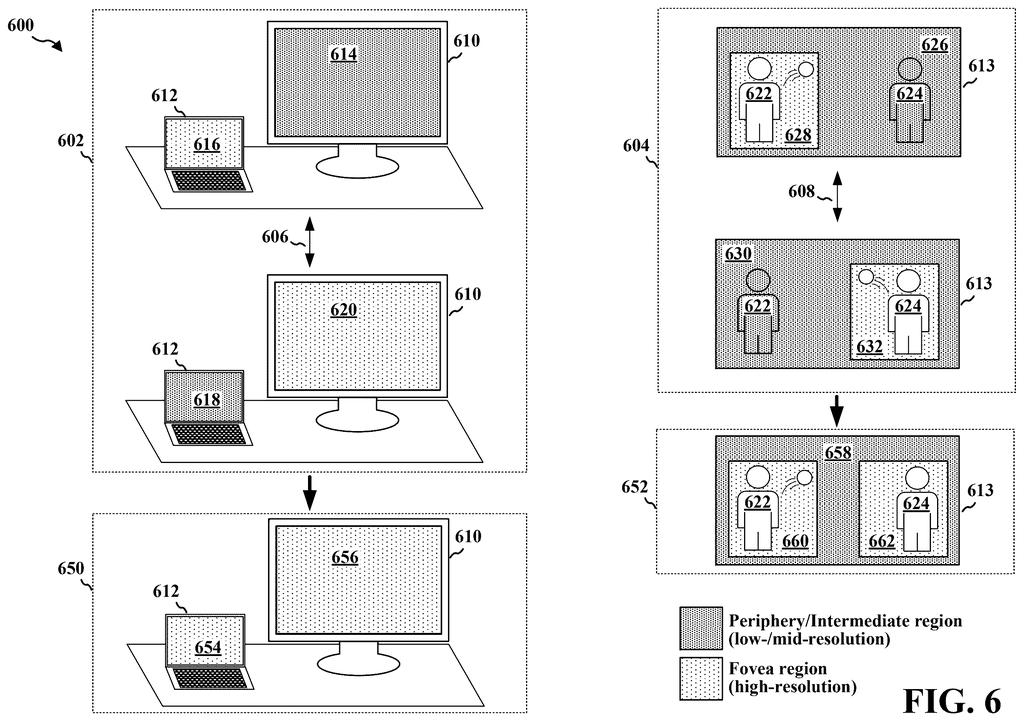
Qualcomm's patent describes an image processor that can identify two separate regions of interest in a scene and render both of them in high detail, while intentionally blurring the rest of the image you aren't looking at. That blurring isn't a bug; it's a power-saving trick called foveated rendering, and it lets the chip do less work without you noticing a difference.
The new part here is the multi-fovea approach. Most current systems pick one sharp zone centered on wherever your gaze lands. Qualcomm's method handles two non-overlapping zones simultaneously, which is useful any time your attention is genuinely split across a screen.
determine a first region of interest (ROI) and a second ROI associated with image data, wherein the first ROI is non-overlapping with respect to the second ROI; generate, based on the image data, multi-foveated image data that includes a first fovea region for the first ROI and a second fovea region for the second ROI …
Translation: The system identifies two distinct areas where you are looking and renders both of them in high detail simultaneously.
How the chip picks and renders two sharp zones
Foveated rendering is a technique borrowed from how human eyes actually work: your retina sees sharply only in a small central zone called the fovea, and your brain fills in the blurry edges. Headset makers use eye-tracking cameras to figure out where you're looking and then only render that spot in full resolution, saving processing power everywhere else.
Qualcomm's patent extends that idea to two simultaneous regions of interest (ROIs). An image processor determines two non-overlapping zones in a frame, for example a player character on the left and a UI element on the right. Both zones are rendered at the same high resolution. Everything outside them, the periphery region, is rendered at a lower resolution.
- First fovea region: high-resolution rendering for ROI one
- Second fovea region: high-resolution rendering for ROI two, spatially separate
- Periphery region: lower-resolution rendering covering the rest of the frame
The output is a single composite image, called multi-foveated image data in the patent, that looks sharp where it needs to and blurry where it doesn't. The claim is written around a chip-level processor and memory, meaning this is designed to run on dedicated silicon, likely inside an XR (extended reality) headset chip, rather than as a general software filter.
… the first fovea region and the second fovea region have a first resolution that is higher than a second resolution of a periphery region associated with the multi-foveated image data.
Translation: The headset focuses high-quality graphics on your specific gaze points while keeping the background blurry to save power.
What this means for VR headset battery and comfort
For anyone wearing a VR or mixed-reality headset, this kind of rendering directly affects two things you feel immediately: battery life and visual comfort. Rendering a full frame in high resolution is expensive, and current single-fovea systems already cut power use significantly. Adding a second sharp zone without rendering everything else at full quality extends those savings to more real-world usage patterns, where your attention actually does bounce between two areas.
Qualcomm's XR chips already sit inside many of the leading standalone headsets, so a technique like this has a realistic path to products that exist today, rather than requiring entirely new hardware. The ongoing stream of Big Tech patent news around XR chip rendering shows how much of the headset comfort battle is being fought at the silicon level, where milliseconds and milliwatts determine whether a device feels good to wear.
That makes this Qualcomm's 29th filing we've tracked since July in our AR glasses race watchlist, joining smooth video for smart glasses and location sharing via cameras.
Qualcomm already makes the chips inside most major headsets, and eye-tracking hardware already exists in premium models, so turning this patent into a real feature is primarily a software problem, not a reason to design new devices from scratch.
The practical gap is latency. Eyes dart around constantly, and a system that locks onto two sharp zones has to recalculate those zones fast enough that the blurry edges never become noticeable. That speed question is the one this document leaves unanswered, and it is probably what separates a comfortable experience from one that causes headaches.
If the engineering team can solve that timing problem, this looks like something that could ship as a firmware update rather than requiring customers to buy new hardware.
Get our take in your Top Stories
Liked this breakdown? Add Patentlyze as a preferred source on Google, and our plain-English take shows up more often in your Top Stories the next time Qualcomm patent news breaks.
There are more where this came from
We read every patent application Big Tech publishes and send you the ones worth knowing. Plain English, free, every week.
The drawings
13 drawing sheets from US 2026/0253362 A1 · click any drawing to enlarge


Want this weekly breakdown for a company we don't cover? Patentlyze Pro →
Be the first to weigh in