
Nvidia Patents a Way to Keep the Most Safety-Critical Car Features Running When Others Fail
When something goes wrong inside a self-driving car's computer, not every feature can stay on, so Nvidia has patented a system that decides in advance which ones must never go off.
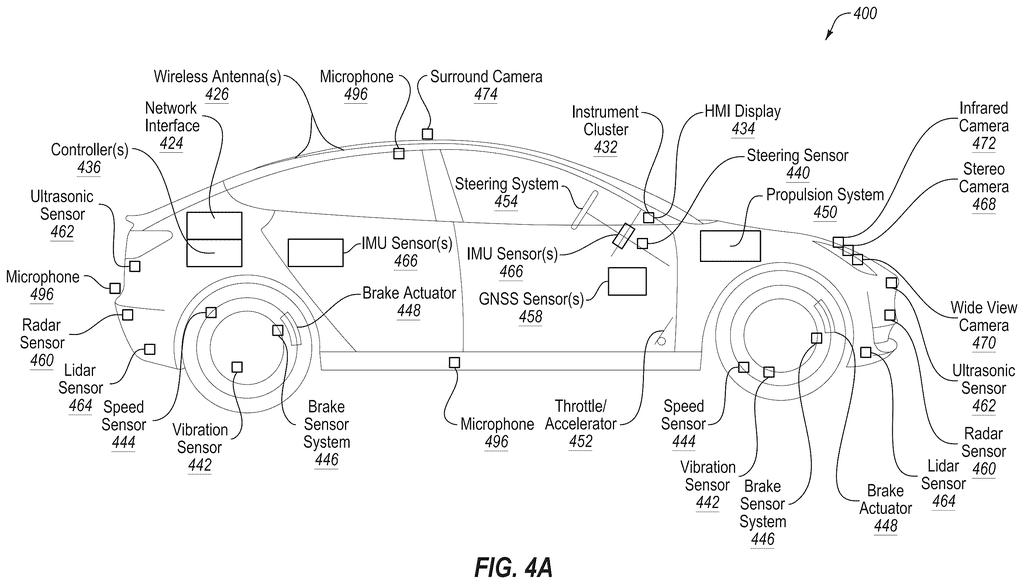
What Nvidia's car safety ranking system actually does
Every time a self-driving car makes a split-second decision, dozens of software functions are running at once: keeping the car in its lane, reading traffic signs, watching for pedestrians. If a chip hiccups or a sensor drops out, the car's computer has to decide instantly which functions to protect and which to let slide.
Nvidia's patent describes a system that sorts those functions into categories before anything goes wrong. The most safety-critical ones, like collision avoidance, get a higher protection level than, say, the music recommendation feature. Then, the system puts specific safeguards in place for each category so that the important stuff keeps working even if part of the hardware fails.
The goal is to meet a standard called ASIL D, which is the automotive industry's highest safety rating. Think of it as the difference between a building with one emergency exit and one with four clearly marked exits, backup lighting, and a generator.
assigning a category of a plurality of categories to individual functionalities of one or more functionalities of a system based at least on one or more respective safety levels associated with the one or more functionalities …
Translation: The car software sorts every job into different importance levels based on safety.
How the patent sorts and protects each car function
The patent describes a three-step process for managing which software features in a vehicle stay available during hardware faults or failures.
- Categorization: Each function in the system is assigned a category based on its safety level. A lane-keeping function and a seat-heat controller don't get the same treatment, the patent explicitly ties category assignments to safety standards like ASIL (Automotive Safety Integrity Level), an industry framework that rates how dangerous a failure in any given function could be for the people inside and outside the car.
- Availability measures: Once functions are sorted, the system applies specific protective measures per category. These might include redundancy (running a backup copy of the function), isolation (keeping high-priority functions from being affected by lower-priority crashes), or graceful degradation (scaling back non-critical features to free up resources).
- Operations in compliance: The system then runs all vehicle operations in ways that respect those measures, with the end state being a car capable of meeting ASIL D, the top tier of the ISO 26262 automotive safety standard, which covers failures that could cause life-threatening situations.
The patent is particularly relevant to Nvidia's DRIVE platform, its family of chips and software designed to power autonomous and semi-autonomous vehicles.
… automotive safety integrity level (ASIL) D based at least on the one or more availability measures as implemented …
Translation: This meets the highest auto industry safety rating to prevent critical system crashes.
What this means for drivers in self-driving cars
For a driver, this kind of system is the difference between a car that pulls safely to the shoulder when a sensor fails and one that simply stops responding. The whole point of tiered availability is that you never have to think about what's running under the hood because the car already decided, before you ever got in, what it will protect at all costs.
Autonomous vehicle chips have to meet strict government and industry safety certifications before they can go into production cars, and ASIL D is the hardest of those to hit. Nvidia's DRIVE platform is already in use by multiple automakers, so a patent like this fits into an ongoing effort to certify that the underlying software architecture is as safe as the hardware. Automotive safety is one of the more active corners of the latest Big Tech patents, as chipmakers increasingly have to prove their systems can fail gracefully, not just perform well.
That makes this Nvidia's 44th filing we've tracked since May in the self-driving sensing race, adding to work like the VR steering patent and path detection for objects.
The only time you'd notice this system working is if your car's computer had a partial failure and the car still braked cleanly instead of doing something unpredictable. That's the design goal: a failure you never experienced because the right functions were protected before anything went wrong.
Nvidia's patent describes a method for ranking a car's software features by how critical they are to survival, then building protections around the most important ones first. Navigation glitching is annoying. Emergency braking failing is not.
As cars run more software, the question of what happens when that software partially breaks becomes more consequential for drivers. This filing is an answer to that question, and a concrete one.
Get our take in your Top Stories
Liked this breakdown? Add Patentlyze as a preferred source on Google, and our plain-English take shows up more often in your Top Stories the next time Nvidia patent news breaks.
There are more where this came from
We read every patent application Big Tech publishes and send you the ones worth knowing. Plain English, free, every week.
The drawings
9 drawing sheets from US 2026/0249865 A1 · click any drawing to enlarge


Want this weekly breakdown for a company we don't cover? Patentlyze Pro →
Be the first to weigh in