Qualcomm
Qualcomm · Automotive · Filed Feb 21, 2025 · USPTO published Aug 27, 2026 · Aug 27 release
Qualcomm Patent Uses a 3D Graphics Trick to Improve Cars' Surroundings View
Qualcomm is borrowing a technique from 3D scene rendering to help cars build a sharper, more accurate map of everything around them, a map that driving software then uses to decide where to go.
- Publication number
- US 2026/0253310 A1(US20260253310A1)
- Applicant
- QUALCOMM Incorporated
- Filed · Published
- Feb 21, 2025 · Aug 27, 2026
- Inventors
- Varun Ravi Kumar, Shubhankar Mangesh Borse, Senthil Kumar Yogamani
- Status when we published
- Waiting for an examiner
- Document
- 20 claims
- US classification
- 345/419
- Examiner
- PROTAZI, BRIGITER DIVULALE (Art Unit 2612)
What Qualcomm's overhead driving map system actually does
Imagine you're in a car that needs to know exactly where every other vehicle, pedestrian, and curb is, at all times. The car's cameras see forward, backward, and sideways, and a laser sensor bounces pulses off nearby objects. But stitching all that raw data into a clean, usable overhead map is harder than it sounds.
Qualcomm's patent describes a way to make that overhead map more detailed and accurate by borrowing a trick from 3D computer graphics. The system first builds a rough overhead picture from the cameras and the laser sensor, then drops in small, fuzzy blobs called Gaussian primitives, each one representing a detected object or surface. When these blobs are layered together, they fill in gaps and sharpen edges in a way that a straightforward pixel-by-pixel approach misses.
The end result is a richer overhead picture that the vehicle's driving software can use to make better decisions about steering, braking, and navigating around obstacles.
… generating Gaussian primitives using the initial BEV representation, the Gaussian primitives representing features of objects in the three-dimensional space; and combining the Gaussian primitives with the initial BEV representation using Gaussian splatting to form an enhanced BEV representation of the three-dimensional space.
Translation: The system creates 3D shapes from camera data and uses a rendering technique called Gaussian splatting to sharpen the view.
How Gaussian splatting sharpens the vehicle's aerial view
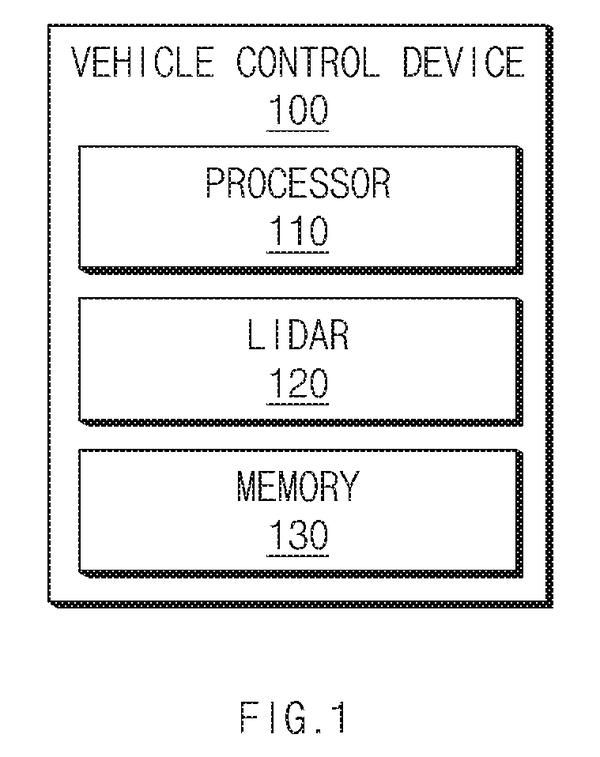
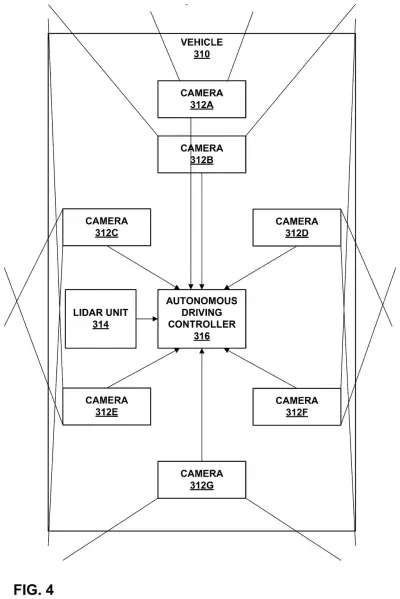
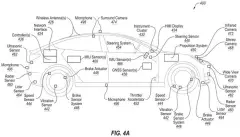
The patent describes a pipeline running on a vehicle's onboard processor, pulling data from two sources at once: a multi-camera system (several cameras mounted around the car) and a depth sensing unit (typically a LiDAR or structured-light sensor that measures exact distances by firing laser pulses).
From those inputs, the system builds an initial bird's-eye view (BEV) representation, essentially a flat, top-down map of the space around the car, similar to what you'd see on a satellite image but updated in real time.
The novel step is what happens next:
- The system analyzes the initial BEV and generates Gaussian primitives, mathematical blobs, each defined by a position, a size, a shape, and a color or feature value. Think of each blob as a soft paintbrush stroke placed on top of an object or surface.
- These primitives are then combined back into the map using Gaussian splatting, a rendering method borrowed from 3D scene reconstruction. Splatting works by projecting each blob onto the 2D map plane and blending overlapping blobs together, producing smooth, dense coverage even where sensor data is sparse or noisy.
- The output is an enhanced BEV representation with finer detail about object shapes, boundaries, and spatial relationships.
The approach is designed to run on Qualcomm's automotive chip platforms, where processing speed and power efficiency both matter for real-time driving applications.
An example device for generating a bird's-eye view (BEV) representation of objects through processing of media data, such as image data and point cloud data, includes a processing system configured to receive, from a multi-camera system of a vehicle, one or more images of a three-dimensional space around the vehicle …
Translation: The technology combines camera footage and depth sensor data to build a top-down map of the area surrounding a car.
What this means for self-driving perception hardware
For the person sitting in a self-driving or driver-assist vehicle, this patent addresses one of the quieter failure modes in automated driving: the moments when the car's internal map is blurry or incomplete and the system makes a hesitant or wrong call. A sharper overhead map means fewer phantom braking events, more confident lane changes, and better detection of objects that sit awkwardly between camera angles or at the edge of a LiDAR sweep.
Qualcomm supplies chips to many automakers and Tier 1 suppliers, so improvements to perception algorithms at the chip level can ripple across a wide range of vehicles rather than staying inside one manufacturer's ecosystem. Automotive perception is one of the more active areas covered among new tech patents, and this filing shows chipmakers, not just car companies, pushing the state of sensor fusion forward.
This is the 27th Qualcomm filing we've tracked in our self-driving sensing watch since July, building on earlier work like their mismatched-camera fix and their protruding-object spotter.
Source: US 2026/0253310 A1 at the USPTO (PDF). Full patent text and figures are in the official publication.
Get our take in your Top Stories
Liked this breakdown? Add Patentlyze as a preferred source on Google, and our plain-English take shows up more often in your Top Stories the next time Qualcomm patent news breaks.
Add Patentlyze on Google
One click.
There are more where this came from
We read the new patents from Big Tech, carmakers and more and send you the ones worth knowing. Plain English, free, every week.
The drawings · 5 sheets
5 drawing sheets from US 2026/0253310 A1 · click any drawing to enlarge


More from Qualcomm
All 637 Qualcomm patents →
More in Automotive
All 432 Automotive patents →
Nvidia
Nvidia Patents a Way for Self-Driving Cars to Know When an Object Is Actually in Their Path
Nvidia
Nvidia Patents a System for Steering Autonomous Vehicles via VR Headset
Nvidia
Nvidia Patents a Way to Keep the Most Safety-Critical Car Features Running When Others Fail
Waymo (Google)