
IBM Patent Stops Unauthorized AI-Generated Answers From Reaching Restricted Users
When a company's AI assistant is trained on confidential documents, what stops a low-clearance employee from asking the right question and getting a restricted answer? IBM's new patent tackles exactly that gap.
How IBM's permission check on AI answers actually works
A security guard sits at a desk watching camera feeds from rooms that have different clearance levels. Some feeds are open to everyone; others are only for senior staff. Now picture your company's AI chatbot doing the same job with documents.
IBM's patent describes a system that tracks where an AI learned each piece of information and then checks whether you have permission to see that information before returning an answer. If the AI draws on a source you're not cleared for, the answer gets blocked, even if the question itself seemed harmless.
This matters most in places like hospitals, law firms, or banks, where different employees have access to different files. Right now, most AI assistants don't make that distinction at all. IBM's approach would bring the same document-access rules your IT team already enforces to the AI's answers themselves.
… tagging data segments in the stored data in the vector store so that a given data segment indicates a data source from which the given data segment originates …
Translation: The system labels every piece of information with its original source so it knows exactly where the data came from.
How the vector store tags and privilege check interact
The system works in three connected stages.
Training and tagging: The AI (called a language model, or LM) is trained on multiple data sources, each with its own access rules. When that training data is saved into a vector store (a searchable database of text chunks encoded as numbers so the AI can retrieve relevant passages quickly), each chunk is tagged to record which original source it came from.
Retrieval at query time: When you ask a question, the system does two things at once. It generates a candidate answer using the AI, and it also searches the vector store to find which specific text passages the answer drew on. Those retrieved passages inherit the access requirements of their tagged source documents.
Permission gating: The system then compares the access requirements of the retrieved passages against your individual privilege level. If any retrieved document is above your clearance, the answer is withheld. The decision is made after the AI generates a response but before that response reaches you, acting as a final checkpoint.
The claim covers using the user's original prompt, the AI's draft answer, or both together to drive the retrieval step, which means the system can catch indirect leakage even when a question doesn't obviously reference a restricted topic.
Based on the retrieved documents, the identified access requirements, and the privilege, it is determined whether to present the answer to the user.
Translation: The system checks if the user is allowed to see the information before it shows them the AI generated answer.
What this means for AI inside regulated companies
Enterprise AI adoption keeps stalling in regulated industries because IT and compliance teams can't easily enforce their existing document-access policies on a chatbot. IBM's patent offers a direct answer: bolt the same role-based access control rules that govern a SharePoint folder onto the AI's output layer. For employees in finance, healthcare, or defense contracting, that could mean AI tools finally clear the security review that has been blocking them.
The approach also addresses a quiet liability that few companies talk about: an AI trained on a mix of public and confidential data can inadvertently surface restricted information in a perfectly ordinary-looking answer. IBM's filing sits alongside other interesting tech patents targeting AI governance and data-access control, a corner of the industry that is drawing serious engineering attention as companies try to deploy large language models inside organizations with real compliance obligations.
That makes this IBM's 41st filing we've tracked since May in our AI guardrails race watch, adding to work like pitting models against each other and spotting conflicting documents.
Claim 1 covers any AI system that stores training data, tags those documents by origin, checks a user's individual permissions against whatever documents the AI actually pulled to build its answer, and then filters what the user sees based on that check. That combination, applied to any language model and any storage setup, is a wide claim. In practice, that scope reaches every enterprise AI tool where different employees should see different answers to the same question.
A hospital chatbot, an internal legal research assistant, a financial data tool, all of these would need to license this approach or design around it. The claim does require that the permission check happen after retrieval, against the specific documents behind the answer, not just at login. That detail matters, but it does not shrink the claim much.
Any developer building a permission-aware AI assistant would have to account for this patent.
Get our take in your Top Stories
Liked this breakdown? Add Patentlyze as a preferred source on Google, and our plain-English take shows up more often in your Top Stories the next time IBM patent news breaks.
There are more where this came from
We read every patent application Big Tech publishes and send you the ones worth knowing. Plain English, free, every week.
The drawings
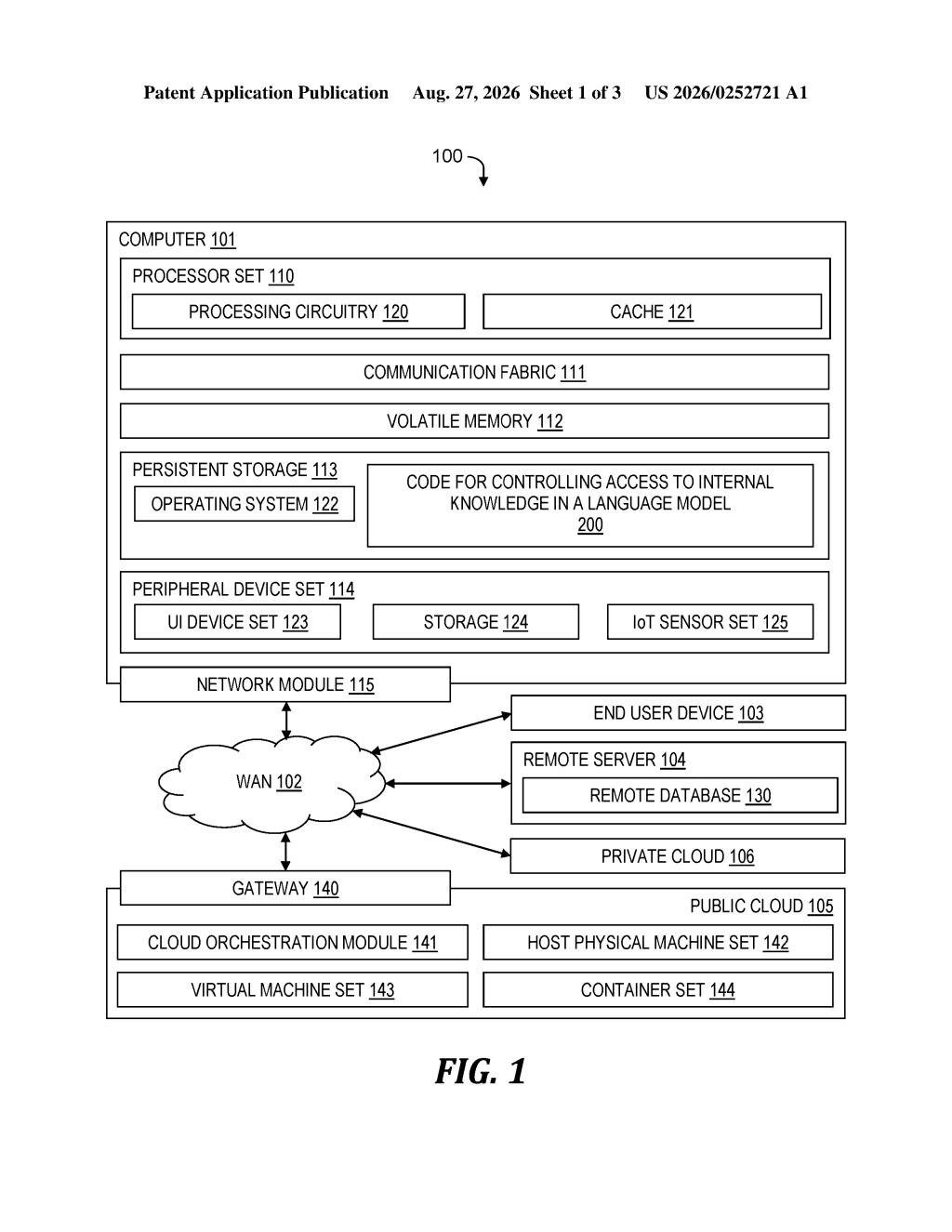
3 drawing sheets from US 2026/0252721 A1 · click any drawing to enlarge


Want this weekly breakdown for a company we don't cover? Patentlyze Pro →
Be the first to weigh in