
Nvidia Patents a Three-Layer Camera System That Reads Depth and Objects for Self-Driving AI
Nvidia's latest patent breaks down every frame of dashcam footage into three separate data streams at once, giving a self-driving AI a richer picture of the world than a single camera feed ever could.
What Nvidia's triple-decoder camera setup actually does
Imagine you're driving through a busy intersection. Your eyes are doing a lot of work at once: reading lane markings, judging how far away that pedestrian is, and noticing the overall scene. Nvidia's patent tries to teach a self-driving car to do the same thing, but in software.
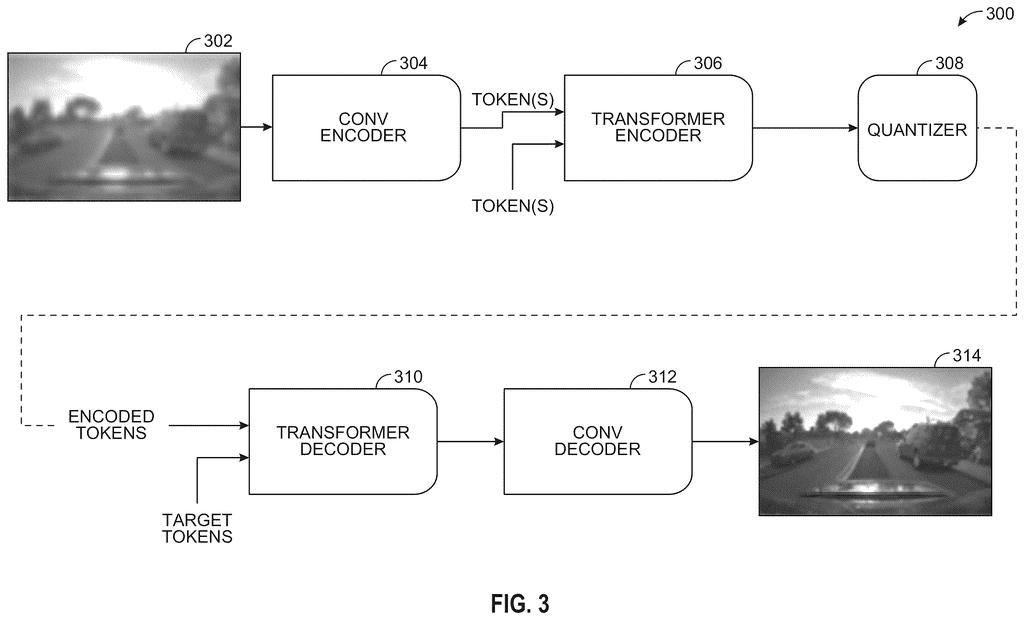
The system takes video from the car's cameras and runs it through a single shared processor (the encoder), then splits the result into three separate outputs. One output reconstructs the raw image, one extracts high-level scene features, and one estimates how far away everything is. Each of those outputs becomes a compact data packet called a "token" that the car's AI brain uses to make driving decisions.
The whole setup is also designed to train itself on real driving footage, so it gets better as more cars collect more data. Think of it as a feedback loop: the more the system sees, the more accurate its three-way picture of the road becomes.
… the plurality of decoders comprising at least an image decoder, a feature decoder, and a depth decoder, wherein one or more parameters of the plurality of decoders and the one or more encoders are updated according to example video data captured by example vehicle sensors.
Translation: The system uses three specialized tools to process video, constantly learning and improving from real-world driving footage.
How the encoder and three decoders carve up a video frame
The patent describes a processing pipeline that converts camera video into a structured set of tokens (small, compressed data packets that an AI model can reason over quickly) using a parallel decoding architecture.
Here's how the pipeline breaks down:
- Encoder: A single shared network ingests one or more video frames from the car's sensors and compresses them into a dense internal representation, essentially a rich numerical summary of what the cameras saw.
- Image decoder: Reconstructs a version of the original frame, helping the system verify it hasn't lost important visual detail during compression.
- Feature decoder: Pulls out semantic information (meaning: what objects are present, what category they belong to) without worrying about pixel-level accuracy.
- Depth decoder: Estimates the distance of every element in the scene, turning a flat 2D image into a rough 3D map of the road ahead.
The three decoders run on the same encoded representation, so the car isn't processing the scene three separate times. The system's parameters (the internal numbers that determine how the encoder and decoders behave) are updated using labeled example footage from real vehicle sensors, a process called supervised fine-tuning.
The resulting tokens from all three decoders are fed into what the patent calls an "autonomous driving foundation model," a large AI trained to handle a broad range of driving tasks rather than one narrow situation.
The first computing system further can decode the encoded representation using a plurality of decoders to generate a plurality of tokens to represent the at least one frame. The plurality of decoders can include at least an image decoder, a feature decoder, and a depth decoder.
Translation: The computer breaks down video into digital building blocks that help the car identify objects and measure their distance.
What this means for Nvidia's self-driving AI ambitions
For a self-driving system, the quality of its scene understanding is a direct ceiling on how safely it can drive. A camera feed that only tells the AI "there's something over there" is far less useful than one that also says "it's a person, it's 8 meters away, and it's moving left." Nvidia's triple-decoder approach tries to supply all three of those answers from a single encoding pass, which keeps the compute cost manageable while increasing the information density the AI gets to work with.
Nvidia is already a central supplier of chips and software to the autonomous vehicle industry through its DRIVE platform, so this patent slots directly into that business. The self-driving space is full of interesting tech patents on perception pipelines, and this one signals that Nvidia is investing in foundation-model-style architectures for vehicles, the same large-model approach that reshaped text and image AI, now pointed at dashcam footage.
That makes this Nvidia's 45th filing we've tracked since May in the self-driving sensing race, following work on keeping critical car features alive and VR-based vehicle steering.
Claim 1 covers any processor that takes video from vehicle sensors, compresses it into an encoded representation, and then runs that representation through three specific decoders: one for images, one for features, and one for depth. The claim does not specify a particular camera count, encoder design, or model architecture, which makes it broad by any reasonable reading.
That breadth has real consequences. Any autonomous vehicle system that reconstructs a visual scene, extracts meaningful patterns from it, and estimates how far away objects are, all from the same encoded representation, could fall within this claim's reach.
Whether the patent carries lasting weight depends on whether examiners find prior art showing that exact three-decoder combination already existed in vehicle perception systems. If they do not, Nvidia holds a wide lane.
Get our take in your Top Stories
Liked this breakdown? Add Patentlyze as a preferred source on Google, and our plain-English take shows up more often in your Top Stories the next time Nvidia patent news breaks.
There are more where this came from
We read every patent application Big Tech publishes and send you the ones worth knowing. Plain English, free, every week.
The drawings
9 drawing sheets from US 2026/0254976 A1 · click any drawing to enlarge


Want this weekly breakdown for a company we don't cover? Patentlyze Pro →
Be the first to weigh in