
Samsung Patent Filing Targets Projector Distortion on Uneven or Irregular Surfaces
Most projectors demand a flat, white wall to look good. Samsung's new patent describes a projector that scans its own target surface and rewrites the image on the fly so imperfections in the wall become invisible.
What Samsung's zone-by-zone image correction actually does
Imagine you pull a portable projector out at a friend's apartment and aim it at a slightly uneven, off-white wall. The image comes out warped in some spots and washed out in others because the projector has no idea the surface isn't perfect.
Samsung's patent describes a way to fix that automatically. The projector uses a distance sensor to measure how far away each patch of the wall is, and a camera to see what the wall's texture and color look like. It then divides the whole surface into zones and calculates a custom correction value for each one. Before projecting anything, it tweaks the image region by region so that what lands on the wall looks like it was meant to be there all along.
The result is a projector that adapts to your real room instead of demanding you adapt the room to it. No manual keystone sliders, no hunting for a perfectly flat screen.
identify a projection surface state based on sensing results obtained from the distance sensor and the image sensor, the sensing results including the distance to each region among the plurality of regions and the image of the plurality of regions …
Translation: The device analyzes depth data and pictures to understand the shape of the wall or screen.
How the projector maps distance and color to set correction weights
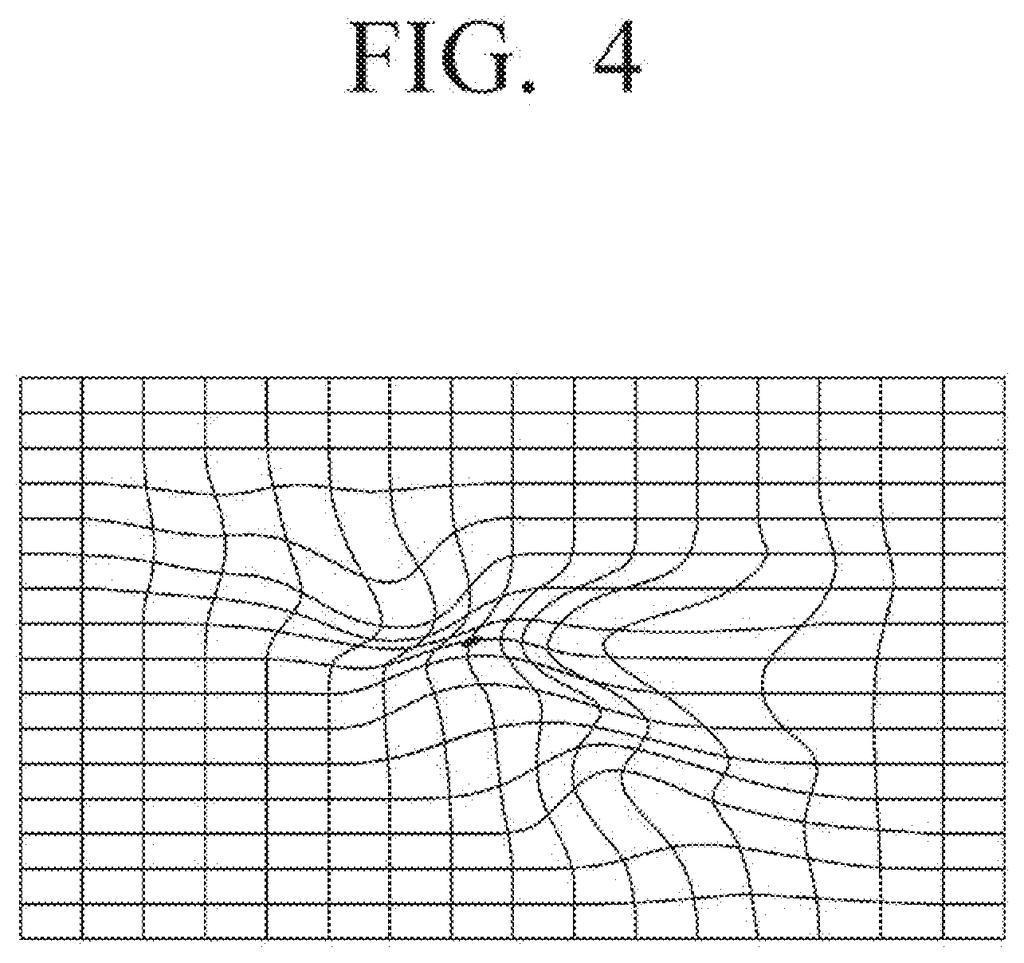
The system works in two sensing passes before projection starts. A distance sensor sweeps across a grid of zones on the projection surface and records how far each zone sits from the lens. Meanwhile, an image sensor (essentially a built-in camera) photographs those same zones, capturing color, brightness, and texture variations.
The processor combines both data sets to identify the projection surface state, meaning it builds a map of where the wall is too close, too far, angled, wrinkled, or discolored. From that map it calculates a correction weight for every zone individually and stores those weights in memory.
When an image is about to be projected, the processor applies the stored weights zone by zone before sending the frame to the projection unit. A zone where the wall bows outward might get its brightness turned down; a zone with a yellowish patch might get a color shift to compensate. The final corrected frame is what actually hits the wall.
- Distance data catches geometry problems (angles, bumps, folds).
- Camera data catches color and reflectivity problems (stains, textures, off-white paint).
- Per-zone weights mean corrections are surgical, not a single global tweak.
… sets a correction weight for each region among the plurality of regions according to the identified state and stores the correction weight in the memory, respectively applies the correction weight for each region among the plurality of regions to an image to be projected onto the projection surface to correct the image …
Translation: It calculates specific adjustments for different areas and warps the video so it looks normal.
What this means for living-room and portable projectors
For consumers, this is primarily about removing a quiet annoyance that makes portable projectors frustrating to use outside a purpose-built home theater. Short-throw and ultra-short-throw projectors are already popular, but they still expect a reasonably flat, neutral surface. A projector smart enough to correct for ordinary living conditions could expand the product's appeal well beyond early adopters who own a proper screen.
For Samsung's broader display strategy, this filing sits alongside projector and display patents that try to close the gap between controlled-lab performance and real-world rooms. The same depth-and-camera sensing approach could scale from a pocket projector up to a ceiling-mounted unit in a conference room. Readers who follow latest Big Tech patents in the display and imaging space will recognize this as part of a wider push to move surface-correction from manual setup menus into automatic, sensor-driven pipelines.
That makes this Samsung's 324th filing in the Display patents we've tracked since May, a group that also includes one adjusting color for fingerprints and one splitting camera views.
The projector scans the surface in zones and stores those measurements before it starts projecting. That upfront work takes time and computing power, which feels like a fair price in a living room you set up once, but like an annoying delay when you just want to throw a quick slide onto a conference room wall. The bigger vulnerability is that the system trusts its stored measurements to stay true.
A bedsheet that shifts, or someone walking past the wall mid-presentation, makes those stored corrections wrong, and nothing in the design catches that drift in real time. Still, for the realistic case where the surface holds still, even a flawed zone-by-zone correction beats what projector owners deal with today, which is just accepting a warped image and moving on.
The tradeoff reads as worth it for a living room, and worth reconsidering for anything truly portable.
Get our take in your Top Stories
Liked this breakdown? Add Patentlyze as a preferred source on Google, and our plain-English take shows up more often in your Top Stories the next time Samsung patent news breaks.
There are more where this came from
We read every patent application Big Tech publishes and send you the ones worth knowing. Plain English, free, every week.
The drawings
20 drawing sheets from US 2026/0254932 A1 · click any drawing to enlarge


Want this weekly breakdown for a company we don't cover? Patentlyze Pro →
Be the first to weigh in