
Samsung Patents a Projector That Automatically Frames Its Own Picture
Keystone correction has been a manual chore for decades. Samsung's new patent describes a projector that reads the wall in front of it and straightens its own picture automatically, no remote or menu needed.
What Samsung's self-aligning projector actually does
A projector sits on a coffee table, slightly off-center, aimed at a wall. The image comes out trapezoidal and crooked, and someone has to open a menu and nudge correction sliders until it looks right. That process is what Samsung wants to make automatic.
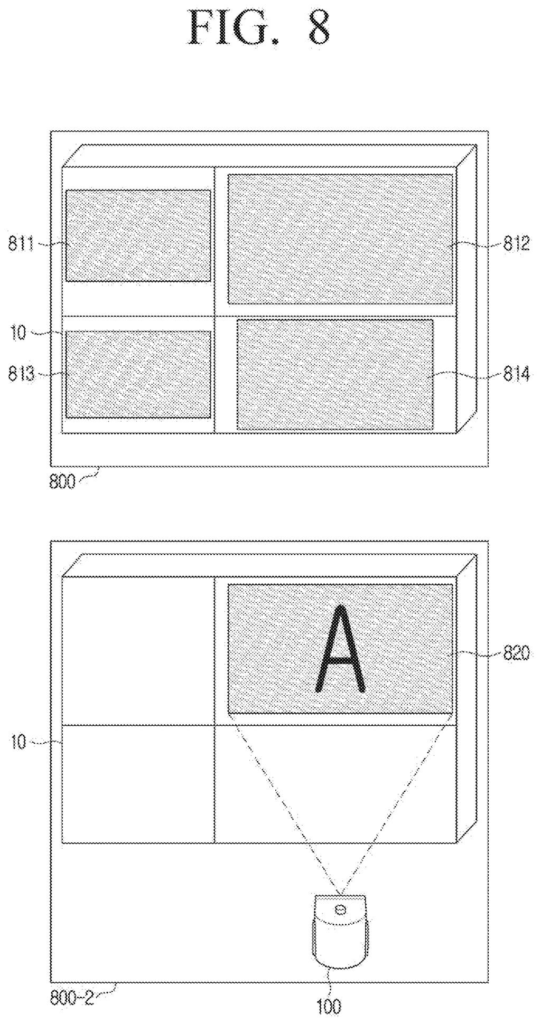
The patent describes a projector with built-in sensors that photograph the surface in front of them, detect the edges of that surface, and measure how far away different points on it are. The device uses that information to reshape the projected image before it ever leaves the lens, so it lands square and fills the intended area.
You get a correctly shaped picture without touching a setting. The system is also designed to handle two different types of surface boundary, so it can distinguish between the edge of a wall and, say, a window frame or a corner, and choose how to crop or correct accordingly.
obtain edge information, based on a captured image of a projection surface area on which the projection image is to be output, through the sensor unit, and control the projection unit to output, based on depth information obtained through the sensor unit, the projection image corrected to correspond to a projection area …
Translation: The device uses sensors to scan a wall and automatically adjust the projected image to fit the available space perfectly.
How the sensor reads edges and corrects the image
The patent describes an electronic apparatus, almost certainly a projector or a device with a built-in projector, that automates geometric correction using a sensor unit, a processor, and a projection unit working together.
Here is the basic pipeline:
- The sensor unit captures an image of the surface where the projection will appear.
- The processor analyzes that image to extract edge information, meaning it identifies the boundaries of the projection surface.
- The sensor unit also provides depth information, measuring how far each part of the surface is from the device. This is what lets the system understand tilt and curvature, not just flat boundaries.
- The processor uses both edge and depth data to compute a corrected image, then instructs the projection unit to output that corrected version.
The claim specifically mentions two types of surface area inside the edge information: a first projection surface area and a second projection surface area. That distinction suggests the system can handle surfaces with multiple distinct regions, such as a wall interrupted by a frame, or two adjacent panels at slightly different angles, and choose which region to use as the target.
The correction happens before or during projection, meaning the output image is already adjusted rather than the device projecting a raw image and then digitally patching it afterward.
… controls the projection unit, based on depth information acquired through the sensor unit, to output a projection image corrected to correspond to a projection area included in the projection surface area based on at least one of a first projection surface area or a second projection surface area …
Translation: The projector uses depth data to identify specific surfaces and reshape the video so it stays within the intended boundaries.
What this means for portable and built-in projectors
For consumers, this is the difference between a projector that works immediately and one that requires a five-minute setup ritual every time you move it. Portable projectors in particular suffer from this: they are marketed as convenient, but the manual geometry correction that follows every placement undercuts that pitch. A device that handles its own alignment through onboard sensors removes the main friction point.
The patent sits at the intersection of computer vision and display hardware, an area where Samsung has been active across its TV, mobile, and home-device lines. Claim 1 is written broadly enough to cover any electronic apparatus with a sensor, a memory, and a projection unit, which means it could apply to a dedicated projector, a phone with a built-in pico-projector, or a TV with projection capabilities. That breadth is notable. Among the new tech patents covering projection and display correction, this one stakes out wide territory by not limiting itself to a specific product form factor.
Samsung's 329th filing in the display patents we cover since May adds to a run that includes a three-panel app layout and a dual-fold camera system.
Claim 1 covers any device that combines a camera, a depth sensor, a processor, and a projector, where the processor uses edge information from a captured image to automatically reshape what the projector displays. That description fits the core function of virtually any smart auto-correcting projector on the market today.
The claim never specifies how the edges are detected, how the depth readings are combined with the image, or how the corrected picture is actually calculated. Leaving those steps undefined makes the claim extremely wide, because any method of doing those things would still fall under it.
If granted as written, this claim could give Samsung a legal foothold against a broad category of auto-correction features, not a specific circuit or algorithm. That is significant leverage, and it also means the claim will face serious questions during review about whether anything this general is actually new.
Get our take in your Top Stories
Liked this breakdown? Add Patentlyze as a preferred source on Google, and our plain-English take shows up more often in your Top Stories the next time Samsung patent news breaks.
There are more where this came from
We read every patent application Big Tech publishes and send you the ones worth knowing. Plain English, free, every week.
The drawings
41 drawing sheets from US 2026/0254930 A1 · click any drawing to enlarge


Want this weekly breakdown for a company we don't cover? Patentlyze Pro →
Be the first to weigh in