
Samsung Patents an AR View Window That Tracks Where Its Camera Points
AR glasses that show you a camera feed can feel disorienting if the image doesn't line up with where the camera is actually pointing. Samsung's latest patent tackles that alignment problem directly.
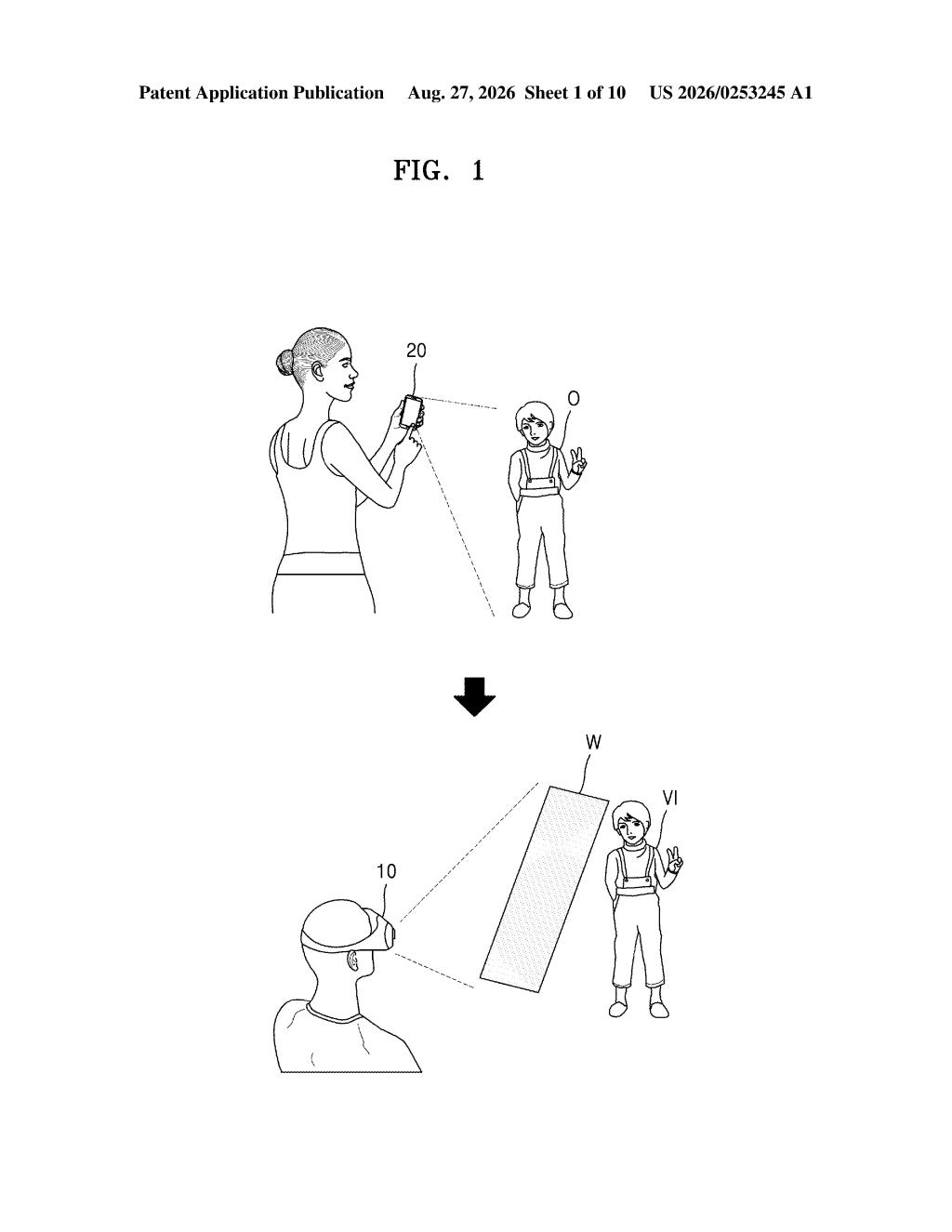
What Samsung's self-adjusting AR window actually does
Today, if an AR headset shows you a video feed from its built-in camera, that image sits in a fixed window inside your field of view, even when the camera tilts or rotates. The result can feel like watching a TV that doesn't move when you do.
Samsung wants to fix that by making the display window itself respond to the camera's orientation. When the camera tilts down, the window shifts down. When it angles left, the window follows. The idea is that the virtual image stays locked to the camera's perspective rather than floating somewhere arbitrary in your vision.
Samsung's patent describes the device reading the camera's pose (its position and angle in space at any moment) and using that data to decide exactly where to place the display window. The goal is a more natural viewing experience where what you see inside your glasses feels like it genuinely corresponds to what the camera sees.
… determining, based on the pose information of the image capture device, a location and an angle of a viewing window, wherein the viewing window is for displaying a virtual image corresponding to the image data …
Translation: The system calculates exactly where and at what tilt to show a digital overlay based on how you are holding your camera.
How pose data drives the window's position and angle
The patent describes a four-step process that runs continuously while an AR device is in use.
- Image capture: A camera built into the AR device grabs a frame of the real world.
- Pose measurement: The system reads the camera's pose information, meaning its exact position and orientation in three-dimensional space at the moment of capture, typically provided by sensors like gyroscopes or accelerometers.
- Window calculation: Using that pose data, the device computes where inside the AR display the viewing window should appear and at what angle it should tilt.
- Output: The window is rendered at those calculated coordinates and shown to the wearer as a virtual image.
The core insight is that the window is not static. Its location and angle are a direct function of where the camera is pointing, so the displayed frame stays geometrically consistent with the camera's viewpoint.
The claim is written broadly, covering any AR device with a camera and a display capable of showing virtual images. It doesn't specify a particular sensor type or display technology, which keeps the patent's scope wide. The practical application could range from pass-through AR headsets (where a camera replaces direct vision) to devices that overlay a camera feed alongside the real world.
A method by which an augmented reality device outputs an image captured through an image capture device, as a virtual image through a viewing window is provided.
Translation: This technology describes how an AR device takes a live camera feed and displays it as a virtual window for the user.
What this means for Samsung's AR glasses ambitions
For AR glasses to feel natural rather than awkward, the virtual content has to stay anchored to what your eyes expect. A camera feed that floats in a fixed spot while your head moves is immediately disorienting, and it's the kind of small friction that makes people take a headset off after five minutes. Samsung's approach, if it works well, could make pass-through camera feeds feel much closer to actually looking through a lens.
Samsung has been building out its AR hardware and software stack for several years, and filings like this one show the detail-level engineering work that has to happen before any glasses feel ready for everyday use. The Patentlyze archive of interesting tech patents in the AR space shows how much of this work, from display calibration to sensor fusion, happens well before a product ever reaches a store shelf.
This is the 39th Samsung filing we've tracked since May in the AR glasses race, building on one merging camera views and one linking chat to avatar faces.
The core idea here is straightforward: when you turn your head, the camera feed window turns with it, matching your angle automatically. No new physical components are required to make that happen, which puts this closer to a software update than a from-scratch invention. The shortest path to a product would be any AR headset that already has a camera and can track head rotation, which describes hardware that exists today at various price points.
The missing piece is refinement rather than invention. What the document leaves open is how the experience actually feels to use. A window that shifts with every small head movement can make people feel queasy, and nothing here addresses how to smooth or steady that motion.
That gap suggests a real product would need additional work before this felt comfortable enough to ship.
Get our take in your Top Stories
Liked this breakdown? Add Patentlyze as a preferred source on Google, and our plain-English take shows up more often in your Top Stories the next time Samsung patent news breaks.
There are more where this came from
We read every patent application Big Tech publishes and send you the ones worth knowing. Plain English, free, every week.
The drawings
10 drawing sheets from US 2026/0253245 A1 · click any drawing to enlarge


Want this weekly breakdown for a company we don't cover? Patentlyze Pro →
Be the first to weigh in