
Microsoft Patents a Way to Stop Video Encoders from Fetching Data Across Two Chips at Once
Every time a video encoder copies a patch of image from one part of a frame to compress another, it has to fetch that patch from memory. Microsoft's new patent makes sure that fetch never has to straddle two different chips at the same time, a small rule change that can meaningfully speed up hardware video encoders.
How Microsoft's split-memory video compression actually works
Imagine you're trying to compress a video and you need to grab a small square of image you already processed to help shrink a new square. That reference square is stored somewhere in memory, but on a real chip, memory comes in two flavors: fast, expensive memory sitting right on the chip, and larger, slower memory sitting off it.
Microsoft's patent sets a rule: when the encoder looks for that reference square, it has to land entirely in one memory or the other. It can't be half on the fast chip memory and half in the slower external memory. That split-fetch is slow and complicated, and the patent's point is to simply ban it.
The result is that hardware video encoders, the kind built into cameras, phones, game consoles, and streaming boxes, can run more efficiently without sacrificing too much in video quality. You'd likely never see this at work, but it touches every compressed video file your device produces.
searching first candidate reference blocks in the first memory buffer, the first memory buffer storing first reconstructed sample values of a first area of the current picture, the first area covering at least part of the given root unit; searching second candidate reference blocks in the second memory buffer …
Translation: The system looks for matching image data in two separate memory banks to help compress the video file.
How the encoder keeps reference blocks inside one memory at a time
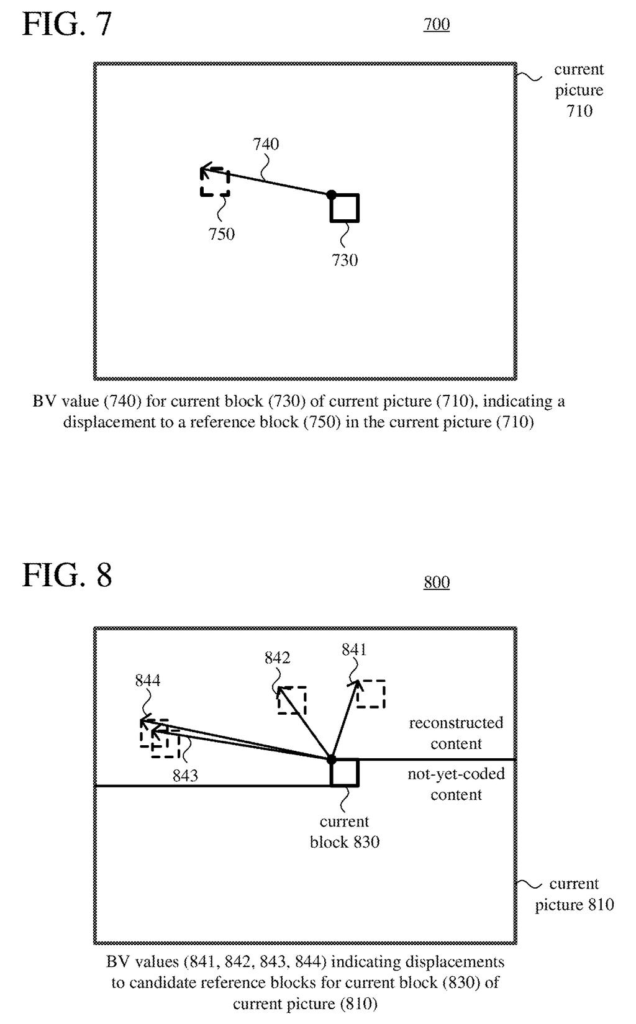
Video compression using a technique called intra block copy (BC) works by finding patches of a frame you've already processed that look like the patch you're currently trying to compress. Instead of re-encoding all that pixel data, the encoder just records a pointer: "use that block over there." That pointer is called a block vector (BV).
The patent constrains where that reference block is allowed to live. The current frame is divided into two search zones:
- An inner search area: stored in fast on-chip memory (think of it as the encoder's working desk)
- An outer search area: stored in larger but slower off-chip memory (the filing cabinet across the room)
The rule is strict: a reference block must sit entirely inside one zone or the other. A block that overlaps the boundary between them is forbidden. This matters because fetching data that spans two physically separate memory systems forces the chip to run two separate memory operations and stitch the results together, which costs time and power.
The encoder searches both zones and picks the best match, but it only picks candidates that obey the no-overlap rule. The patent also ensures that blocks close to the current block (which tend to be the most useful for compression) can still be chosen, so compression quality doesn't take a big hit from the constraint.
… the location of a reference block is constrained so that it can be entirely within an inner search area of the current picture or entirely within an outer search area of the current picture, but cannot overlap both the inner search area and the outer search area.
Translation: The patent forces the computer to pick reference data from only one memory chip at a time to avoid slow data retrieval.
What this means for hardware video chips in cameras and consoles
For consumers, this is a plumbing-level improvement that shows up as video that compresses faster, uses less power, or both. Hardware video encoders are built into an enormous range of products: phone chips, webcams, streaming sticks, game consoles, and broadcast cameras. Any of those that implement a future video codec with intra block copy (the VVC or AV1 families both use variants of it) could benefit from this kind of memory-access rule.
The filing is specific to hardware implementations, which means it targets a real engineering bottleneck rather than a theoretical one. Microsoft's encoder teams have clearly worked through the memory-architecture details carefully. For readers tracking the engineering decisions behind next-generation video chips, this patent sits alongside the latest Big Tech patents in the video-codec and semiconductor space, where compression efficiency and chip memory design are increasingly intertwined.
Microsoft's tenth filing we've tracked since July in our AI chip wars watchlist, after one using light as a processor and one routing queries through a GPU, adds another piece to the company's hardware picture.
This patent is closer to a shipping feature than most codec filings because it describes a concrete constraint, not a broad method. The rule it proposes is simple enough to implement in hardware today: divide the search area, forbid cross-boundary reference blocks, done.
The main prerequisite is that the underlying codec already supports intra block copy, which VVC does and which hardware chips are beginning to implement. Microsoft doesn't need to invent new memory technology or new compression math. The chip design just needs to enforce a boundary rule at the search stage.
That said, the real-world path still runs through chip tape-outs, codec standard adoption, and device manufacturing cycles, none of which happen quickly. This is less a moonshot idea and more an engineering note that says: here is the right way to implement this in silicon, and we have a patent on it.
Get our take in your Top Stories
Liked this breakdown? Add Patentlyze as a preferred source on Google, and our plain-English take shows up more often in your Top Stories the next time Microsoft patent news breaks.
There are more where this came from
We read every patent application Big Tech publishes and send you the ones worth knowing. Plain English, free, every week.
The drawings
14 drawing sheets from US 2026/0254975 A1 · click any drawing to enlarge


Want this weekly breakdown for a company we don't cover? Patentlyze Pro →
Be the first to weigh in