
Microsoft Patent Challenges Whether AI Truly Reasons or Simply Memorizes Answers
AI models can look like they're reasoning when they're really just recalling answers they've seen before. Microsoft's new patent describes a system that automatically generates fresh problem variations to expose the difference.
How Microsoft tells real AI reasoning from memorized answers
A student stares at a math problem and gets the right answer instantly. Was it algebra, or was it that exact problem from last night's homework? You can't tell just from the answer. AI models have the same problem, at massive scale.
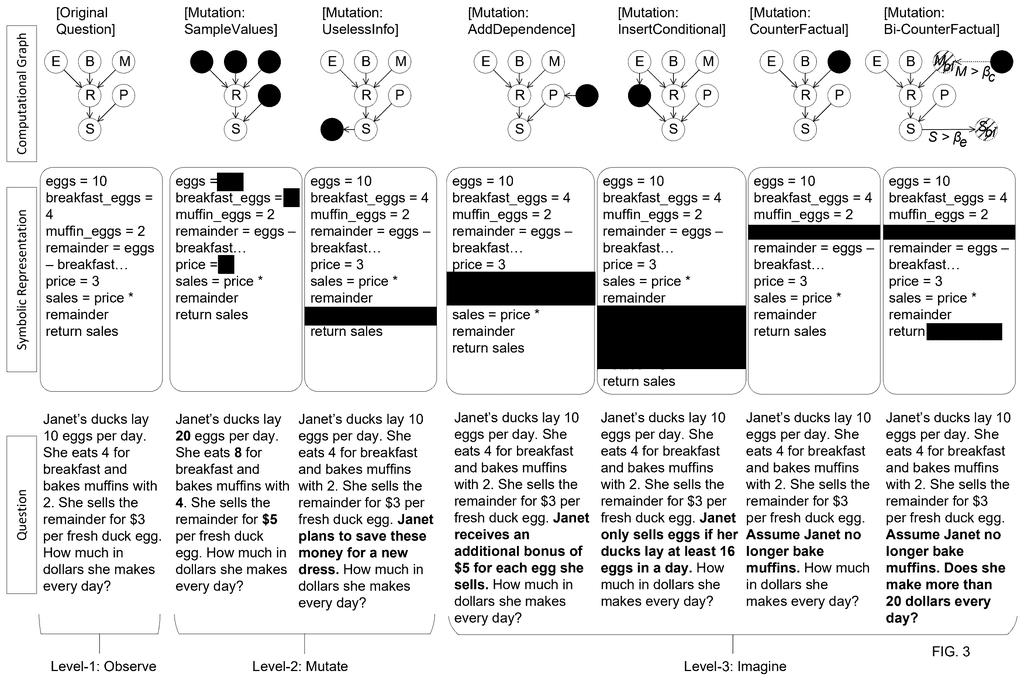
Microsoft's patent describes a system that takes a reasoning problem, converts it into a kind of symbolic blueprint (think: variables and the rules connecting them), then scrambles that blueprint to produce a new but equivalent problem. If the AI gets the original right but flubs the tweaked version, it was probably reciting, not reasoning.
The same engine that generates test problems can also be used to train AI, feeding it a constant stream of fresh variations so it never gets the chance to simply memorize its way to a correct answer. The goal is AI that actually works through a problem rather than pattern-matching to something it has seen before.
generating, based on a reasoning problem, a symbolic representation of the reasoning problem, the symbolic representation comprising a first variable, a second variable and a dependency between the first variable and the second variable; …
Translation: The system turns a logic puzzle into a math formula with connected moving parts.
How the symbolic mutation engine generates fresh test problems
The system starts with an existing reasoning problem written in plain language, such as a logic puzzle or a word problem. It converts that problem into a symbolic representation (a structured, machine-readable form that captures the variables in the problem and the mathematical or logical relationships between them, rather than the specific numbers or words).
That symbolic representation is then mutated: variables are changed, dependencies between them are rewired, and new values are substituted in a controlled way. The result is a symbolic problem variant, which the system then translates back into natural language to produce a fresh, human-readable problem that is logically related to the original but not identical.
Because the system generated the variant programmatically, it also knows the correct answer without having to ask a human. That programmatically derived ground truth is used to grade the AI's output.
The patent describes two main applications:
- Testing: running a reasoning model against the generated variants to see whether its accuracy holds up or collapses when the surface details change.
- Training: repeatedly exposing a model to newly synthesized variants during its learning phase so it builds genuine problem-solving habits rather than answer-recall habits.
… comparing model-generated answers against programmatically derived ground truth to distinguish genuine reasoning from memorized patterns.
Translation: This step checks if the AI actually figured out the answer or just looked it up.
What this means for AI you rely on to solve real problems
For anyone using an AI assistant to solve problems, check logic, or answer factual questions, the difference between a model that reasons and one that recites is the difference between a tool you can trust in new situations and one that only works when the question looks familiar. This patent targets that gap directly.
Microsoft's push into AI reasoning reliability shows up here as infrastructure rather than a flashy feature. You probably wouldn't notice this system working; you'd only notice its absence when an AI confidently gives you a wrong answer to a problem it has never quite seen before. Getting this right is what separates AI that scales to real-world use from AI that performs well only on its own training material.
Microsoft's 28th filing we've tracked in our Enterprise AI coverage since May connects to earlier applications like one that learns from AI errors and one linking business data tables.
The memorization problem in AI is real and underappreciated by most people who use these tools. A language model trained on billions of examples has almost certainly seen problems that look like the ones it gets tested on, which makes standard benchmarks unreliable as measures of actual thinking.
Microsoft's approach here is methodical: generate problems you know the answer to, vary them systematically, and see if the model keeps up. That is a reasonable engineering response to a hard problem, and it addresses something users would directly benefit from: AI that stays correct when a question is phrased differently or the numbers change.
The catch is that symbolic mutation only goes so far. It works well for problems with clean logical structure (math, scheduling, certain kinds of deduction) but gets harder to apply to the messier reasoning humans actually need help with. This is a solid step toward more trustworthy AI, but not a complete answer.
Get our take in your Top Stories
Liked this breakdown? Add Patentlyze as a preferred source on Google, and our plain-English take shows up more often in your Top Stories the next time Microsoft patent news breaks.
There are more where this came from
We read every patent application Big Tech publishes and send you the ones worth knowing. Plain English, free, every week.
The drawings
5 drawing sheets from US 2026/0259817 A1 · click any drawing to enlarge


Want this weekly breakdown for a company we don't cover? Patentlyze Pro →
Be the first to weigh in