
Meta Patents a Multi-Camera System That Boosts Image Sharpness in AR Glasses
AR glasses have a real hardware problem: small frames mean small cameras, and small cameras mean blurry images. Meta's latest patent describes a way to spread several cameras across a pair of glasses and stitch their output into a single, sharper picture.
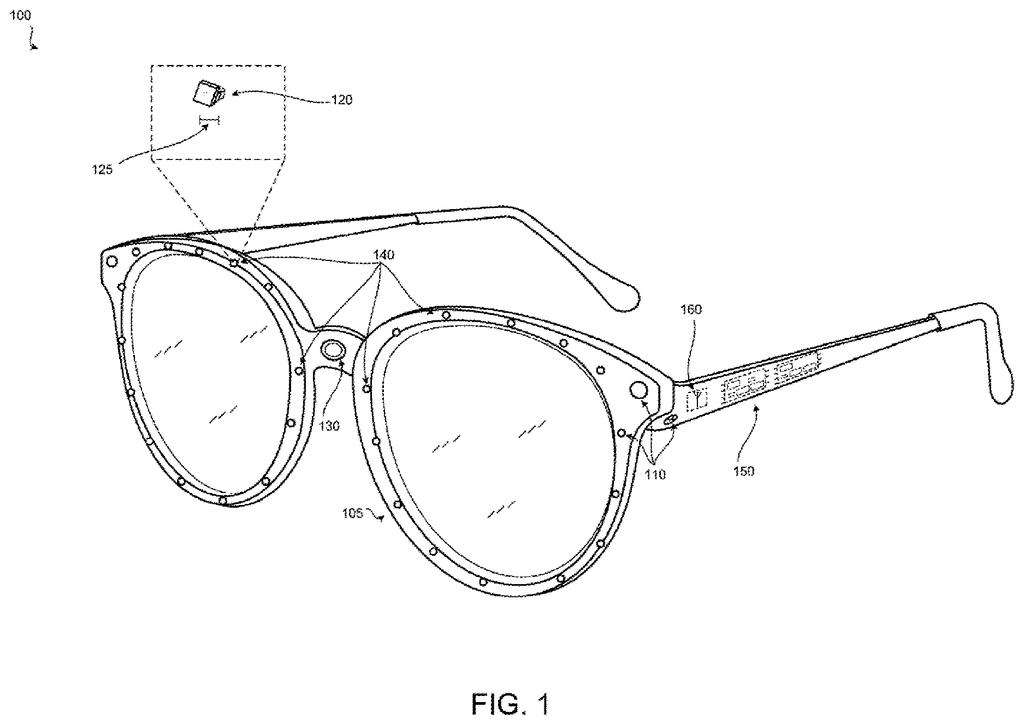
What Meta's distributed AR camera system actually does
Today's AR glasses are squeezed for space. Fitting cameras, sensors, and a computer into a frame no bigger than a pair of sunglasses means every component is a compromise, and image quality usually suffers most.
Meta's patent describes a smarter way to use the cameras that are on the glasses. One wide-angle camera runs continuously, capturing everything in front of you. A set of narrower cameras around the frame wake up only when needed, each covering a tighter slice of your view. A small onboard computer then pulls all those images together.
The key step is combining two different ways of reading those images: one method finds fixed landmarks (like a door frame or a logo), and another tracks how things are moving from moment to moment. Blending both produces a single image sharper than any one camera could deliver on its own.
… computationally combine the first output image and the second output image set to generate a third output image having a resolution higher than a corresponding first image acquired by the first sensing device.
Translation: The system merges different camera views to create a sharper, high resolution final picture.
How the two image-processing methods combine into one sharper frame
The system centers on a computing module that coordinates several cameras built into the glasses frame. One primary camera captures a continuous wide-field stream. Secondary cameras, each with a narrower angle of view, turn on selectively to fill in detail where it is needed, conserving battery.
The computing module then runs two parallel image-analysis passes on the incoming footage:
- Local feature matching: the system identifies stable, recognizable points in the scene (think: corners of objects, text characters, distinct edges) and matches them across camera feeds. This anchors the combined image to real-world reference points.
- Optical flow correspondence: this technique (which measures how pixels shift between consecutive frames, essentially reading the direction and speed of motion) fills in the areas between those stable anchors, capturing smooth movement and fine texture.
The two outputs are then computationally combined into a third image whose resolution is higher than anything the wide camera alone could produce. The claim specifies this explicitly: the final image must exceed the resolution of the primary camera's raw output.
Because the secondary cameras activate selectively rather than running all the time, the design is meant to balance image quality against the power limits of a wearable device.
The system includes a computing module in communication with a plurality of spatially distributed sensing devices.
Translation: A central computer connects with multiple tiny cameras spread out across the AR glasses frame.
What this means for the future of AR glasses image quality
For anyone who has tried a current generation of AR glasses, image clarity is one of the first things you notice missing. Overlaying digital information on a blurry or low-resolution real-world view breaks the illusion fast. A system that can pull sharper images from the same cramped hardware, without draining the battery in an hour, would meaningfully close that gap.
Meta's long bet on AR glasses shows up clearly here. This patent is squarely aimed at the engineering bottleneck that has held back every lightweight AR headset: you cannot simply bolt on a bigger camera. Getting more out of the cameras you already have is the only real path, and this filing describes a concrete method for doing exactly that.
This is the 62nd Meta filing we've tracked in our AR glasses race since May, adding to work like their controller position tracking and lower-memory display sharpening patents.
Claim 1 is broader than it might first appear. It does not specify any particular camera hardware, any resolution threshold, or any particular algorithm inside the feature-matching or optical-flow steps. What it covers is the architecture : a primary wide-angle camera running continuously, secondary narrow-angle cameras activating selectively, and a computing module that blends two categories of image analysis into a higher-resolution output.
That breadth matters in practice. If granted as written, the claim could reach any AR glasses maker who uses a hub-and-spoke camera arrangement combined with both feature matching and motion-based image processing, regardless of how their specific algorithms work. That is a wide perimeter around a fairly general idea.
The prior art challenge here will be real. Computational photography on phones has used multi-lens fusion and optical-flow sharpening for years, and AR headset researchers have published extensively on distributed sensing. Whether Meta can distinguish its framing from existing work will decide how much of that claimed territory it actually gets to keep.
There are more where this came from
We read every patent application Big Tech publishes and send you the ones worth knowing. Plain English, free, every week.
The drawings
25 drawing sheets from US 2026/0278813 A1 · click any drawing to enlarge


Want this weekly breakdown for a company we don't cover? Patentlyze Pro →