
Salesforce Patents a Side Panel That Ranks and Unifies Sales Data in One Place
Salespeople routinely jump between five or six different screens to get a complete picture of a single deal. Salesforce has filed a patent for a side panel that pulls all of that information into one place, ranked by what matters most.
What Salesforce's unified data panel actually does for salespeople
A sales rep opens a deal record and immediately has to check email threads in one tab, activity logs in another, and a third-party forecasting tool somewhere else entirely. That's a lot of context-switching just to know where a deal stands.
Salesforce's patent covers a side panel that sits inside the existing CRM window and collects data from all those scattered sources at once. Instead of each data source showing up in its own format, the system converts everything into a consistent visual shape so the panel looks clean and predictable no matter where the information came from.
The panel also doesn't just dump everything in front of you. It uses rules and categories to decide which pieces of information are most important right now, then lists them in that order. The idea is that you see the most relevant insight first, without hunting for it.
… determine, dynamically, an order for the plurality of insights based, at least in part, on a plurality of priorities determined based on the categorizing …
Translation: The system automatically sorts sales insights by priority to show what matters most.
How the insight aggregator standardizes and ranks incoming data
The patent describes three main components working together.
First, an insight aggregator connects to multiple data sources, which could include internal CRM records, activity logs, or external tools, and converts their outputs into a standardized data format. That means different sources don't produce differently shaped cards or widgets; they all conform to the same template so the interface stays consistent.
Second, a record database stores the underlying deal or account data that feeds into the aggregator. The aggregator draws on this as one of its inputs.
Third, a processor takes the aggregated insights and runs them through a categorization step using metadata (descriptive tags that tell the system what kind of information each insight is). Based on those categories and a set of priority rules, the processor dynamically determines the order in which insights appear.
- Data arrives from multiple sources in different formats
- The aggregator normalizes everything into one standard shape
- Insights are tagged, categorized, and ranked by priority rules
- The ranked, standardized list appears inside a web application as a unified side panel
The result is a panel that lives inside the existing CRM interface, updates dynamically, and always shows the most relevant information at the top.
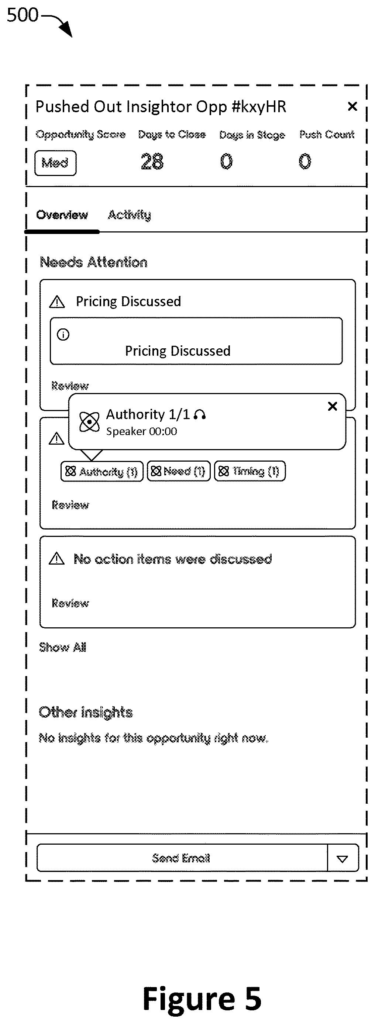
The pipeline interface provides an interface illustrating key metrics, activities, insight, and/or other categories.
Translation: A single dashboard displays important sales metrics and activities all in one place.
What this means for sales teams drowning in CRM tabs
For sales teams, scattered data is a daily friction cost. Every minute spent clicking between tools is a minute not spent on a customer call, and CRM adoption often drops precisely because the tool feels like extra work rather than a shortcut. A panel that consolidates and ranks information inside the existing interface removes at least some of that friction.
For Salesforce as a platform, this kind of standardization layer matters strategically. Salesforce's bet on AI-driven CRM surfaces depends on having clean, normalized data to work with. A unified display format also makes it easier to layer new data sources on top later, since the interface already knows how to handle inputs in a consistent shape.
This is the 84th Salesforce filing in our Salesforce coverage since May, adding to work on agent permissions and image understanding.
The problem this patent targets is real and well-documented: CRM tools are only as useful as the data people can actually find inside them, and context-switching is a genuine drag on productivity. Salespeople are not abandoning their CRMs because the data isn't there; they're abandoning them because getting to the right data takes too many clicks.
That said, the solution here is more of an interface design patent than a technical leap. Aggregating data from multiple sources, normalizing formats, and ranking by priority are all established ideas. The claim is essentially that Salesforce has built a specific, integrated version of this inside a web application with a defined ordering mechanism.
The value, if it works as described, is practical rather than dramatic. Sales teams using Salesforce every day could genuinely benefit from fewer tabs open during a deal review. Whether this patent describes something meaningfully different from what Salesforce or its competitors already ship is a harder question than the filing answers.
There are more where this came from
We read every patent application Big Tech publishes and send you the ones worth knowing. Plain English, free, every week.
The drawings
13 drawing sheets from US 2026/0277938 A1 · click any drawing to enlarge


Want this weekly breakdown for a company we don't cover? Patentlyze Pro →