
Amazon Patents a Search Shortcut That Finds AI Database Results Faster
Every time you search for something "similar" in an AI app, the database underneath is doing expensive math. Amazon has filed a patent for a way to short-circuit much of that work by getting smarter about which stored results are worth reusing.
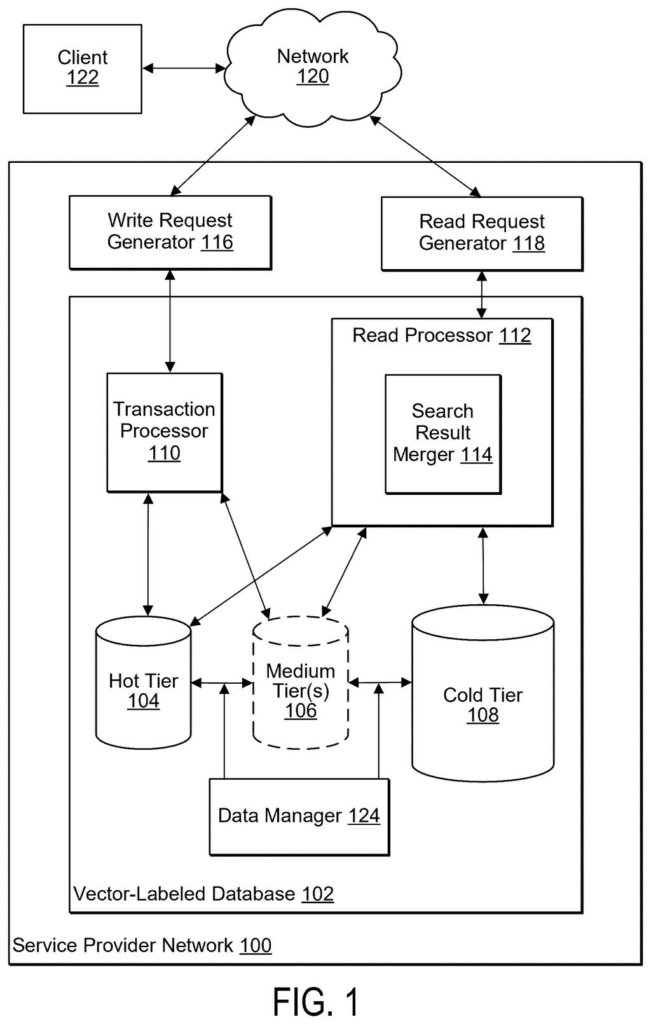
What Amazon's cluster-aware cache routing actually does
Right now, when a database receives two nearly identical search requests back to back, it often does the full expensive calculation twice anyway, because nothing told it the first answer was sitting nearby in a cache. That's a lot of wasted work.
Amazon's patent describes a router that, before forwarding your search to the main database, does a quick preliminary scan to figure out roughly where your query falls in the data. Think of the data as a giant map of neighborhoods. The router figures out which neighborhood your search belongs to, then sends you straight to the cache that stores answers for that neighborhood.
The result is that two searches for similar things land in the same cache more often, so the second request can reuse the first request's answer instead of recomputing it from scratch. Faster responses, less server work, lower costs.
… determine a portion of vector space for the request vector using at least a first layer of an approximate nearest neighbor index search; select, based on the determined portion of vector space for the request vector, a particular cache of the set of caches …
Translation: The router looks at the early stage of a search to pick the right cache to check.
How the router picks the right cache before querying
The patent centers on vector databases, which store information as lists of numbers (vectors) that represent meaning or similarity. When you ask an AI app to find items "like" something, the database searches for vectors that are mathematically close to your query vector.
Finding those close vectors is called an approximate nearest neighbor (ANN) search. ANN indexes organize vectors into a hierarchy of clusters, a bit like a tree, so the search can skip most of the data and only examine the relevant branch. This is fast but still non-trivial at scale.
Amazon's proposed system adds a router that performs only the top layer or two of that tree traversal before the full query is handed off. That partial scan is cheap, and it tells the router which cluster node the query vector is closest to. The router then maps each cluster node to a dedicated cache.
- Query comes in with a search vector.
- Router does a shallow ANN traversal to identify the relevant cluster.
- Router selects the cache associated with that cluster.
- The cache is checked first; a hit returns the result immediately.
- On a miss, the full database is queried and the result is written back to that same cluster's cache.
Because similar queries always route to the same cache, repeated or near-identical searches accumulate in one place, making cache hits far more likely than if results were scattered randomly.
The router may direct all reads with search vectors close to the particular node to the associated cache.
Translation: Similar searches are funneled to the exact same cache to speed things up.
What this means for AI search speed at cloud scale
Vector databases are the backbone of AI-powered search, recommendation engines, and retrieval-augmented generation systems (the technique that lets AI chatbots look up facts before answering). They run at enormous scale inside cloud platforms, and the cost of repeated ANN searches adds up fast. A higher cache hit rate means fewer full searches, which translates directly to lower latency for your app and lower compute bills for the business running it.
Amazon has been filing around vector-database infrastructure since at least 2023, which fits with AWS's heavy investment in AI search services. This patent targets a specific, measurable inefficiency rather than making broad claims, which suggests it addresses a real bottleneck the team has observed in production workloads.
Amazon's third filing in the Language AI patents we've tracked since May follows one turning text into animated video and one adding formal logic to LLMs.
The problem this patent attacks is real and quantifiably expensive. At cloud scale, a modest improvement in cache hit rates for a high-traffic vector database can save meaningful compute costs every day, not in theory but in actual server time and energy.
The approach is proportionate to the problem. The router's partial tree traversal is a low-overhead operation, so the system doesn't spend expensive resources to decide where to route cheap queries. That's a sensible trade-off, and it's the kind of engineering discipline that tends to work in production.
This is infrastructure plumbing, not a headline AI capability. But AI applications are only as fast and affordable as the data layer underneath them, and that layer gets very little public attention. Anyone building on top of AWS vector search services stands to benefit if this routing logic makes it into a shipping product.
There are more where this came from
We read every patent application Big Tech publishes and send you the ones worth knowing. Plain English, free, every week.
The drawings
15 drawing sheets from US 2026/0288835 A1 · click any drawing to enlarge


Want this weekly breakdown for a company we don't cover? Patentlyze Pro →
Be the first to weigh in