
AMD Patents a GPU That Draws Less Detail When You're Already Moving the Camera
AMD has filed a patent for a rendering system that deliberately lowers image quality during the exact moments you're least likely to notice: when the GPU is struggling and you're actively spinning or dragging a 3D scene.
What AMD's load-sensing render trick actually does
A gamer tilts the camera during a hectic firefight. The scene is already pushing the graphics card hard, and motion blur makes fine detail irrelevant for half a second. AMD's new patent targets that exact window.
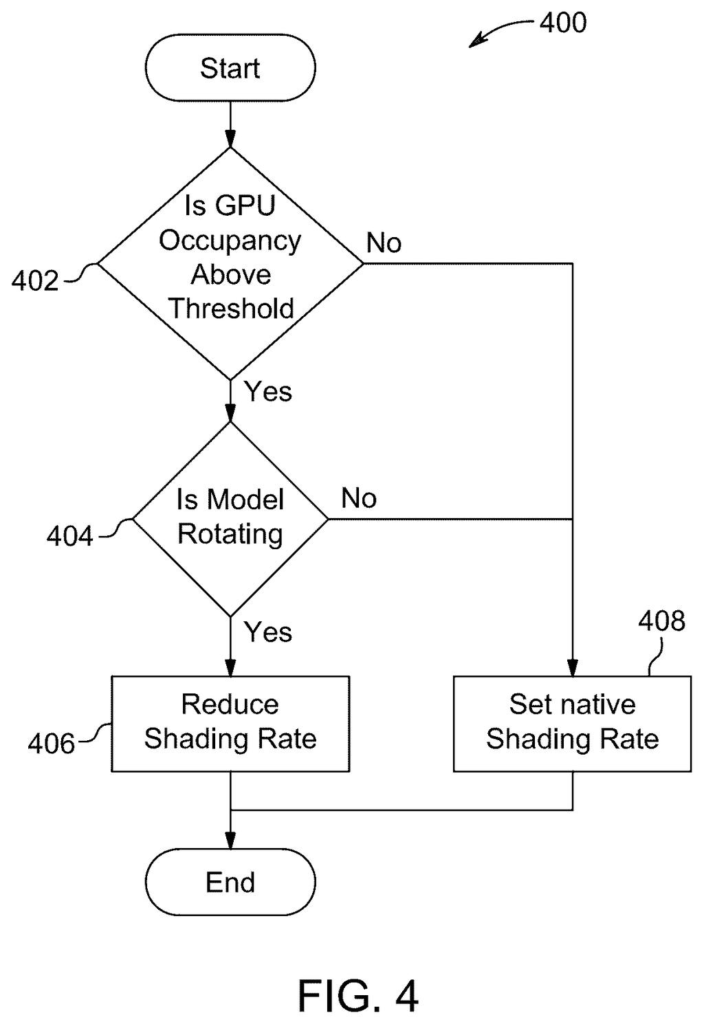
The idea is to let the GPU draw images at a lower level of detail (called the shading rate) only when two things are true at once: the chip is already running close to its limit, and you're actively interacting with the scene, like rotating a model or panning a view. If either condition isn't met, the image renders at full quality.
The system looks at how busy the GPU was during the previous frame or frames and combines that with whether your mouse, controller, or touch input was active. When both signals are high, it dials back the detail automatically. When things calm down, full quality returns. You get a smoother experience without a manual settings change.
… wherein the shading rate is reduced from a native shading rate in cases where both the user is interacting with the model and the GPU occupancy exceeds a threshold occupancy level and wherein the shading rate is the native shading rate otherwise.
Translation: Detail is lowered only when the user is moving and the graphics card is too busy, and stays normal the rest of the time.
How the GPU reads load and input to pick a shading rate
The patent describes a method called adaptive variable rate shading (VRS), a technique that lets a GPU shade different parts of a frame at different resolutions rather than calculating full pixel-level detail everywhere.
What makes this filing specific is the two-signal trigger. The GPU tracks two inputs simultaneously:
- GPU occupancy: how much of the chip's processing capacity is already in use (think of it like a CPU usage bar, but for the graphics card).
- User interaction: whether the person is actively moving or manipulating the 3D scene at that moment.
The shading rate only drops below the native (full) rate when both thresholds are crossed at the same time. If the GPU is busy but the scene is static, full quality holds. If you're dragging the view but the GPU has headroom, full quality holds. Only the overlap triggers the reduction.
The system samples occupancy and interaction data from the immediately preceding frame, or averages them across several recent frames, and feeds that history into the decision for the current frame. This makes the adjustment reactive but not jittery, since it's working from a recent trend rather than a single spike.
What this means for PC gaming and 3D software users
For everyday PC gaming or 3D design work, this kind of automatic quality management matters because manual graphics settings are a blunt instrument. You either run at high quality all the time (and risk stutters) or you drop settings globally (and lose detail even when the GPU has spare capacity). AMD's approach tries to match quality to the actual moment.
From a product standpoint, this is most useful for workloads with variable demand: open-world games where load spikes unpredictably, CAD or 3D modeling tools where users rotate heavy meshes, or real-time rendering pipelines. AMD has been filing around GPU efficiency and workload management since at least 2023, and this patent fits that pattern. If the technique reaches production drivers, users could get steadier frame rates without a visible quality hit during calm moments.
AMD's 14th filing we've tracked since June in our GPU rendering race watchlist follows work like cutting ray-trace memory waste and AI texture compression.
Claim 1 draws a tight circle around one specific trigger: the graphics processor must be heavily loaded **and** the user must be actively doing something, like moving a camera or pressing a button, at the same time. Both conditions must be true together before the system reduces image detail. That conjunction is the full extent of what this patent would block if granted.
In practice, that scope is narrow. A product that reduces image quality based on processor load alone, or based on user movement alone, falls outside this claim entirely.
Whether that narrow slice matters depends on whether real software actually reaches for that two-condition design. The filing describes the logic clearly but offers no evidence that requiring both signals together produces better results than simpler approaches, leaving open the question of whether this protects a decision engineers would make anyway.
There are more where this came from
We read every patent application Big Tech publishes and send you the ones worth knowing. Plain English, free, every week.
The drawings
8 drawing sheets from US 2026/0289892 A1 · click any drawing to enlarge


Want this weekly breakdown for a company we don't cover? Patentlyze Pro →
Be the first to weigh in