
Meta Patents AR Glasses Where the Lens Is Part of the Frame Itself
Meta has filed a patent for a way to bake corrective lenses directly into the rigid frame of augmented reality glasses, potentially cutting out the clip-on inserts and add-on optics that make today's AR headsets so chunky.
What Meta's frame-molded AR lens actually does
You're wearing a pair of AR glasses and trying to read a floating menu in front of you, but the whole rig sits awkwardly on your face because there's a layer of clip-in prescription lenses bolted between you and the display. That extra hardware adds weight, shifts things out of alignment, and makes the glasses look nothing like a normal pair.
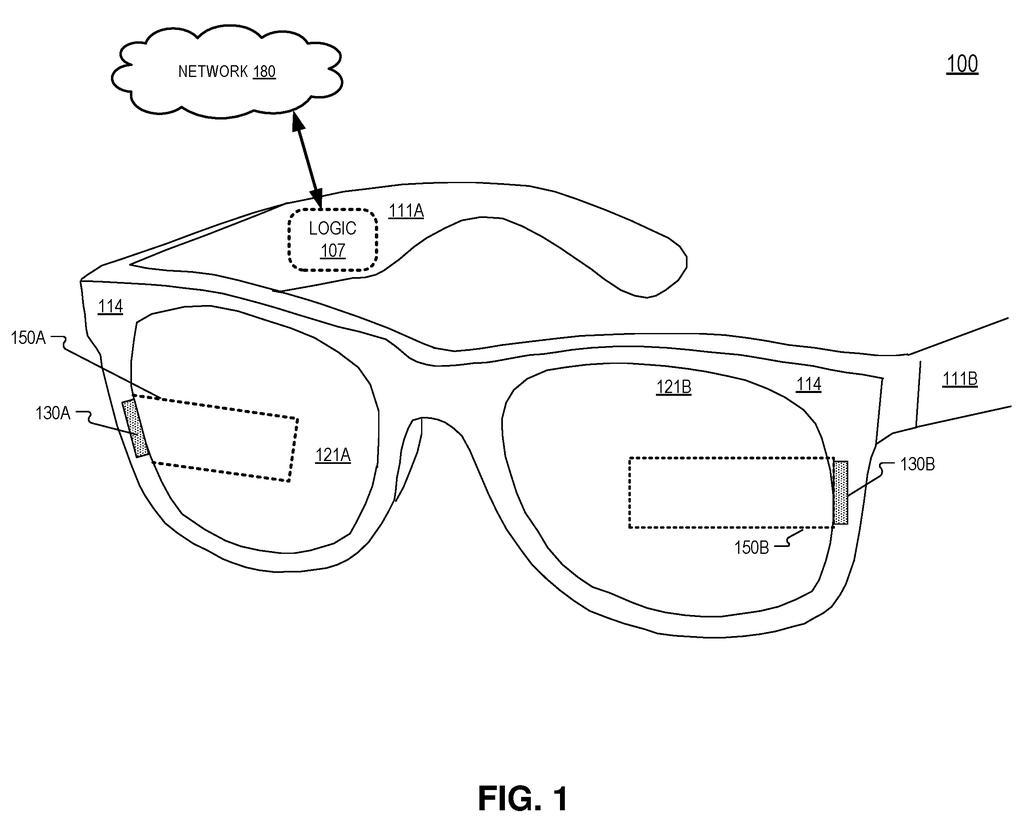
Meta's new patent tackles that by fusing one of the corrective lenses directly into the glasses frame itself during manufacturing, as one continuous molded piece of optical plastic. The waveguide (the thin slab that beams digital images toward your eye) sits sandwiched between that built-in lens and a second lens on the outer side. Together, the two lenses do two jobs: one focuses the screen content onto your eye, and the other handles real-world focus, so both the digital overlay and the scene in front of you look sharp.
The result, in theory, is a thinner, lighter frame with fewer separate parts that can loosen or misalign over time.
… an eye-side lens integrated with the structural frame as a molded contiguous refractive material, wherein the eye-side lens has a first optical power configured to focus the display light to the eyebox region …
Translation: The inner lens is molded directly into the frame to help direct the projected image to your eye.
How the waveguide sits between two fused optical layers
The patent describes a head-mounted display whose core optical stack has three layers: an eye-side lens (between your eye and the waveguide), the waveguide itself, and a world-side lens (facing outward toward the scene in front of you).
The key claim is that at least one of those lenses is integrated into the structural frame as a molded contiguous refractive material. "Contiguous" means there is no seam or joint; the lens and the frame are one unbroken piece of optical-grade plastic or polymer, formed together in a single mold. This is different from today's approach, where the frame holds the optics as separate inserted components.
- Eye-side lens: has a specific optical power (how strongly it bends light) tuned to focus the waveguide's projected display image onto the eyebox, the zone where your eye needs to be for the picture to look right.
- Waveguide: a thin, flat light guide that takes display output and angles it toward your eye. It sits between the two lenses.
- World-side lens: has its own optical power, and the combined power of both lenses together focuses real-world light from the scene onto your eye as well.
By splitting the optical correction across two surfaces (and hiding one inside the frame), Meta can potentially tune each surface independently, making the overall system easier to manufacture in prescription variants without adding a separate insert.
What this means for thinner, prescription-ready AR glasses
For anyone who wears glasses, AR headsets have always had an awkward fit problem. Most current devices either require you to remove your prescription glasses, wear uncomfortable contact lenses, or attach a custom insert inside the headset at extra cost. A frame where corrective optics are baked in from the start could make prescription AR glasses far more practical to produce at scale.
Thinner frames also matter for how the device looks and feels worn all day. several Meta filings on optics and wearable display hardware this year suggest the company is trying to close the gap between today's bulky prototypes and something you would actually wear in public. If the molded-lens approach reduces part count and assembly complexity, it could bring manufacturing costs down too, which eventually affects what you pay.
Meta's 68th filing we've tracked since May in the AR glasses race adds to a run that includes typing on flat surfaces and rescuing hand tracking in low light.
Claim 1 is fairly specific: it requires a waveguide, two lenses with defined optical powers that work together, and one of those lenses molded as a single contiguous piece with the frame. That last requirement is the load-bearing part of the claim. It would not block a competitor from making AR glasses with separately inserted prescription lenses, or from achieving the same optical result with lenses that are bonded or slotted into the frame rather than molded as one piece.
The practical scope, then, is narrower than the headline suggests. Another manufacturer could design around this by keeping the lens as a discrete component that clips or glues into the frame housing, which is essentially how most hardware is built today. What the claim does protect, if granted, is the specific manufacturing shortcut of treating the lens and the structural frame as a single molded object.
That shortcut matters more for production economics than for optics. Fewer parts, fewer assembly steps, and fewer potential failure points are real manufacturing wins. Whether that particular approach is novel enough to survive examination is a separate question, but the engineering motivation behind the filing is clear and practical.
There are more where this came from
We read every patent application Big Tech publishes and send you the ones worth knowing. Plain English, free, every week.
The drawings
10 drawing sheets from US 2026/0287906 A1 · click any drawing to enlarge


Want this weekly breakdown for a company we don't cover? Patentlyze Pro →
Be the first to weigh in