
Sony Patents a Visual Map That Shows a Robot Every Angle It Can Photograph From
Programming a robot to photograph something without bumping into walls or missing the shot is surprisingly hard. Sony's new patent turns that problem into a picture.
What Sony's robot camera planning tool actually does
Every time a factory robot tries to inspect a part or photograph an object, an engineer has to figure out exactly where the robot arm can move to get a usable image. That process usually means trial and error, manual calculations, or specialized software that only experts understand.
Sony's patent describes a tool that takes the position of whatever the robot needs to photograph and automatically calculates every location the robot could move to in order to get a clear shot. Then it displays all those valid positions as a highlighted region on a map of the robot's possible movements. Instead of guessing, the operator can simply look at the map and pick a path through the highlighted zone.
Think of it like a GPS heat map, but for a robot's arm joints rather than city streets. The shaded areas tell you where you can go; everything else is off-limits for imaging. That visual shortcut could make robotic camera setups much faster to program, even for people who aren't robotics specialists.
… calculating, on a basis of a position of one or more subjects in a task space, an imageable region where a robot that images the subject is capable of imaging the subject in a configuration space of the robot …
Translation: The system figures out all possible camera angles and robot positions based on where the subjects are located.
How the system translates object positions into camera zones
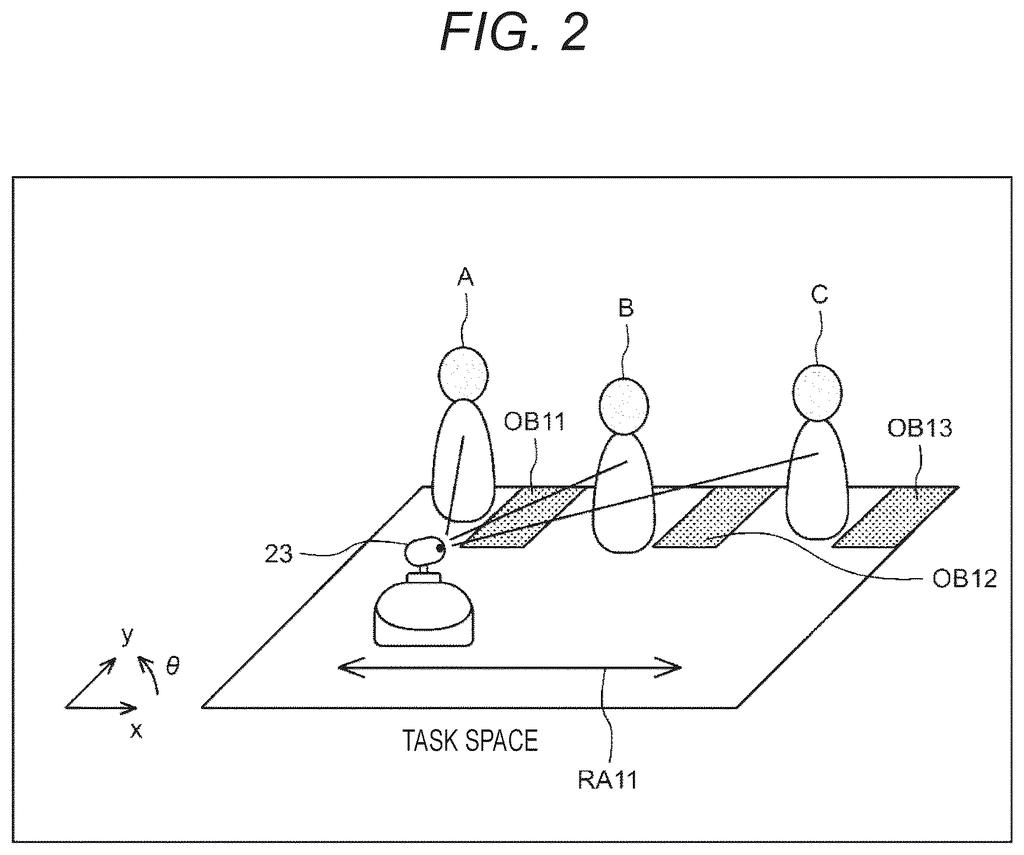
The patent centers on two connected spaces that robotics engineers work with constantly. The first is the task space (the physical world where the object sits, measured in ordinary coordinates like X, Y, Z). The second is the configuration space (a mathematical map of every possible combination of joint angles the robot arm can reach, often called C-space).
The system takes the known position of a target object in task space and works out which regions of configuration space allow the robot's camera to actually see that object clearly. Those regions are called imageable regions. Rather than outputting a list of coordinates, the system renders those regions as a visible overlay on a display of the configuration space.
Key steps the system performs:
- Reads the object's position in the physical workspace
- Computes which joint-angle combinations give the robot's camera a valid line of sight to the object
- Highlights those combinations as a region on a configuration-space map
- Displays the map so an operator can plan or verify a movement path visually
The practical result is that route planning, which normally requires inverse-kinematics calculations (math that converts a desired camera position into joint angles), becomes a matter of looking at a highlighted map and drawing a path through the green zone.
… an information processing method, an information processing apparatus, and a program capable of performing route planning more easily …
Translation: The software helps plan paths for the robot more simply.
What this means for factory inspection and robotic imaging
For anyone running an automated inspection line or a research lab that uses robotic cameras, the bottleneck is often not the robot itself but the time it takes to program safe, effective camera paths. A visual tool that collapses that calculation into a map you can read at a glance could cut setup time significantly and reduce dependence on specialists.
the pattern in Sony's robotics and imaging filings points toward combining its camera expertise with industrial automation. If this kind of tool made it into commercial robot-programming software, it could lower the skill floor for deploying camera-equipped robots in quality control, medical imaging rigs, or research environments where the objects being photographed change frequently.
Sony's 72nd filing in our Camera patent coverage since May adds to a run that includes one on avoiding mirror glare and one on bidirectional 3D depth scanning among the filings we've tracked.
For the average person, this patent is not about a consumer gadget. Its audience is the engineer or technician who has to set up a robot camera system and currently spends hours on math that this tool would turn into a two-minute map exercise.
The concrete payoff is time and error reduction at the programming stage, not at the moment the robot runs. You would notice it the first time you had to retrain a robot for a new product on the line and finished in an afternoon instead of a day.
The idea itself is not novel in the academic sense; robotics researchers have worked with configuration-space visualization for decades. What patents like this one do is package that concept into a specific, implementable system, which is where real-world value either appears or gets buried in complexity.
There are more where this came from
We read every patent application Big Tech publishes and send you the ones worth knowing. Plain English, free, every week.
The drawings
8 drawing sheets from US 2026/0288151 A1 · click any drawing to enlarge


Want this weekly breakdown for a company we don't cover? Patentlyze Pro →
Be the first to weigh in