
Sony Patents a Fix for the Blurry Edges Between AR Lens Gratings
AR glasses make light do something tricky: they bounce images off tiny etched patterns inside a thin piece of glass. Where two of those patterns meet, things can go wrong visually. Sony is patenting a specific structural fix for exactly that seam.
What Sony's grating buffer zone does for AR glasses
You're wearing a pair of AR glasses, and across your view there's a subtle smear or ghost image right where one part of the lens seems to meet another. It's distracting, and it's caused by the invisible grating patterns that guide light through the lens.
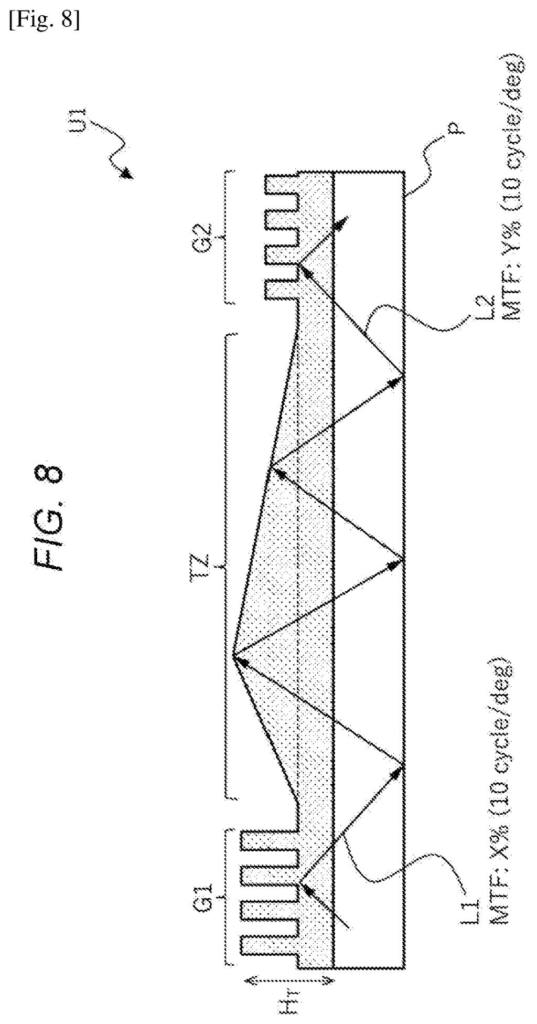
Sony's patent describes a small physical structure placed between two of those gratings. Think of it as a tiny ramp or ridge built into the lens itself: it starts flat at the edge of one grating, rises to a peak, then slopes back down before the next grating begins. That shape smooths out what would otherwise be an abrupt, glitch-causing seam.
The goal is cleaner, more consistent images across the full viewing area of an AR display. Fewer artifacts at the edges means a more natural, comfortable experience for you.
A technology for reducing an adverse effect caused by a structure formed near a diffraction grating is provided.
Translation: Sony wants to fix visual problems caused by the edges where AR lens parts meet.
How the transition zone bridges two diffraction gratings
AR and mixed-reality displays work by bouncing light through a light guide plate, which is essentially a flat piece of glass or plastic that carries an image to your eye. To get light in and steer it around, manufacturers etch tiny patterns called diffraction gratings onto the surface. These gratings act like microscopic prisms, bending light in precise directions.
The problem is that a single grating can't do everything. A typical waveguide uses multiple gratings: one to inject light, one to spread it horizontally, and one to push it toward your eye. Where two gratings sit near each other, their edges create a structural boundary on the lens surface. That boundary can scatter light unpredictably, creating visual artifacts like halos, smearing, or brightness inconsistencies.
Sony's patent introduces a transition zone structure placed at or between those grating edges. The structure has a specific cross-sectional profile: it rises from one grating edge to a peak (the "vertex point"), then descends back toward the lens surface before the second grating begins. Both endpoints sit closer to the flat lens surface than the peak does, forming a subtle arch.
This arch shape redirects or absorbs the stray light that would otherwise cause problems at the boundary. By controlling the geometry of that transition precisely, Sony aims to suppress the optical interference that comes from an abrupt grating edge.
… a transition zone structure on the first surface side of the light guide plate, wherein the transition zone structure extends from a first end point at or adjacent to the first diffraction grating to a vertex point …
Translation: The patent introduces a specially shaped ramp structure sitting right between the lens gratings.
What this means for image quality in AR headsets
AR display quality lives or dies on how clean the image looks across the full lens. Artifacts at grating boundaries are a known, persistent headache for manufacturers. Fixing them usually means tolerating performance trade-offs in the lens design, so a structural solution baked into the lens itself could let engineers optimize each grating independently without worrying as much about what happens at the seams.
For you as a user, cleaner grating boundaries mean fewer distracting visual artifacts, less eye fatigue, and a display that feels more like looking through a clear window. Given several Sony filings on waveguide display optics in recent years, this looks like incremental but real engineering progress on one of the harder problems in getting AR glasses to feel natural.
Sony's 31st filing we've tracked in the AR glasses race since July adds to earlier applications on direct eye projection and making objects see-through.
Grating boundary artifacts are one of those failures that don't appear in spec sheets but show up immediately in user experience: they make virtual objects look pasted onto the world rather than present in it. For AR glasses to move from novelty to daily tool, that kind of visual seam has to go away. The stakes are not small.
Sony's structural answer here targets the artifact at its source, in the physical shape of the lens, rather than patching over it in software after light has already scattered the wrong way. Software corrections for optical problems carry processing costs and can only partially compensate for what the glass already did badly.
What stays open is whether a precisely shaped ridge running between two etched lens regions can be produced reliably across millions of units without introducing new inconsistencies. The idea earns its keep on paper; the manufacturing floor is where it will either hold or disappear.
There are more where this came from
We read every patent application Big Tech publishes and send you the ones worth knowing. Plain English, free, every week.
The drawings
25 drawing sheets from US 2026/0287893 A1 · click any drawing to enlarge


Want this weekly breakdown for a company we don't cover? Patentlyze Pro →
Be the first to weigh in