
Google Patents an AI Assistant That Asks Before Sharing Your Data
Most AI assistants send your requests to outside services without telling you. Google's new patent describes a system that stops, asks your permission first, and offers a local fallback if you say no.
What Google's consent-first AI assistant actually does
Ever asked your phone's assistant something and wondered where that question actually went? When you tell an AI assistant to book a restaurant or check a flight, your words often travel to third-party apps and servers you've never heard of, without any warning.
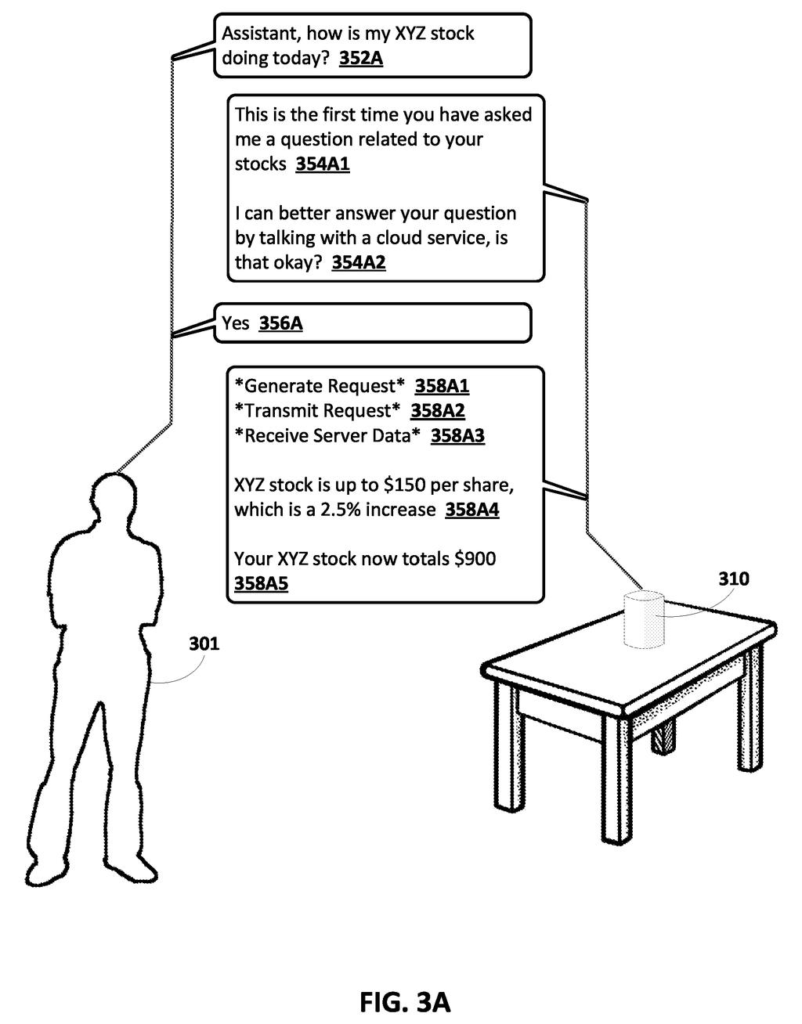
Google's patent describes an assistant that figures out, right on your device, whether your request needs to contact an outside service. If it does, the assistant pauses and asks you before sending anything. You can say yes, and it fetches what you need. You can say no, and it tries to answer using only the information already on your phone.
There's also a detail about background noise: if the assistant picks up ambient sound when it hears your request, it can adjust what gets sent to the outside service, potentially stripping out or flagging that context. The whole design puts your explicit choice between your words and any outside system that would receive them.
transmitting, to the third-party server or the third-party software application, a request to fulfill the command, the request including the command and an indication that the command cannot be stored non-transiently by the third-party server or the third-party software application …
Translation: Google sends a command to an outside app with strict instructions that it cannot be saved permanently.
How the device decides when to ask, share, or go it alone
The system works in two distinct stages, both designed to keep the user in control.
First, the device processes your voice or text input locally, meaning on the phone itself, not in the cloud. It categorizes the command to figure out what kind of request it is. If the category requires data from a third-party server or app (think a restaurant booking engine or a travel service), the device flags that before doing anything else.
Second, the system transmits a request to that outside service only after the user consents. The request includes a flag telling the third-party server that it cannot store the command non-transiently, meaning it's not supposed to keep a permanent record of what you asked. If you decline to share, the device generates a response using only local data, which may be less complete but preserves your privacy.
The patent also describes modifying outbound requests based on ambient noise captured at the moment you spoke. The exact mechanism isn't spelled out in fine detail, but the implication is that the system can detect environmental context and adjust what it sends accordingly, an additional layer of control over what third parties receive.
… generating a prompt that requests a user consent to transmitting of a request to the server and/or the third-party application to obtain the data needed to perform the certain fulfillment.
Translation: The assistant pops up to ask your permission before sharing your information with an external service.
What this means for AI assistant privacy on your phone
For most people, AI assistant privacy is a black box. You speak, something answers, and you have no idea what got logged or where. This patent addresses a real and specific gap: the moment your request leaves your device and enters a third-party system. By building the consent step into the assistant itself, rather than burying it in a settings menu, Google would make that moment visible.
The non-storage flag sent to third parties is the more ambitious piece. If honored, it could limit the data trail your requests leave behind. Whether outside services would actually comply is a separate, harder question, and patents don't answer it. But for users who feel uneasy about how much their AI assistant shares, this design at least acknowledges the concern rather than ignoring it.
Google's 53rd filing we've tracked since May in our on-device AI privacy work follows a secure ad control application and a crowd-level privacy application.
When you ask a voice assistant to check your calendar or place an order, your request often travels to outside companies you have never heard of, who may log it, sell it, or lose it in a breach. Most people have no idea this is happening, and the gap between what they assume and what actually occurs has real costs for real people.
A system that pauses to ask permission before sending data outside the device matches the actual scale of that problem. The local fallback makes the tradeoff honest: if you decline, the assistant still tries to help using only what is already stored on your phone, rather than refusing to function at all.
The weakest point is Google's instruction to outside servers asking them not to store your data. That request carries no technical force, only the hope that the outside company obeys, and users relying on that layer of protection should know it exists on paper rather than in the underlying system.
There are more where this came from
We read every patent application Big Tech publishes and send you the ones worth knowing. Plain English, free, every week.
The drawings
11 drawing sheets from US 2026/0288853 A1 · click any drawing to enlarge


Want this weekly breakdown for a company we don't cover? Patentlyze Pro →
Be the first to weigh in