
Qualcomm Patents a Way to Swap Live Radio Scans for Virtual Simulations
Every radio scan a network runs to track an object costs real wireless bandwidth. Qualcomm has filed a patent that lets a virtual copy of the network stand in for those scans, cutting the radio traffic required to get the same answer.
How Qualcomm cuts wireless scanning with virtual copies
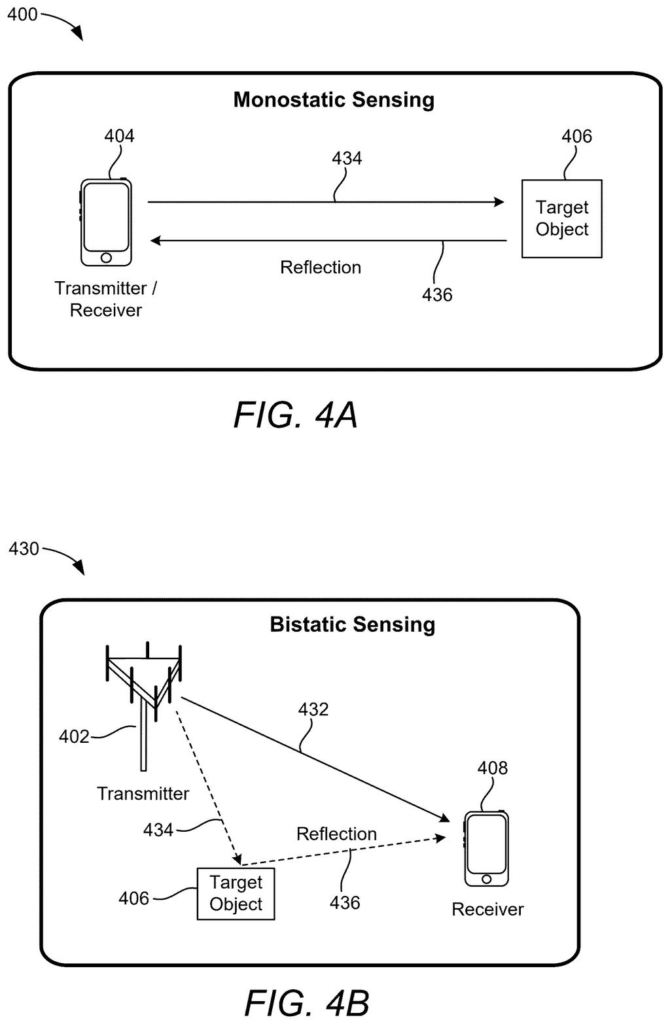
Every time a cell tower or Wi-Fi router tries to sense where something is, it has to send radio signals and measure the echoes. That costs spectrum, and spectrum is shared by everyone nearby.
Qualcomm's patent describes a system where the network runs one real scan to gather some initial data, then hands the job to a network digital twin, a detailed virtual model of how radio signals travel in that environment. The twin runs a simulated version of the scan and fills in the rest of the picture without touching the airwaves again.
The result is that your device and the devices around you share the radio spectrum more efficiently. The network learns what it needs to know about a target object by doing much of the sensing work inside a computer model rather than burning live wireless resources on every measurement.
… utilizing a NDT to simulate or emulate a second RF-S procedure for sensing the target object based on the second RF-S configuration …
Translation: Using a virtual model to run a simulated radio scan instead of relying entirely on real-world testing.
How the digital twin fills in for a real radio scan
The patent describes a two-role system. A NDT consumer (a network node that needs object-sensing data) performs a real-world radio frequency sensing (RF-S) procedure, essentially sending radio signals and recording the reflected measurements for a target object.
Those real measurements are passed to a NDT producer, the node that runs the digital twin. The producer analyzes the incoming data to identify a set of sensing hypotheses, candidate models of the physical environment and the target's properties that would produce radio measurements consistent with what was actually observed. Think of it like a detective narrowing down suspects from a list of possibilities.
From those hypotheses, the producer configures a second sensing procedure and runs it entirely inside the network digital twin (NDT), a software model of the network's radio environment. The simulation produces detailed information about the target (position, movement, size) without transmitting a single additional radio signal.
The target information from that simulation is then sent back to the consumer. Key claimed benefits include:
- Lower RF resource consumption, fewer real transmissions needed
- Faster results when the twin can simulate faster than hardware can scan
- Reduced interference for other devices sharing the same spectrum
… reducing a radio frequency (RF) resource utilization associated with RF-S operations …
Translation: Saving valuable wireless network capacity by swapping physical radio scans for computer simulations.
What this means for crowded wireless networks
Radio spectrum is one of the most constrained resources in modern wireless networks. As more devices use RF sensing for functions like indoor positioning, gesture recognition, and object detection, the competition for that spectrum grows. A system that can replace many of those scans with simulation could help networks scale sensing features without adding congestion.
Qualcomm keeps filing on wireless sensing and digital-twin infrastructure, and this patent fits that pattern. If the approach makes it into base stations or chipsets, it could let future Wi-Fi or 5G networks sense the physical world around them at far lower cost to everyone sharing the air.
Qualcomm's 461st filing in our Qualcomm coverage since May adds to a thread that includes a phone requesting sharper AI data and an AI road threat co-pilot.
Wireless spectrum is finite, sensing applications are multiplying fast, and every over-the-air scan taxes every nearby device sharing that airspace. That pressure grows heavier each year, which makes the engineering motivation here easy to respect.
The method works only if a virtual copy of a physical environment stays accurate enough to substitute for the messy real world. Indoor spaces with moving people, shifting furniture, and unpredictable signal reflections are notoriously hard to model, and a virtual twin that drifts from its physical counterpart would produce sensing errors that nobody would catch quickly.
The patent protects the architecture of this approach, not the accuracy of the underlying model, and accuracy is precisely where almost all the value either appears or disappears. That gap between what is claimed and what actually determines success is the central question any serious reader should hold onto.
There are more where this came from
We read every patent application Big Tech publishes and send you the ones worth knowing. Plain English, free, every week.
The drawings
15 drawing sheets from US 2026/0291632 A1 · click any drawing to enlarge


Want this weekly breakdown for a company we don't cover? Patentlyze Pro →
Be the first to weigh in