
Microsoft Patents an AI System That Tracks Online Behavior to Detect Cyberattacks
Every time something happens in a cloud system, Microsoft's patented approach gives that event a unique digital fingerprint, so anything that looks even slightly off gets flagged automatically.
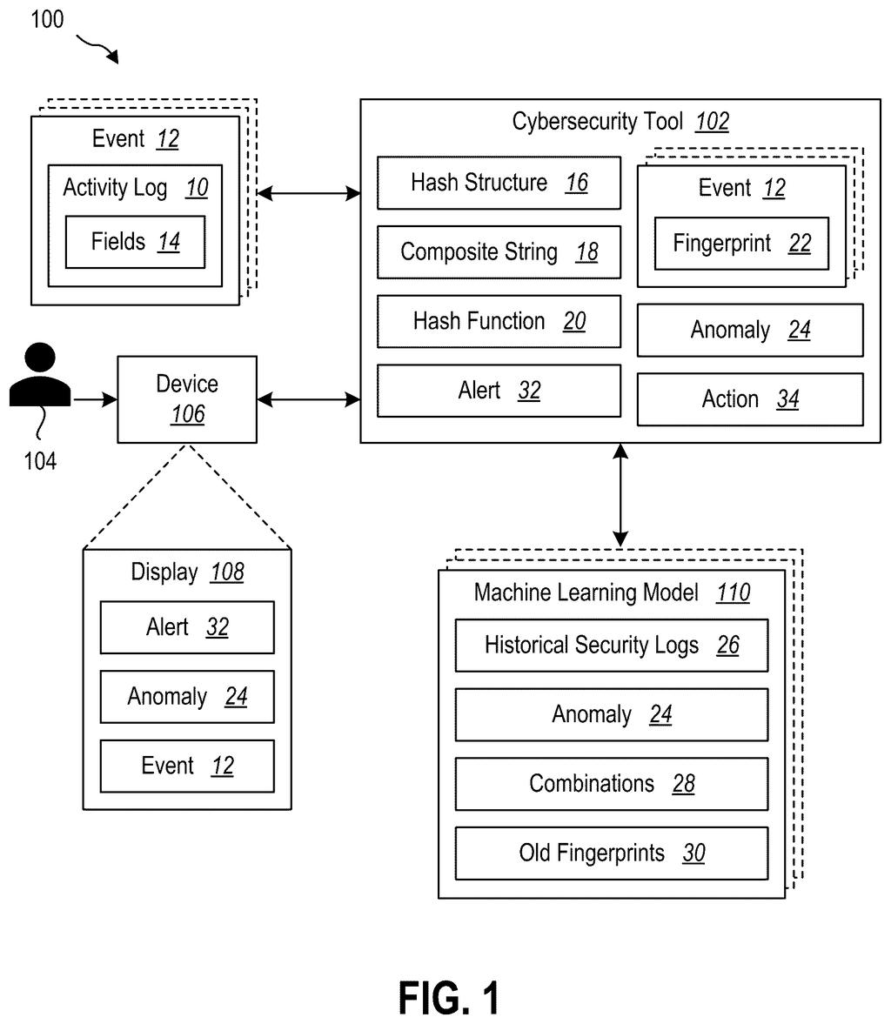
What Microsoft's cloud activity fingerprinting actually does
You're running a company on cloud software, and somewhere in thousands of automated daily actions, a hacker does something they shouldn't. No alarm goes off because the action looks, on the surface, pretty normal.
Microsoft's patent describes a system that assigns a unique fingerprint to every event in a cloud environment, like a login, a file access, or a settings change. That fingerprint is generated by feeding details from activity logs into a machine learning model, which compresses them into a short, fixed code. If a later event produces a fingerprint that doesn't match expected patterns, the system flags it as suspicious.
Think of it like a bouncer who has memorized every regular guest's face and handshake. A new combination, even a subtle one, triggers a second look. The goal is to catch threats that would otherwise blend in with normal traffic.
… forming, by the machine learning model, a composite string with the information; applying, by the machine learning model, a hash function to the composite string; generating, by the machine learning model, a fingerprint for the event in response to applying the hash function to the composite string, wherein the fingerprint is a unique value for the event; …
Translation: The system turns log data into a unique ID to track online behavior.
How the hash function builds a unique event fingerprint
The system starts by pulling fields from an activity log (a running record of everything that happens in a cloud environment, like who logged in, from where, and what they touched). A machine learning model extracts relevant pieces of information from those fields and combines them into a single composite string, essentially one long text value that represents all the key details of that event.
That composite string is then run through a hash function (a mathematical process that converts any input into a short, fixed-length code). The result is a fingerprint: a unique value tied to that specific event and its combination of attributes. Because hash functions are deterministic, the same event always produces the same fingerprint, and any change to the underlying details produces a completely different one.
The system then compares fingerprints across events to look for anomalies (patterns that deviate from what's normal). When something unusual is detected, the system triggers an action, which could mean alerting a security team, blocking the activity, or logging it for review.
- Extracts data fields from cloud activity logs
- Builds a composite string from those fields
- Applies a hash function to produce a unique fingerprint
- Flags fingerprints that indicate anomalous behavior
The systems and methods generate a unique fingerprint for an event in the cloud environment using a hash structure. The systems and methods detect an anomaly in the event using the fingerprint.
Translation: Cloud activity is checked for unusual patterns by comparing unique event IDs.
What this means for cloud security and IT teams
For IT and security teams, the promise here is reducing the needle-in-a-haystack problem. Cloud environments generate enormous volumes of log data every day, and manually reviewing it for threats is not realistic. A fingerprint-based approach gives analysts a consistent, machine-readable way to compare events at scale, potentially catching attacks that slowly build over time rather than triggering obvious alarms.
For everyday users, the impact is indirect but real: better cloud security means your data stored in Microsoft 365, Azure, or similar services is harder for attackers to access. The system is designed to catch the subtle intrusions, the ones where a bad actor already has a foothold and is moving carefully.
Microsoft's 457th filing in our Microsoft coverage since May adds to a security thread that includes a self-checking AI agent and a sensitive-data finder.
The core tradeoff is straightforward: this system learns what normal activity looks like, then flags anything that deviates. That means it is essentially blind during early deployment, before enough history exists to define normal in the first place.
The deeper vulnerability is that the fingerprint is only as strong as the information fed into it. An attacker who understands which activity details the system tracks could behave just differently enough to stay harmful while still looking familiar.
Both costs read as acceptable for the target environment. Microsoft is building for large, mature cloud setups with years of accumulated data, where a reliable baseline is achievable. That is a reasonable place to draw the line, as long as no one expects this to catch threats in a brand-new deployment with nothing to compare against.
There are more where this came from
We read every patent application Big Tech publishes and send you the ones worth knowing. Plain English, free, every week.
The drawings
4 drawing sheets from US 2026/0303619 A1 · click any drawing to enlarge


Want this weekly breakdown for a company we don't cover? Patentlyze Pro →
Be the first to weigh in