
Nvidia Patents a System That Automatically Fixes Distorted Images From Wide-Angle Cameras
Wide-angle cameras are everywhere in self-driving cars and VR headsets, but they famously bend straight lines into curves. Nvidia has filed a patent for a processor that analyzes a scene and automatically adjusts the projection math to keep those lines looking straight.
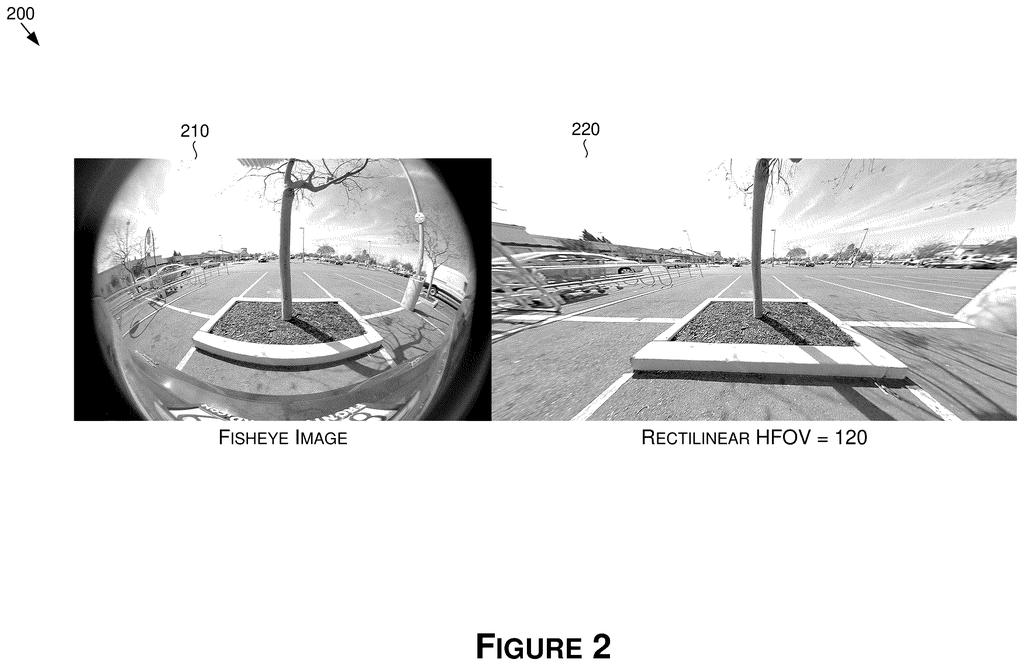
What Nvidia's wide-angle distortion fix actually does
Imagine looking at a photo taken with a very wide-angle camera lens and noticing that the buildings on the edges look stretched and tilted, even though they were perfectly upright in real life. That warping is an unavoidable side effect of squeezing a wide field of view onto a flat image.
Nvidia's patented approach teaches a processor to look at what's actually in the scene before deciding how to redraw the image. If it spots a horizon line or a point where parallel lines appear to converge, it uses that information to choose specific settings for a projection technique called Panini projection, which is already used in panoramic photography to reduce edge distortion.
The result is a wide-angle view where the things you care about, like roads, buildings, and horizon lines, look the way your eye expects them to. The system can also apply a vertical squeeze to the final image to fix any remaining curve in horizontal lines.
… using vanishing point detection to determine whether to apply distortion correction.
Translation: The system uses perspective lines to figure out if the image needs fixing.
How the system reads the scene before choosing a projection
The patent describes a processor that handles two types of image projection back to back.
First, it generates a standard rectilinear (perspective) projection, the same math your phone camera uses, as a reference image. It then runs detection algorithms on that reference to find two key features:
- Vanishing points (the spot where parallel lines like train tracks appear to meet in the distance), which signal a scene with strong perspective depth.
- Horizontal lines in the central part of the frame, such as a horizon or the edge of a building, which are particularly prone to looking curved in wide-angle images.
Armed with those detections, the system applies a Panini projection, a mathematical technique borrowed from panoramic photography that compresses the edges of a wide-angle view more gently than a standard lens does. The key parameters of that projection (essentially, how aggressively to apply the compression) are tuned based on how far away detected objects are, whether a vanishing point was found, and whether horizontal lines are present.
If horizontal lines were detected, the processor applies an additional vertical compression pass to straighten any remaining bow in those lines. The whole pipeline runs inside a single processor, making it practical for real-time use in devices that can't afford a separate image-processing chip.
… vertical compression is applied to the Panini projection image to correct for distortion of horizontal lines …
Translation: It squashes the image vertically to straighten out any warped flat lines.
What this means for cameras in cars and VR headsets
Wide-angle cameras are standard equipment in self-driving and driver-assist systems, where a single sensor needs to cover a broad field of view without making nearby lane markings or curbs look distorted. Warped geometry can confuse both human drivers glancing at a display and the AI systems interpreting the feed. A processor that corrects that distortion automatically, without needing a human to dial in settings, matters a lot at scale.
The same problem exists in VR headsets and immersive video, where distorted wide-angle footage breaks the sense of presence. Nvidia's track record in computer-vision patents gives this filing useful context: the company already supplies processors to both automotive and XR (extended reality) markets, so the practical addressable uses for this kind of on-chip correction are real.
Nvidia's 79th filing we've tracked in self-driving sensing since May builds on one sharpening driver-facing cameras and one tightening object boxes.
Claim 1 is broader than the abstract makes it sound. It covers any processor that generates a visualization using a Panini projection with parameters based on "detected scene content" and uses vanishing-point detection to decide whether to apply distortion correction. That combination, scene-content analysis driving projection parameters, is the core protected idea, and it's written at a level of generality that could cover a wide range of implementations beyond the specific pipeline described in the abstract.
That breadth has practical consequences. If this claim held up, it could create friction for any chip or software stack that automates Panini-style distortion correction by reading the scene first rather than using fixed settings. That covers a meaningful slice of automotive vision processing and panoramic imaging software.
Panini projection itself is decades old, and vanishing-point detection is well-established computer vision. The patent's defensible ground is the specific combination: using scene-content signals to tune projection parameters in real time. Whether examiners find that combination obvious over existing prior art is the real question, which is why the grant likelihood here sits at medium rather than high.
There are more where this came from
We read every patent application Big Tech publishes and send you the ones worth knowing. Plain English, free, every week.
The drawings
15 drawing sheets from US 2026/0301319 A1 · click any drawing to enlarge


Want this weekly breakdown for a company we don't cover? Patentlyze Pro →
Be the first to weigh in