
Nvidia Patents a Way to Draw Tighter Boxes Around Objects in AI Vision
Every AI camera system draws invisible rectangles around objects it detects, and Nvidia has filed a patent for a method that makes those rectangles as tight as mathematically possible, no matter which direction an object is facing.
How Nvidia's tighter object boxes help AI see clearly
Every time a self-driving car's camera spots another vehicle, the AI wraps an invisible box around it to track where it is and how big it is. If that box is too loose, the car thinks the other vehicle takes up more space than it really does, and that sloppiness adds up fast when dozens of objects are on screen at once.
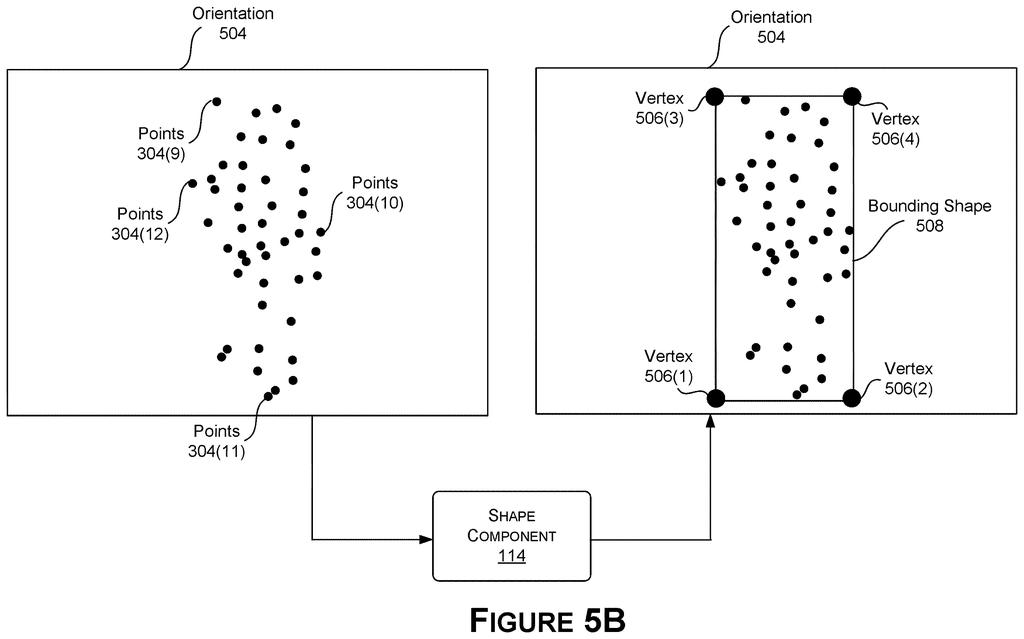
Nvidia's patent describes a method that figures out the smallest possible box that still fits snugly around any object, regardless of the angle it's sitting at. Instead of just drawing a box in one fixed direction, the system tries the object at many different rotations, measures the box size for each one, and picks the rotation that produces the tightest fit.
Once the best rotation is found, that compact box gets handed off to an AI model, which uses it to identify or classify whatever is inside. The result is less wasted space, cleaner data, and an AI that spends its attention on the actual object rather than the empty air around it.
… selecting a bounding shape of the plurality of bounding shapes having a least amount of area as a representative bounding shape to represent the plurality of points …
Translation: The system finds the smallest possible box that fits around the object.
How the rotation-and-select method finds the minimum box
The patent describes a multi-step pipeline that operates on a set of 2D points representing the visible surface of an object in an image.
- Point rotation: The system takes the full set of surface points and rotates them through a range of orientations, essentially asking, "What would this object look like if it were tilted 5 degrees? 10 degrees? 45 degrees?"
- Bounding-shape computation: For each orientation, the system computes a bounding shape (the patent emphasizes rectangles) that fully encloses all the rotated points. Think of it as shrink-wrapping the point cloud from a given angle.
- Minimum-area selection: All the candidate rectangles are compared by area, and the one with the least total area is selected as the representative bounding shape for that object.
- ML inference on the crop: The selected bounding shape is then used to crop the relevant portion of the image, and one or more machine learning models process that crop to extract information, such as object class, distance, or intent.
The key insight is that a standard axis-aligned bounding box (one that only runs perfectly horizontal and vertical) can be a very poor fit for a diagonal or oddly angled object. By searching across orientations and picking the minimum, the system produces a tighter, more informative crop.
… determine a bounding shape (e.g., a minimum-area bounding rectangle) for an object and/or a point set associated with the object …
Translation: It calculates the tightest rectangular border around an identified object in a picture.
What tighter bounding boxes mean for self-driving and robotics
For perception systems in self-driving cars, delivery robots, and warehouse automation, object detection accuracy depends heavily on how well the system isolates each object from its background. A bloated bounding box includes irrelevant pixels, which can confuse downstream AI models about what they're actually looking at. Tighter boxes mean cleaner inputs, and cleaner inputs generally translate to better classification accuracy.
For everyday users, the payoff is indirect but real: a car or robot that draws tighter mental boundaries around the things around it is one that makes fewer errors about where those things actually are. Whether that matters at a product level depends on how well competing teams have already solved this with simpler tricks, but the core problem is real and worth solving.
Nvidia's 77th filing we've tracked in our self-driving sensing race since May builds on earlier work like 3D intersection mapping and camera timing alerts.
Claim 1 is written broadly. It covers any method that rotates a point set, computes bounding shapes across orientations, picks the minimum-area one, and then feeds the result to a machine learning model. That scope is wide enough to potentially touch a large portion of 2D object-detection pipelines that use oriented bounding boxes, which is a very common technique in computer vision for autonomous systems.
The breadth cuts both ways. On one hand, if granted with this scope, the claim could give Nvidia leverage over a technique that rivals in automotive and robotics perception almost certainly use in some form. On the other hand, broad claims are exactly what patent examiners push back on hardest, and minimum-area bounding box search is a well-studied problem in computational geometry with a long prior-art trail going back decades.
Nvidia's track record in autonomous-perception patents suggests the company is building a thicket of IP around the full sensor-to-decision pipeline. This filing fits that pattern. Whether claim 1 survives examination at this width is the real question.
There are more where this came from
We read every patent application Big Tech publishes and send you the ones worth knowing. Plain English, free, every week.
The drawings
13 drawing sheets from US 2026/0289945 A1 · click any drawing to enlarge


Want this weekly breakdown for a company we don't cover? Patentlyze Pro →
Be the first to weigh in