
Amazon Patents a Hidden System That Catches and Fixes Its Own Automation Errors
Amazon has filed a patent for a monitoring system that sits invisibly between AI agents and the services they talk to, catching errors and nudging the agent to try again before anything goes wrong.
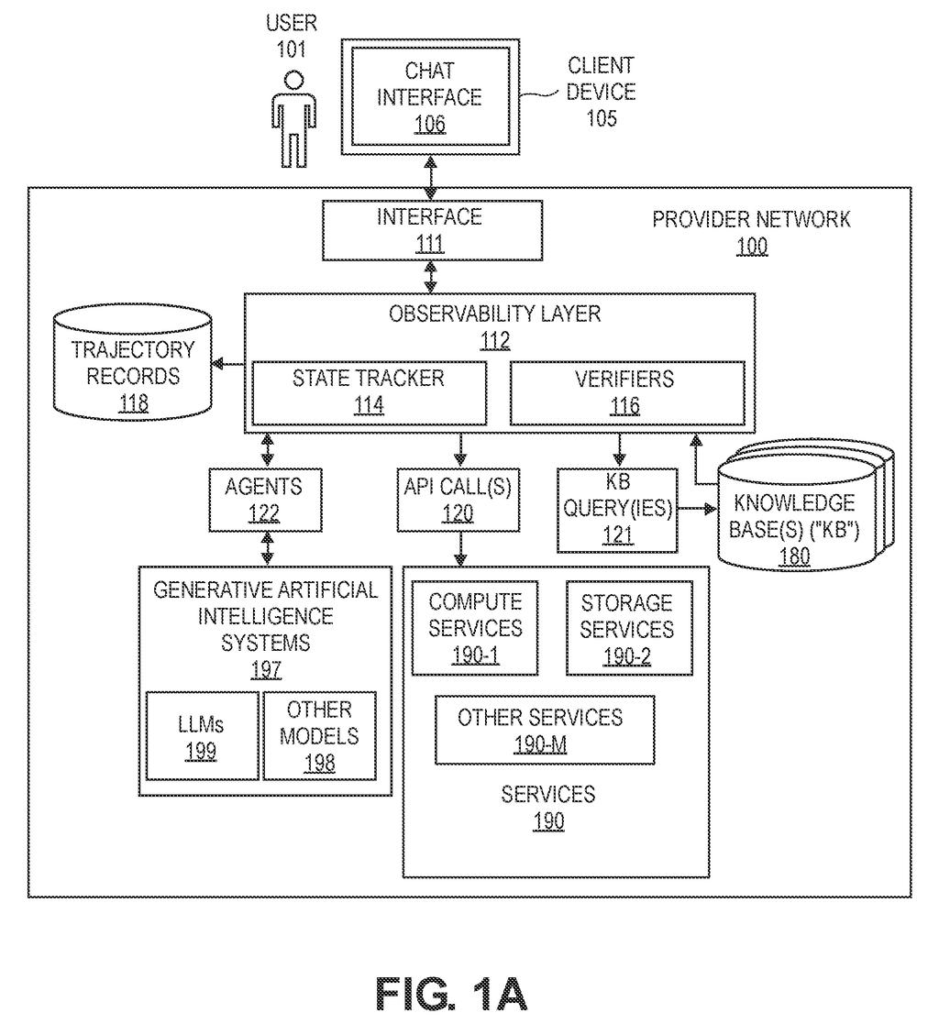
What Amazon's silent AI error-catcher actually does
You're a business running an AI assistant that handles customer requests by calling external services, like checking inventory or booking appointments. If that AI sends a garbled request or gives the customer a wrong answer, things break, and the customer never gets what they need.
Amazon's patent describes a hidden referee that watches every message passing between your AI agent and those outside services. If the agent sends a bad request, the referee blocks it. If the agent gives the customer an inaccurate answer, the referee blocks that too and sends a private correction back to the agent, formatted exactly like a message from the customer. The agent doesn't know it's being coached; it just sees feedback and tries again.
The clever part is that the whole system stays invisible. Because the referee's messages are formatted to look like they came from the expected source, the agent keeps operating normally. No crashes, no awkward error codes, just a quiet correction loop running behind the scenes.
… an observability layer such that the observability layer remains hidden to one or more artificial intelligence (“AI”) agents of an agentic network …
Translation: A secret monitoring layer watches AI agents without them knowing it is there.
How the observability layer intercepts and rewrites bad responses
The patent describes a software layer that sits in the middle of an agentic network (a group of AI agents that collaborate to complete tasks). Every message going in or out of each agent passes through this layer before reaching its destination.
When the layer intercepts a message, it checks it for accuracy. The patent doesn't prescribe one specific checking method, but the system compares outgoing agent responses against what the underlying service actually returned, looking for mismatches. Think of it as a fact-checker who reads the AI's answer alongside the source document.
- Blocked outbound request: If an agent sends a malformed or inaccurate request to an external service, the layer stops it before the service ever sees it.
- Blocked inbound response: If the agent's answer to the original requester is wrong, the layer stops that too.
- Schema-conforming feedback: Instead of throwing an error, the layer sends the agent a correction message formatted exactly like a real reply from the expected source (matching its schema, or data structure) so the agent processes it normally.
Because the correction messages are indistinguishable from legitimate traffic, the agent never detects the watchdog. The loop repeats until the agent produces an accurate response, which is then forwarded to the original requester.
… the observability layer prohibits an endpoint from receiving the agent request and sends a message to the AI agent that conforms to a schema of endpoint …
Translation: It blocks bad requests and tricks the AI into accepting corrected data.
What this means for businesses running AI agents in production
For businesses deploying AI agents in real workflows, errors aren't just inconvenient; they can mean wrong orders, bad customer advice, or failed transactions. Today, most error handling is bolted on as visible guardrails that the AI knows about, which can cause agents to behave differently once they detect monitoring. Amazon's approach keeps the correction layer transparent to the agent, which theoretically makes the system more reliable without changing how the agent was trained.
Amazon's interest in agentic AI infrastructure shows up clearly here. This kind of behind-the-scenes quality control is the plumbing that enterprise customers need before they'll trust AI agents with anything consequential. If this ends up in Amazon Bedrock or a related AWS service, it could make agent-based automation meaningfully more trustworthy for industries like finance, healthcare, or e-commerce.
Amazon's sixth filing we've tracked in our AI guardrails race since July builds on earlier applications, including watching its own AI and scoring responses early.
The shortest path from this patent to a shipping feature is unusually short. There is no new hardware required, just a software layer sitting between AI agents and the tools they call out to, catching mistakes before they cause real damage.
Most of what this needs already exists inside Amazon's cloud infrastructure: multi-agent coordination, input validation, and activity logging. The main unanswered question is whether the mistake-catching process can run fast enough that correcting an error mid-task is actually quicker than scrapping the task and starting over.
For businesses running AI agents in high-stakes environments, this matters. It solves a specific, painful problem: agents in production make errors, and right now there is no clean way to intercept those errors mid-task, without the agent losing its place or the user noticing anything went wrong.
There are more where this came from
We read every patent application Big Tech publishes and send you the ones worth knowing. Plain English, free, every week.
The drawings
21 drawing sheets from US 2026/0300675 A1 · click any drawing to enlarge


Want this weekly breakdown for a company we don't cover? Patentlyze Pro →
Be the first to weigh in