
Zoox Patents a Two-Track System for Steering Autonomous Cars Along a Route
Zoox's latest patent separates the shape of a self-driving car's route from the speed at which it travels that route, letting each be adjusted independently on the fly. It's a small architectural choice that can make a big difference when traffic or road conditions change suddenly.
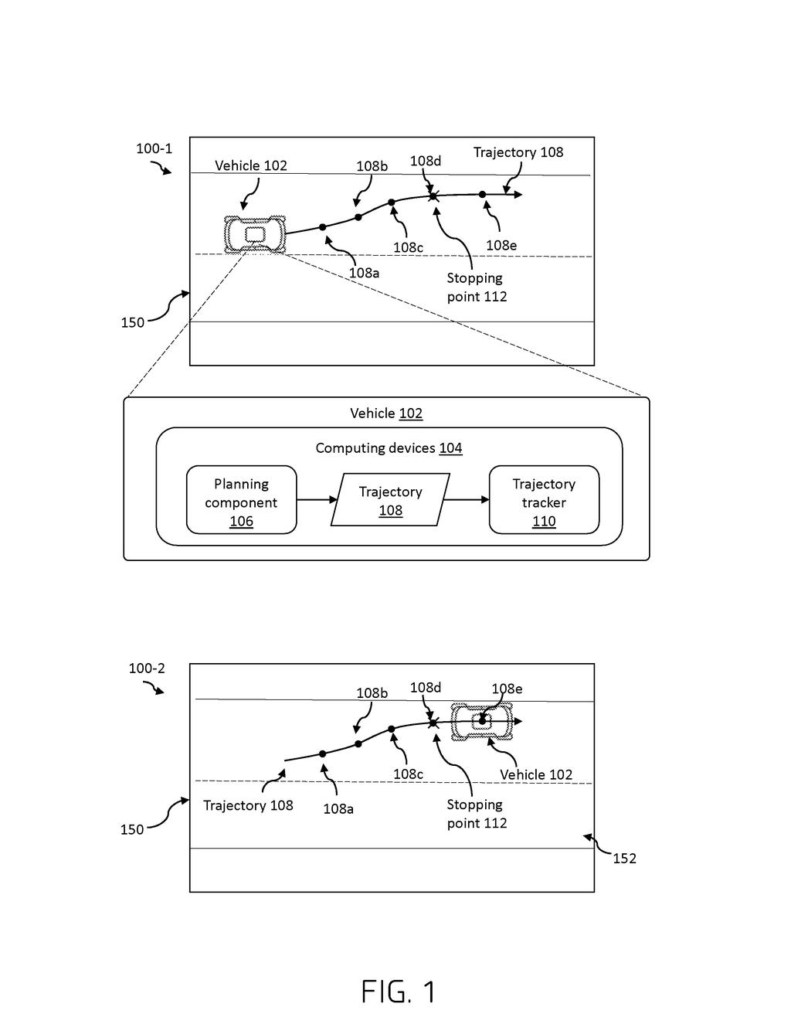
What Zoox's split path-and-speed system actually does
A self-driving car turns onto a busy street, and a pedestrian steps off the curb. The car's route plan is still fine, but its timing is not.
Zoox's patent tackles exactly that split-second problem. Instead of treating a vehicle's planned path as one big block (shape and speed bundled together), the system breaks it into two separate pieces: a geometric profile, which describes the actual curve of the route through space, and a temporal profile, which describes how fast the car should be moving at each point along that curve. Each piece can be changed without throwing out the other.
So if the car needs to slow down, it adjusts the timing plan while keeping the same lane-curve. If it needs to take a slightly different line through an intersection, it adjusts the path without rewinding the whole speed schedule. You get a system that can react faster and more precisely to what's happening around it.
the geometric profile comprises a sequence of geometric control states defining a path through the environment, and the temporal profile comprises a sequence of temporal control states defining expected progress of the vehicle along the path …
Translation: The car plans both its spatial path and its expected timing along that path.
How the system syncs position on the path to expected speed
The patent describes a planning and control architecture for autonomous vehicles that separates trajectory information into two distinct layers.
The geometric profile is a sequence of positions and orientations in space, essentially a line drawn through the environment that the car should follow. The temporal profile is a separate sequence of time-based states that encode expected speed, acceleration, and progress along that geometric line at any given moment.
At runtime, the system does something called interpolation (filling in values between known data points): it takes the car's current position, projects it onto the geometric path to find how far along the route the car is, then reads the temporal profile to find what speed and progress the car should have at that distance. That expected value then feeds directly into the vehicle's control system.
- Either profile can be modified independently using a shared parameter, so path shape and speed schedule stay in sync without being locked together.
- The system continuously recalculates where the car sits along the route and what the timing profile expects at that point.
- Control commands are issued based on the gap between current state and expected temporal attribute, letting the car correct for delay or drift.
One or more of the geometric profile or the temporal profile may be modified via a common parameter, and the vehicle may be controlled based at least in part on the modified profile
Translation: Both the route and timing can be updated together using a shared setting to steer the vehicle.
What this means for smoother autonomous vehicle control
Autonomous vehicles usually plan a trajectory as a single, unified object. When something changes, the whole plan often has to be recomputed, which takes time. Separating the path shape from the timing schedule means the car can make smaller, faster corrections without starting over.
For passengers, this kind of architecture could translate to less abrupt braking, smoother lane changes, and more reliable behavior in dense urban traffic. Zoox, which builds a fully autonomous robotaxi designed specifically for city environments, has particular reason to care about fast, fine-grained control adjustments. Zoox's run of autonomous vehicle control filings suggests the company is building out a detailed, low-level toolkit for city driving well below the headline AI layer.
Amazon's filing is the 29th we've tracked since May in our self-driving sensing race watchlist, joining Zoox work like a road-confusion warning system and an object path forecaster.
Every fraction of a second a self-driving car spends recalculating its entire route is a fraction of a second it is not responding to the road. In dense city traffic, that delay surfaces as a lurch, a hesitation, or a ride that feels mechanical rather than considered.
Amazon's filing addresses a specific source of that friction: when a car needs to adjust its speed, it currently has to rethink its path too, and vice versa. Keeping those two decisions separate means smaller, faster corrections instead of full replans.
For a paid ride service, smoothness is not a spec-sheet feature. It is what the passenger actually feels, and whether they book again.
There are more where this came from
We read every patent application Big Tech publishes and send you the ones worth knowing. Plain English, free, every week.
The drawings
6 drawing sheets from US 2026/0296492 A1 · click any drawing to enlarge


Want this weekly breakdown for a company we don't cover? Patentlyze Pro →
Be the first to weigh in