
Apple Patents Finger Controls Along the Front Glass of Its VR Headset
What if you could control a headset by touching its outer face rather than hunting for a button or waving in the air? Apple has filed a patent that places touch sensors along the rim of a head-mounted device's front glass panel.
What Apple's headset edge sensor actually does
Today's head-mounted devices give you a limited number of ways to control what you see: voice commands, hand gestures tracked by cameras, or a small physical button. Apple's patent describes a different approach: thin, elongated touch sensors embedded along the outer edge of the curved glass panel on the front of the headset.
Those sensors can detect a tap, a press, or other finger contact from the outside of the device while you're wearing it. A bystander looking at you would see the external display on the front of the headset, with a slim sensor running along its border.
The idea is that your finger resting on the rim of the headset could serve as a discreet input method, without requiring a separate controller or a dramatic hand gesture that everyone around you notices.
a curved glass layer that forms at least part of the outer surface; a head-mounted housing that forms a ring-shaped border around the curved glass layer; displays and lenses supported by the head-mounted housing; and a button on the head-mounted housing that is configured to receive user input.
Translation: The headset uses a curved glass front surrounded by a ring-shaped housing that holds internal screens and lenses.
How the finger sensor fits around the front display
The patent describes a head-mounted device with a curved glass layer forming part of its outer surface, a housing that creates a ring-shaped border around that glass, and displays and lenses inside for the wearer.
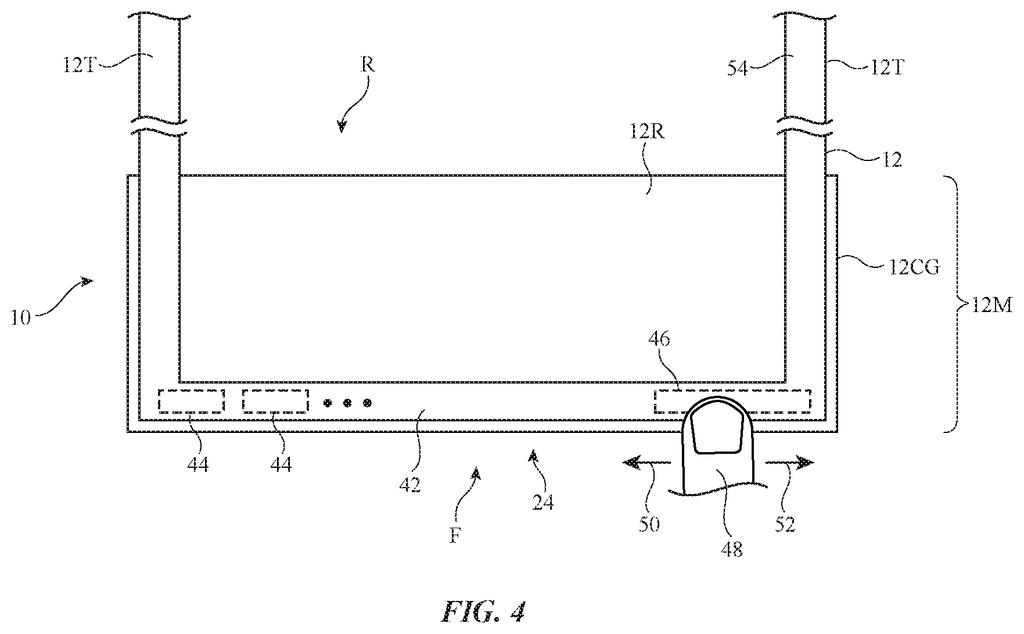
On the front face, the device includes one or more external displays that are publicly visible, meaning people nearby can see content on the outside of the headset, not just the wearer. Sitting along the perimeter of that external display are finger sensors shaped to follow the edge, like a thin strip running around the border.
Those sensors are designed to detect:
- Touch input, a finger making contact with the surface
- Force input, how hard the finger is pressing
- Other input from external objects
Additional sensors can also appear on other parts of the support structure, not just the front face. The first independent claim anchors the invention around the curved glass, the ring-shaped housing, and a button that receives user input, establishing the physical form factor that the sensor system is built around.
One or more finger sensors that are configured to detect touch input, force input, and/or other input from an external object such as a user's finger may be included in the head-mounted device. A finger sensor may have an elongated shape that runs along a peripheral edge of an external display on the front face.
Translation: Built-in touch sensors along the edges of the front display can detect when your fingers touch or press the device.
What this means for how you control AR headsets
For anyone who has fumbled with a headset's single side button or felt self-conscious performing mid-air gestures in public, an edge sensor offers a quieter option. Running your finger along the front rim of a device is a small, natural motion that does not require lifting your arm or speaking out loud.
The external display element is also worth noting. A headset with a screen on its outer face changes the social dynamic of wearing one, and controls that wrap around that screen extend the front panel into an interactive surface rather than just a window. Whether that trade, more sensors, more glass complexity, more potential failure points along a curved edge, is worth the payoff depends on how reliable the sensors are in everyday wear.
Apple's 47th filing we've tracked in our AR glasses race watchlist since May builds on work like its AI gap-filling patent and its eye-tracking sharpness patent.
Folding touch controls into the curved front edge of the headset means that same strip has to survive being the outermost part of the device, exactly where it will get knocked, scratched, and bumped in daily life. A crack along that border could kill the input entirely, and that fragility is a real cost the design has not yet proven it can absorb.
The subtler cost is learning. A glass edge gives no physical signal that your finger has found the right spot, so users have to memorize an invisible boundary rather than feel a button click into place.
The geometry does earn something back: keeping controls on the front face avoids bolting extra hardware onto the sides or top, which would make the device bulkier and stranger-looking to bystanders. Whether the durability gamble pays off depends entirely on how tough that sensor strip turns out to be, and right now the patent answers the concept but not that question.
There are more where this came from
We read every patent application Big Tech publishes and send you the ones worth knowing. Plain English, free, every week.
The drawings
9 drawing sheets from US 2026/0299736 A1 · click any drawing to enlarge


Want this weekly breakdown for a company we don't cover? Patentlyze Pro →
Be the first to weigh in